 Image: Libretis, Paris
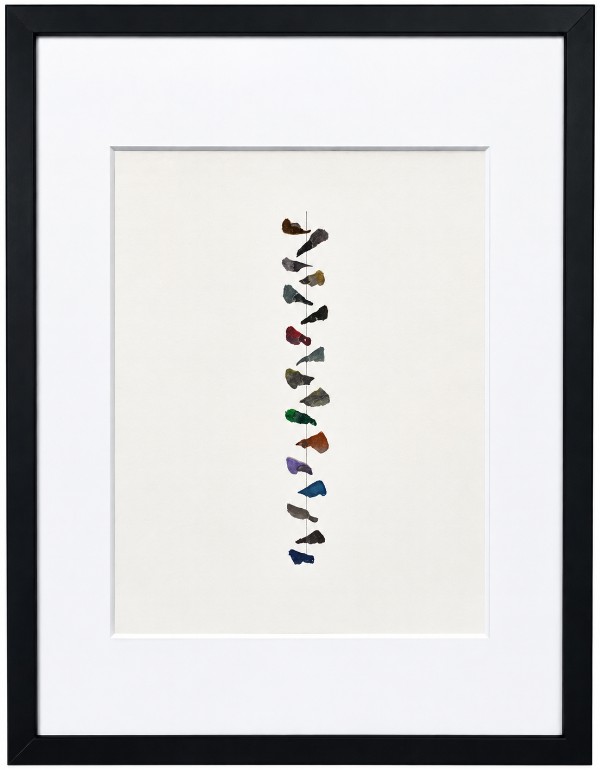
Libretis, the Paris-based gallery, is drawing attention to a 1973 gouache by Richard Tuttle in a newsletter devoted to the American artist’s postminimalist practice. The work, titled ‘Gouache for Yvon’, is presented as belonging to a turning point in Tuttle’s career, when he was developing the sparse visual language that would define much of his work from the early 1970s onward.
According to the gallery text, Tuttle’s approach in this period shifted emphasis away from representation and toward color, rhythm and space. The newsletter describes the gouache as an example of that economy of means: a sequence of colored marks arranged along a vertical axis, producing a composition defined by precision and restraint. The work is one of a group of paper-based pieces that the artist used to investigate the relationship between form and void, balance and imbalance.
The newsletter places this material within the broader arc of Tuttle’s practice, identifying works on paper as central to his artistic development. Rather than treating paper as preparatory, the text presents these works as a primary site for experimentation, where minimal interventions could generate complex spatial and visual effects. In the case of ‘Gouache for Yvon’, the arrangement of touches of color is described as creating a subtle but tightly controlled composition.
Libretis also situates Tuttle within major institutional collections, noting that his work is held by the Museum of Modern Art in New York, the Whitney Museum of American Art, Tate in London and the Centre Pompidou in Paris. Those references frame the 1973 gouache as part of a body of work that has secured a place among the most distinctive contributions to American art in the second half of the 20th century.
The gallery’s newsletter is bilingual, with French and English versions of the same description. In both, it stresses that Tuttle’s gouaches from the 1970s reflect foundational concerns that shaped the rest of his career. No exhibition venue or public event is identified in the source material; the communication reads instead as a focused presentation of a single work and a concise account of its significance within the artist’s oeuvre.
The work is identified as ‘Richard Tuttle. Gouache for Yvon’, gouache, 34.8 x 27.6 cm, 1973.