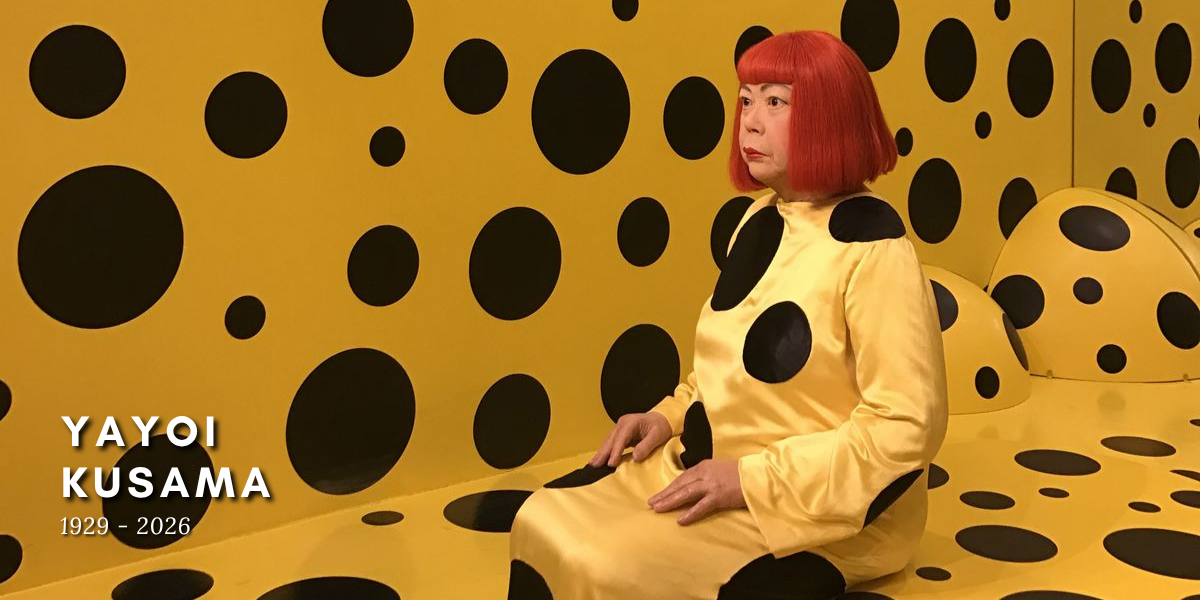
 Image: Deodato Arte, Milan
Yayoi Kusama, the Japanese artist whose polka dots, pumpkins and Infinity Mirror Rooms became among the most recognisable images in contemporary art, has died in Tokyo at the age of 97.
Kusama died on 14 August 2026 in a hospital in Tokyo, and the news was announced officially on 27 August by her studio and the Yayoi Kusama Foundation, according to the tribute Deodato Arte published the same day. Her studio said she continued to paint until the final days of her life.
Born in Matsumoto, Japan, in 1929, Kusama began drawing as a child, giving form to hallucinatory visions of shapes, flowers and patterns that appeared to multiply and fill the space around her. She trained in Nihonga painting before turning away from its formal restrictions in pursuit of a more personal visual language. At the end of the 1950s she left Japan for the United States, settling in New York in 1958, where she developed the Infinity Nets, large canvases covered with obsessively repeated marks, and worked within an expanding network of avant-garde and Pop artists.
During the 1960s her practice expanded into space through sculpture, happenings and installations. She made her first Infinity Mirror Room in 1965 and, in 1966, presented Narcissus Garden at the Venice Biennale, an installation of reflective spheres that questioned the relationship between artwork, audience and art market. Deodato Arte's biography of the artist records that she met Andy Warhol in the 1960s and that he became the first buyer of her work.
Her practice brought together repetition, accumulation, reflection and immersive space. Dots appeared across canvases, sculptures, rooms, trees and bodies, while pumpkins - a subject she traced to childhood walks through her family's plantations - became a monumental sculptural form and one of her best-known motifs. She described the vegetable as having a "solid spirituality". The underlying principle she called self-obliteration: the erasure of individuality within a potentially infinite space.
Kusama returned to Japan in the 1970s and from 1977 lived voluntarily in a psychiatric hospital in Tokyo, continuing to work daily in a nearby studio. Recognition broadened from the 1990s: she represented Japan at the 1993 Venice Biennale with a mirrored hall filled with small pumpkins, and major international museums subsequently dedicated exhibitions and retrospectives to her work. Her imagery extended into fashion and popular culture through collaborations including those with Louis Vuitton, first in 2012 and renewed in 2022.
The gallery's announcement also places Kusama among the strongest-performing women artists at auction. Citing Artprice, it says her auction turnover exceeded $120 million in each year from 2021 through 2024, with a 2022 peak of $195 million from 900 lots sold, and identifies Untitled (Nets), an oil on canvas from 1959, as her auction record, sold for $10.5 million at Phillips in New York on 18 May 2022. It says she ranked sixth in the global auction ranking in 2024, the highest position reached by a woman, after becoming the first woman to enter its top 10 in 2021.
The Yayoi Kusama Foundation has said it intends to continue preserving her legacy. Deodato Arte, which has devoted exhibitions and projects to the artist in Milan, published its tribute on 27 August 2026.