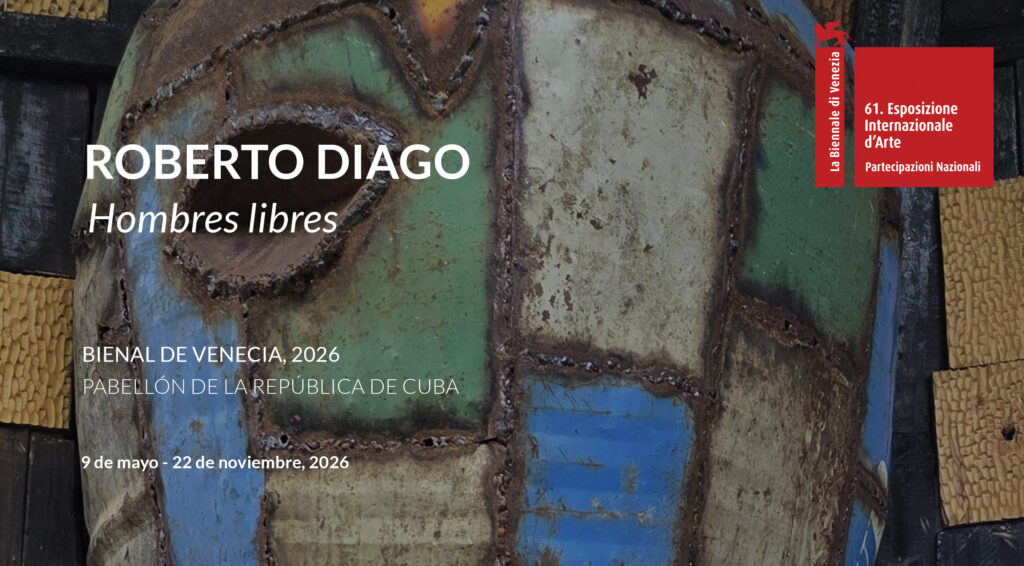
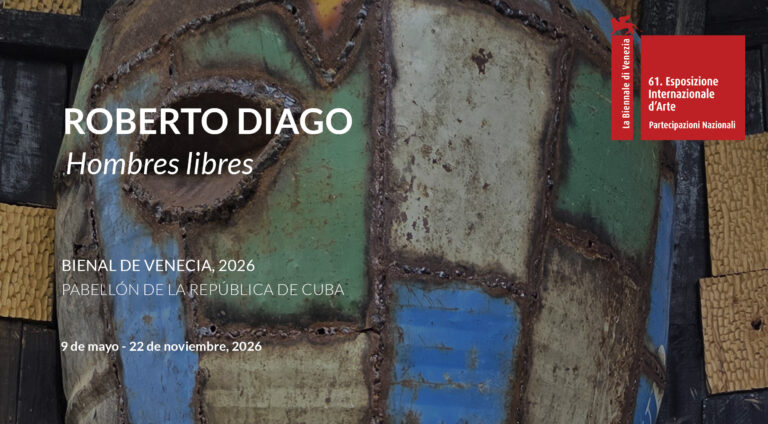
 Image: Key visual for 'Hombres Libres / Free Men', Pavilion of the Republic of Cuba, 61st International Art Exhibition – La Biennale di Venezia, 9 May – 22 November 2026. Courtesy Galería Artizar
Cuba's national pavilion at the 61st International Art Exhibition of La Biennale di Venezia presents 'Hombres Libres / Free Men' (2025) by Juan Roberto Diago Durruthy, on view at Il Giardino Bianco – Art Space, Via Giuseppe Garibaldi 1814, from 9 May to 22 November 2026. La Biennale lists it among the 100 national participations in this year's exhibition, 'In Minor Keys' by Koyo Kouoh, with Daneisy García Roque as commissioner and Nelson Ramírez de Arellano Conde as curator. The pavilion is produced and co-organised by Galería Artizar, the gallery based in La Laguna, Tenerife and Madrid, in collaboration with Estudio Roberto Diago — a private gallery carrying the production of a state-approved national participation.
The installation is a group of sculptural heads of different sizes that advance toward the visitor. Made from oxidised metals, wood, plastic and reclaimed materials, their surfaces carry raised marks and wounds that refuse to be erased, and in that material landscape black skin is treated not as a passive surface but as an archive of trauma, resistance and survival. Il Giornale dell'Arte, reviewing the pavilion on 11 May 2026, described the scar as tangible evidence of an existence that has passed through violence without losing sovereignty.
For Diago the free man is not defined by a legal notion of emancipation but by the ability to recognise one's own marks and withhold them from historical oblivion. Freedom appears as a continuous practice that demands memory and dignity, and what emerges is a genealogy of survivors rather than a victim narrative, in which precarity and pride are inseparable.
ArtReview's survey of the Biennale's off-site venues found rusted iron heads, fragmented wooden figures and small birdhouse-like structures that recall a shrine, a shelter or a prison cell, installed within the rough brick architecture of the Venetian space and looking salvaged after a collapse. Text works spelling out phrases such as 'El sistema no nos quiere' ('The system does not want us') make the political charge explicit, and one of the strongest pieces sets a rusted bust inside a recessed brick chamber crossed by the shadow of a barred window. The same account reads the pavilion against Cuba's collapsing infrastructure, fuel and food shortages and international scrutiny of its political prisoners after the July 2021 protests, and against the contradiction of a pavilion approved by the culture ministry yet produced entirely by a commercial gallery — neither state propaganda nor fully autonomous critique.
Born in Havana in 1971 and trained at the San Alejandro academy, Diago has spent more than three decades on the African diaspora and the persistence of contemporary forms of slavery and discrimination, with work in institutions including Harvard University, the Museo Reina Sofía and the Museo Nacional de Bellas Artes de Cuba. In Artizar's press communication, that museum's director, Jorge Fernández, reads the work as a homage to the Maroons who chose death over enslavement. El Apartamento, which represents Diago from Havana, Madrid and Miami, flagged the pavilion in its summer newsletter as the headline item among its artists' current institutional exhibitions.