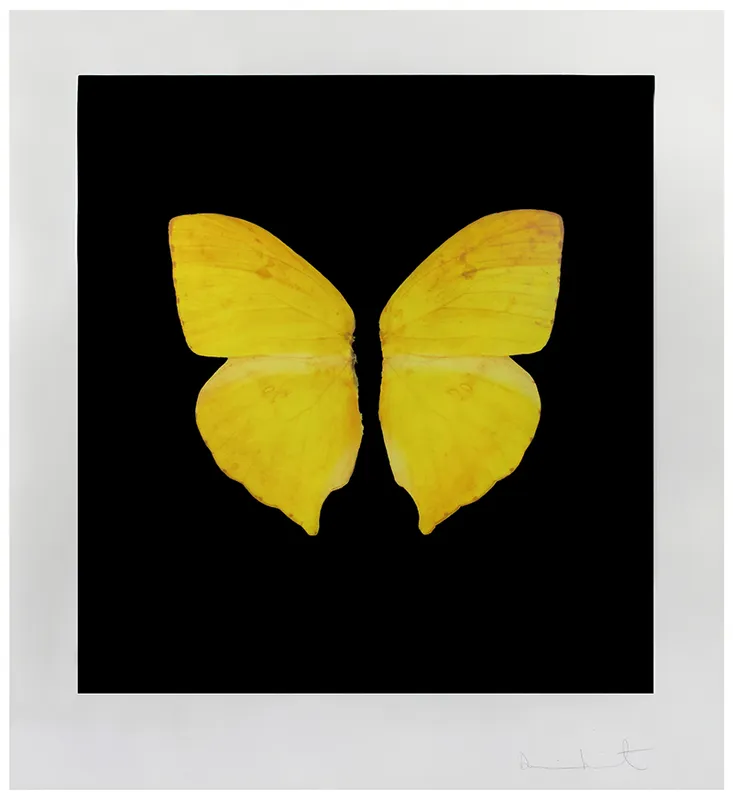
 Image: Damien Hirst, ‘The Souls on Jacob’s Ladder Take Their Flight’, 2007. Courtesy Shapero Modern, London
Shapero Modern has framed its Summer Show 2026 as a test of art recognition, asking visitors how quickly they can identify four artists from small fragments of their work. The gallery’s newsletter, titled ‘The Collector’s Eye’, presents snippets from works by Helen Frankenthaler, Alex Katz, David Hockney and Jack Milroy, and invites viewers to match each image to the artist behind it before revealing the answers.
The Summer Show 2026 runs from 4 June to 31 August 2026 at the gallery’s flagship space, 94 New Bond Street, W1S 1SJ, in London. Shapero Modern’s mailing frames the exercise around artists with a truly distinctive visual language, with the premise built around the idea that even a flash of colour, a line or a pattern can be enough to identify a maker’s hand. The format gives the presentation a playful, collector-oriented edge while keeping the focus on individual style.
Among the works included is Helen Frankenthaler’s ‘Flotilla’ (2006), identified in the newsletter as a seascape. The accompanying text emphasizes Frankenthaler’s method of allowing colour to bleed and soak across the picture plane, producing an abstraction that the gallery characterizes as hovering between dream and memory. The title is also explained in the email: ‘Flotilla’ refers to a small fleet of ships, and the composition is said to include one floating along the horizon.
Alex Katz is represented by ‘Goldenrod, from the Flowers portfolio’ (2021), a print featuring a botanical scene of slender green stems and vivid yellow flowers against a dark background. Shapero Modern’s text describes Katz as stripping the flowers down to their essentials, reducing detail in favour of bold colour and graphic impact. The work’s bright yellow field is presented as the most immediate clue to its authorship.
David Hockney appears with ‘Coloured Flowers made of paper and ink’ (1971). The image is characterized as a still life of a vase filled with daisies, cornflowers and poppies, with pencils visible at the bottom of the composition. That detail is used to underscore the work’s constructed nature and Hockney’s playful approach to representation.
The final work is Jack Milroy’s ‘The Monkey and the Nest’ (2026), which the gallery highlights for its humour and visual puns. Shapero Modern notes that Milroy has spent more than six decades transforming printed pages into sculptures, combining craftsmanship with wit. In this work, the newsletter says, birds, fish and bright colours conceal a monkey, making the piece part puzzle and part sculpture.
Shapero Modern presents the exhibition at its London address, 94 New Bond Street, where it runs until 31 August 2026. The show’s invitation to “recognise the artist from a snippet of their work” places four distinct practices side by side, from Frankenthaler’s colour fields to Katz’s graphic botany, Hockney’s paper and ink still life, and Milroy’s sculptural play with printed matter.
The four quiz works sit within a larger group presentation of post-war and contemporary prints. The gallery’s own listing for the show also includes Alexander Calder’s ‘Le Bateau Lavoir’ (1969) and a plate from ‘La Mémoire élémentaire’ (1976), Damien Hirst’s ‘The Souls on Jacob’s Ladder Take Their Flight’ (2007), Henri Matisse’s ‘La Silence habité des maisons’ (1947), now marked sold, Andy Warhol’s ‘In the Bottom of My Garden’ (1956), Robert Indiana’s ‘The Decade Portfolio’ (1971), Frank Stella’s ‘The Funeral’ from the Moby Dick (Dome) series (1992), Pablo Picasso’s ‘Françoise’ (1946) and an untitled 2009 work by Jonas Wood.