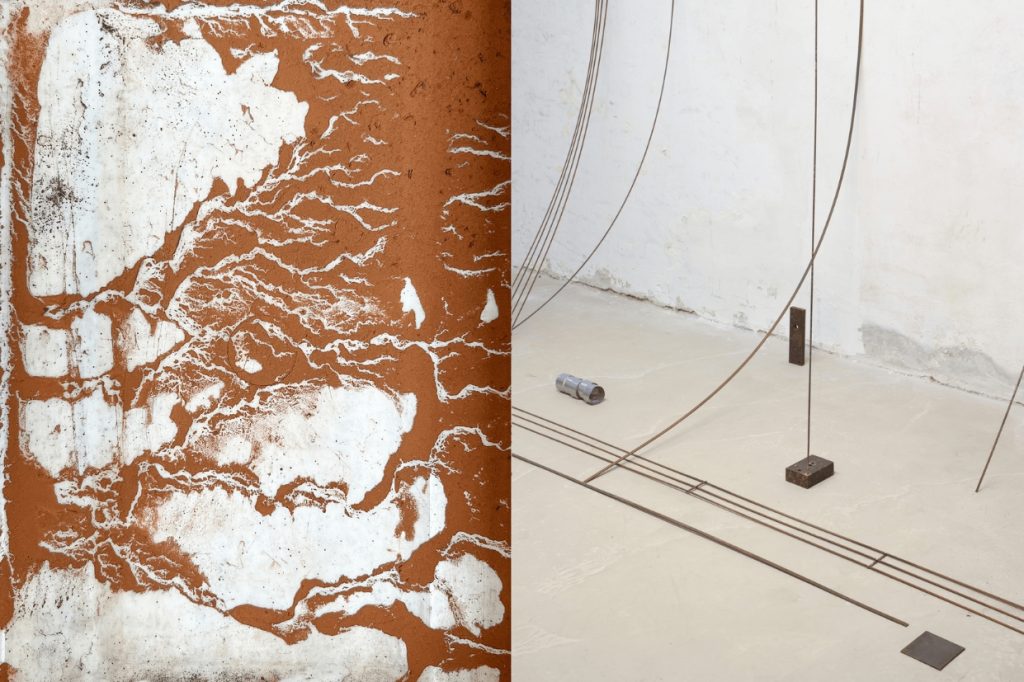
 Image: Kunsthaus Dahlem, Berlin ; Melanie Ender
Kunsthaus Dahlem in Berlin is presenting 'almost in between' ('beinahe dazwischen'), the first solo exhibition in Germany by Austrian artist Melanie Ender. The exhibition runs from 4 July to 4 October 2026 and was developed for the building’s Ostflügel as a group of finely articulated, site-specific installations that respond to the house’s architecture and to its history as a site of artistic production. Kunsthaus Dahlem says the works extend Ender’s process-driven practice, which is shaped by working procedures, spatial perception and close attention to material as an active counterpart.
The show is curated by Yevheniia Havrylenko of Kunsthaus Dahlem. According to the institution, Ender created works for what was once the state studio of Arno Breker, described on the exhibition page as one of the leading monumental sculptors of National Socialism. Rather than echoing that scale or permanence, Ender’s pieces are presented as resisting claims to durability. The museum frames the installation as a conversation with a building whose history is embedded in German art and political history, while the works themselves remain deliberately delicate and responsive.
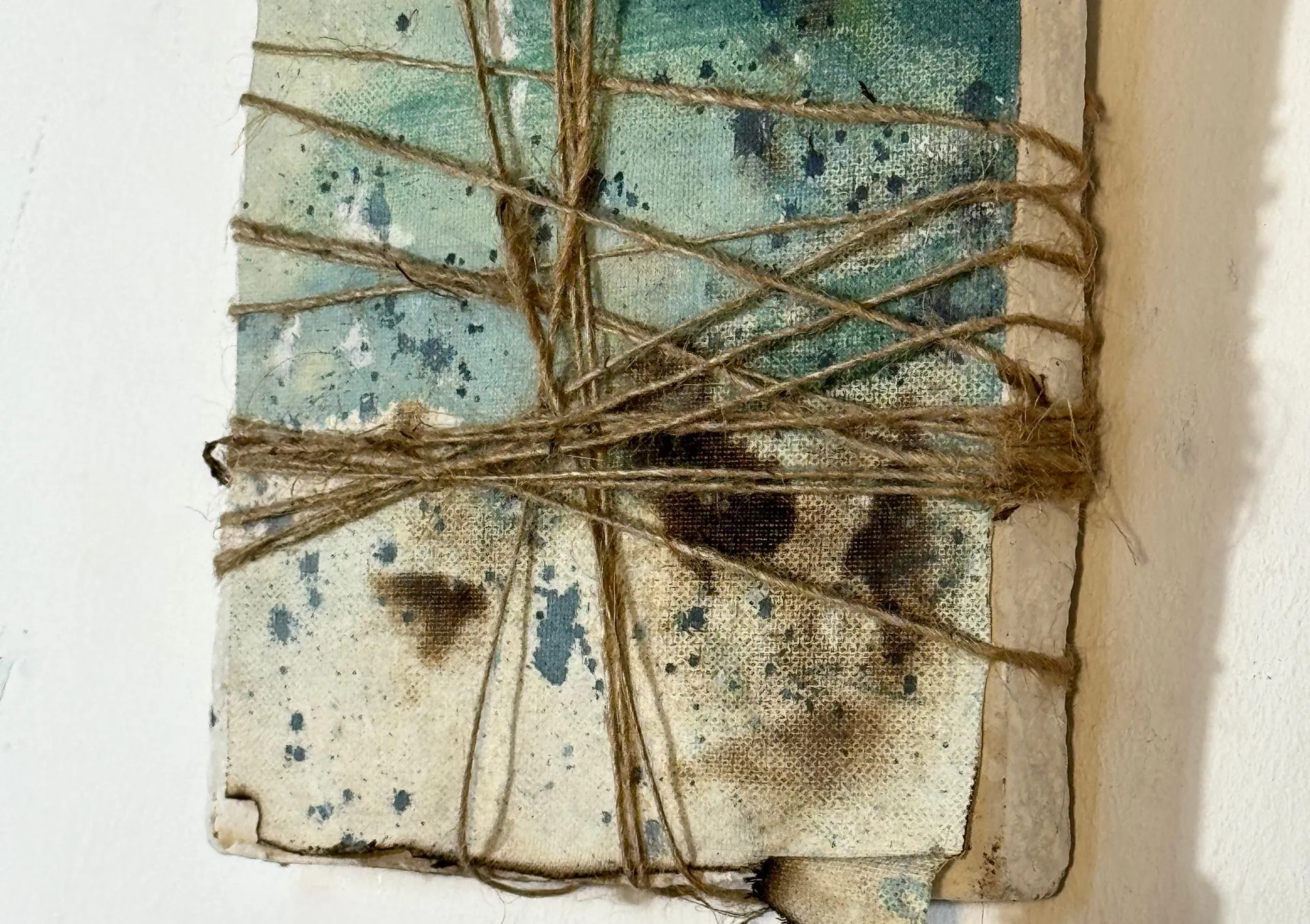
Kunsthaus Dahlem’s exhibition text describes Ender’s practice as one that examines how structures designed for stability and control can reveal openness to transformation over time. Straight lines slip out of form, and seemingly rigid metal rods are placed in precarious balances. The resulting works are meant to stay sensitive to their surroundings, loosening fixed orders and making processes of change visible. In this context, Ender’s installation 'remnants of almost in between' extends her recurring interest in material as something that registers movement, friction and instability rather than simply supporting a finished object.
Material transformation is central to the exhibition’s concept. The museum notes that Ender gathers and documents traces left by work with metal, including rust dust and iron oxide abrasion, then transfers them onto textiles as pigments. These materials are described as having archival value, allowing residue from the making process to remain present in the finished work. The exhibition text also stresses the bodily dimension of the pieces: compressed textile surfaces carry tension and cracks, constructions reveal their dependence on supports, and the works preserve signs of rubbing, scraping, pressure and touch.
That bodily quality also shapes the relationship between the works and the room around them. Instead of matching the architecture’s scale or competing with it, the installations are proportioned to human presence and are intended to create a direct physical relation between work and viewer. The museum contrasts this with the monumentality of the former studio, placing vulnerability and fragility at the center of the encounter. Several works shown in the exhibition are identified on the website, including 'processpiece' (2026), 're-positioning piece' (2025–2026), 'yet untitled d' (2026) and 'floorunit_0' (2026).
The exhibition page gives Ender’s biography in brief, noting that she was born in 1984 and lives and works predominantly in Vienna. It states that she studied at the University of Applied Arts Vienna and the Academy of Fine Arts Vienna between 2006 and 2013, and that she received the State Scholarship for Fine Arts of the Republic of Austria and the City of Vienna’s promotion prize in 2022 and 2023. The museum also lists support from the Freundeskreis Kunsthaus Dahlem – Bernhard Heiliger e. V. and the Austrian Federal Ministry of Housing, Arts, Culture, Media and Sport. In August, the museum has scheduled an artist talk with Ender on 15 August at 3 pm and a curator’s tour with Havrylenko on 30 August at 2 pm.