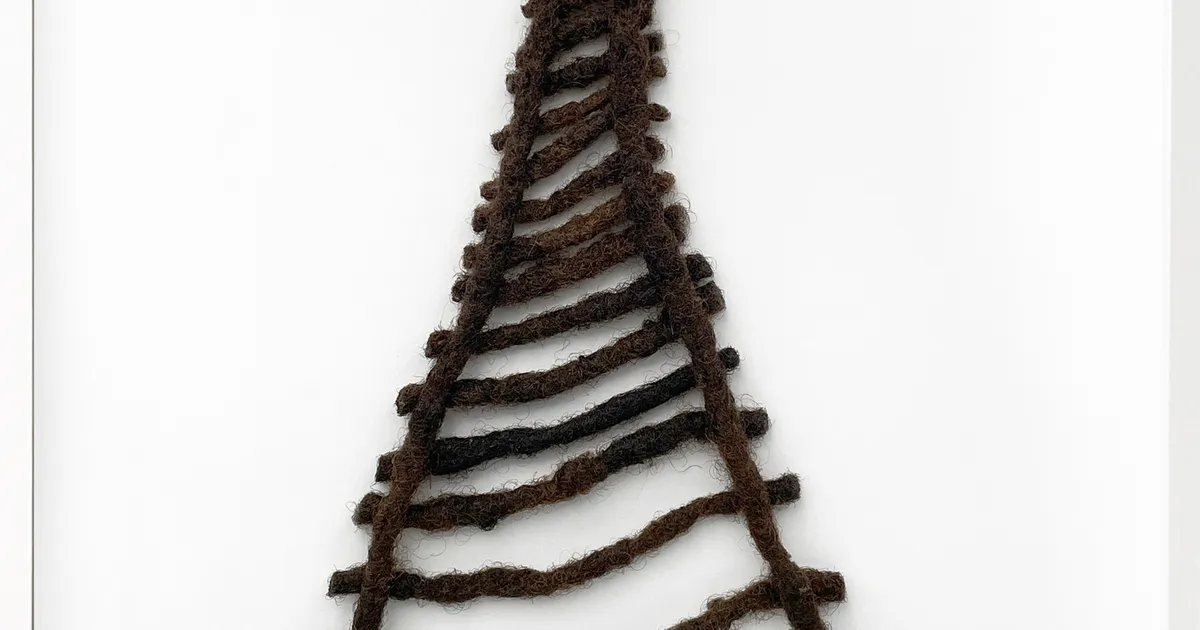
 Image: Lisa Sette Gallery, Phoenix
Lisa Sette Gallery’s Volume 24 newsletter features a profile of Sonya Clark, presenting the textile and social practice artist through a work titled 'Hair Bow for Sounding the Ancestors' from 2014. The gallery describes Clark’s practice as balancing the simplicity of everyday materials such as hair, textiles and language with an urgent exploration of craft, history and race. The newsletter centers on the ways Clark uses material to think through identity and inheritance, and places that approach alongside other artists featured in the same publication.
According to the gallery text, Clark’s work is shaped in part by her Afro-Caribbean family background, including a Jamaican mother, Trinidadian father and Scottish great-grandfather. The newsletter says this family history informs her perspective on American identity, which it characterizes as forged through slavery, immigration, love and the intergenerational linking of cultures. The gallery frames Clark’s materials as carriers of meaning rather than neutral substances, describing hair, thread and combs as “bearers of identity” that hold inherited knowledge across time.
The featured work, 'Hair Bow for Sounding the Ancestors', is made of human hair and a violin bow. In 2014, the gallery says, Clark pursued this line of inquiry by re-hairing violin bows with human hair and collaborating with musicians who used the bows in a performance of James Weldon Johnson’s 'Lift Ev’ry Voice and Sing' and Francis Scott Key’s 'Star-Spangled Banner'. The newsletter does not present the work as a new commission or exhibition announcement, but as part of an online publication that introduces recent and ongoing practices from the gallery’s represented artists.
The artist’s biography in the newsletter identifies her as a Professor of Art and the History of Art at Amherst College. It also notes that she earned an MFA from Cranbrook Academy of Art, a BFA from the School of the Art Institute of Chicago, and a BA from Amherst College, where she received an honorary doctorate in 2015. The gallery lists several awards and honors, including the 2026 Guggenheim fellowship for Fine Arts, the Rappaport Prize, a United States Artist Fellowship, a Pollock-Krasner award, the 1858 Prize and an Anonymous Was A Woman Award.
Lisa Sette Gallery, based at 210 East Catalina Drive in Phoenix, Arizona, presents the newsletter as Volume 24, available online only. The same publication also includes features on Ala Ebtekar, Duane Michals, Jan Maarten Voskuil, Sam Frésquez, Benjamin Timpson, Ato Ribeiro, Binh Danh, Timothy Horn, Xawery Wolski and Julianne Swartz. On the gallery’s website, 'Newsletter Volume 24' is presented as a publication separate from the gallery’s exhibition calendar.
The newsletter’s Clark feature appears alongside a brief quoted line from Colson Whitehead’s 'The Underground Railroad': “Freedom was a community laboring for something lovely and rare.” A separate section on the same page notes the title 'Senegal Weft Song' below the text, while the page footer repeats the gallery’s contact details and regular hours. The article itself, however, focuses on Clark’s practice as the central example of the publication’s material-driven approach to contemporary art.