 Image: Museo delle Porcellane, Florence
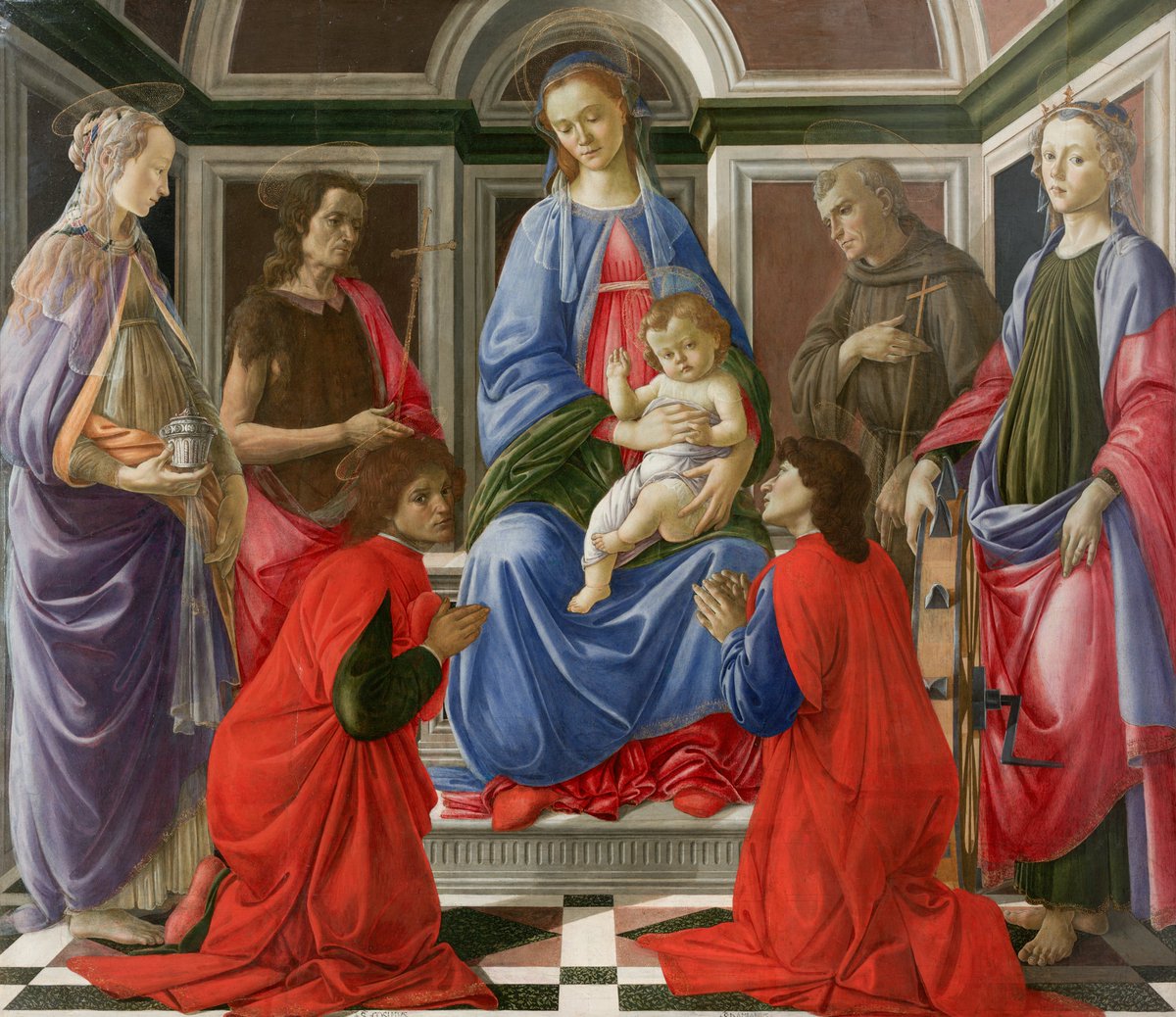
The Uffizi is drawing attention to one of Sandro Botticelli’s earliest altarpieces, 'Madonna col Bambino in trono e i Santi Giovanni Battista, Maria Maddalena, Francesco, Caterina d’Alessandria, Cosma e Damiano', a panel dated to around 1470 and held in the Florentine museum’s collection. The work is identified by the institution as Botticelli’s first monumental commission and one of the first altarpieces he painted.
According to the Uffizi’s description, the painting reflects the artist’s formative years in Florence. The figures of the saints recall the models of Botticelli’s teacher Filippo Lippi, while the classical setting and the careful treatment of drapery point to the workshop of Verrocchio, where Botticelli likely completed his training. The composition also features polychrome marble forms inspired by Alberti, reinforcing the sense of an ambitious early Renaissance setting.
The panel is a tempera on wood measuring 170 by 194 centimetres and is displayed in the Uffizi, with inventory number 1890 n. 8657 and location C9. The museum dates it to circa 1470 on stylistic grounds, including affinities with Botticelli’s 'Fortezza', another work in the Uffizi collection that was executed in the same year.
The painting’s history remains only partly known. The Uffizi notes that it entered the Florentine collections in 1808, after the suppression of the female Benedictine monastery of Sant’Ambrogio in Florence. It was first held at the Galleria dell’Accademia and later transferred to the Uffizi in 1948. At the same time, the absence of saints linked to the monastery or church dedication has led scholars to question whether Sant’Ambrogio was its original destination.
Attention has also focused on the saints Cosma and Damiano, shown prominently in the foreground and identified by the inscriptions 'S. COSIMUS' and 'S. DAMIANUS'. The museum says this detail suggests a commission connected either to the Arte dei Medici e Speziali, the guild of doctors and apothecaries, or to the Medici family, with whom Botticelli would later be associated in some of his best-known works.
The work underwent restoration in 2019, carried out by the Opificio delle Pietre Dure. The Uffizi credits Luisa Gusmeroli and Patrizia Riitano for the painted surface, Ciro Castelli and Andrea Santacesaria for the wooden support, under the direction of Cecilia Frosinini, with research by Roberto Bellucci. The restoration was supported by the generosity of Joseph C. Raskauskas, a member of the Friends of the Uffizi Galleries.