 Image: Asian Art Museum of San Francisco
The Asian Art Museum of San Francisco has entered the final stretch of Chiharu Shiota: Two Home Countries, the Japanese artist’s first solo museum exhibition in the Bay Area. The show remains on view through July 27, 2026, in the museum’s Akiko Yamazaki and Jerry Yang Pavilion, with a closing party scheduled for July 16.
Organized by Japan Society in New York and presented in San Francisco with coordination by the Asian Art Museum’s chief curator, Robert Mintz, the exhibition gives local audiences a broad survey of Shiota’s practice across installation, sculpture, video, drawing, works on paper, and stage design. The museum describes the presentation as a timely meditation on belonging, impermanence, and life in “in-betweenness,” themes that run throughout the artist’s career.
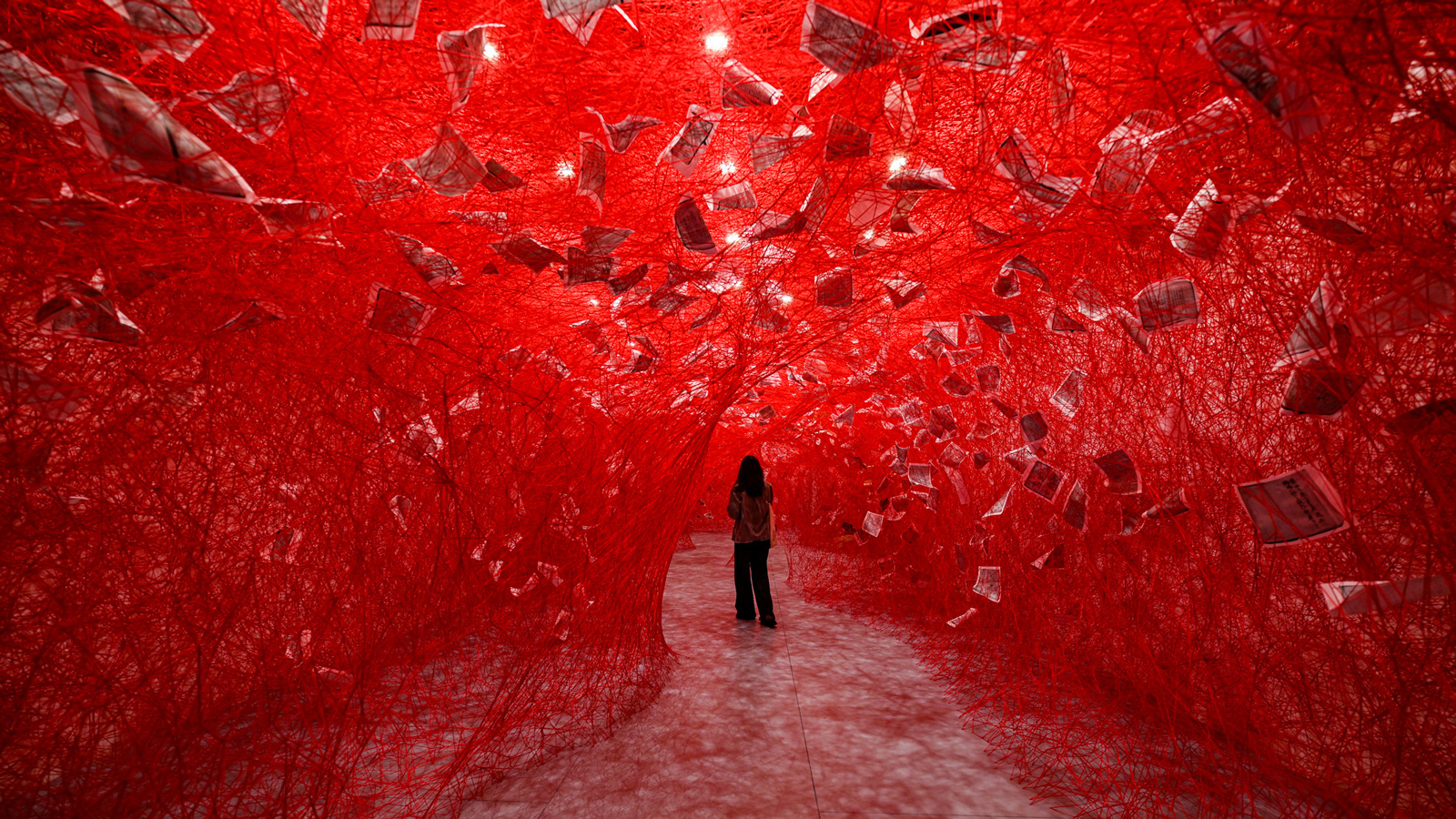
Shiota is best known for large-scale installations that fill spaces with dense webs of colored fibers, and Two Home Countries uses that visual language to explore nationality, identity, and memory. At the center of the exhibition is Diary, a monumental installation in which strands of red yarn stretch across the 88-foot length of the pavilion. Suspended pages from the journals of Japanese soldiers and postwar German civilians hang within the web, linking personal histories across time and place.
The exhibition also includes the work from which it takes its title, Two Home Countries, in which a red dress unravels into cascading cords that fill metal house frames and climb the gallery wall. According to the museum, the piece evokes Shiota’s “in-between sensation” of bicultural identity, shaped by her experiences between Japan and Germany. Other sections bring together sketches, concept drawings, and video material related to her stage design for KINKAKUJI (The Temple of the Golden Pavilion), a theatrical production commissioned by Japan Society in New York.
The exhibition matters in part because it marks a significant West Coast museum debut for an internationally recognized contemporary artist whose work has found wide resonance beyond the field of installation art. The museum’s own framing emphasizes how Shiota makes emotional states visible, turning absence, isolation, and belonging into immersive forms that audiences physically navigate. That approach helps explain why her work has become notable in discussions of how contemporary art addresses memory and identity.
Asian Art Museum leadership has underscored that relevance. Soyoung Lee, the museum’s Barbara Bass Bakar Director and CEO, said Shiota’s work resonates because it speaks to “the experience of living between places, histories, and identities.” The show closes on July 27, but with tours scheduled during its final weeks, the museum is continuing to spotlight an exhibition that connects a deeply personal artistic vocabulary to broader questions of cultural belonging in contemporary life.