 Image: Getty Research Institute, Los Angeles
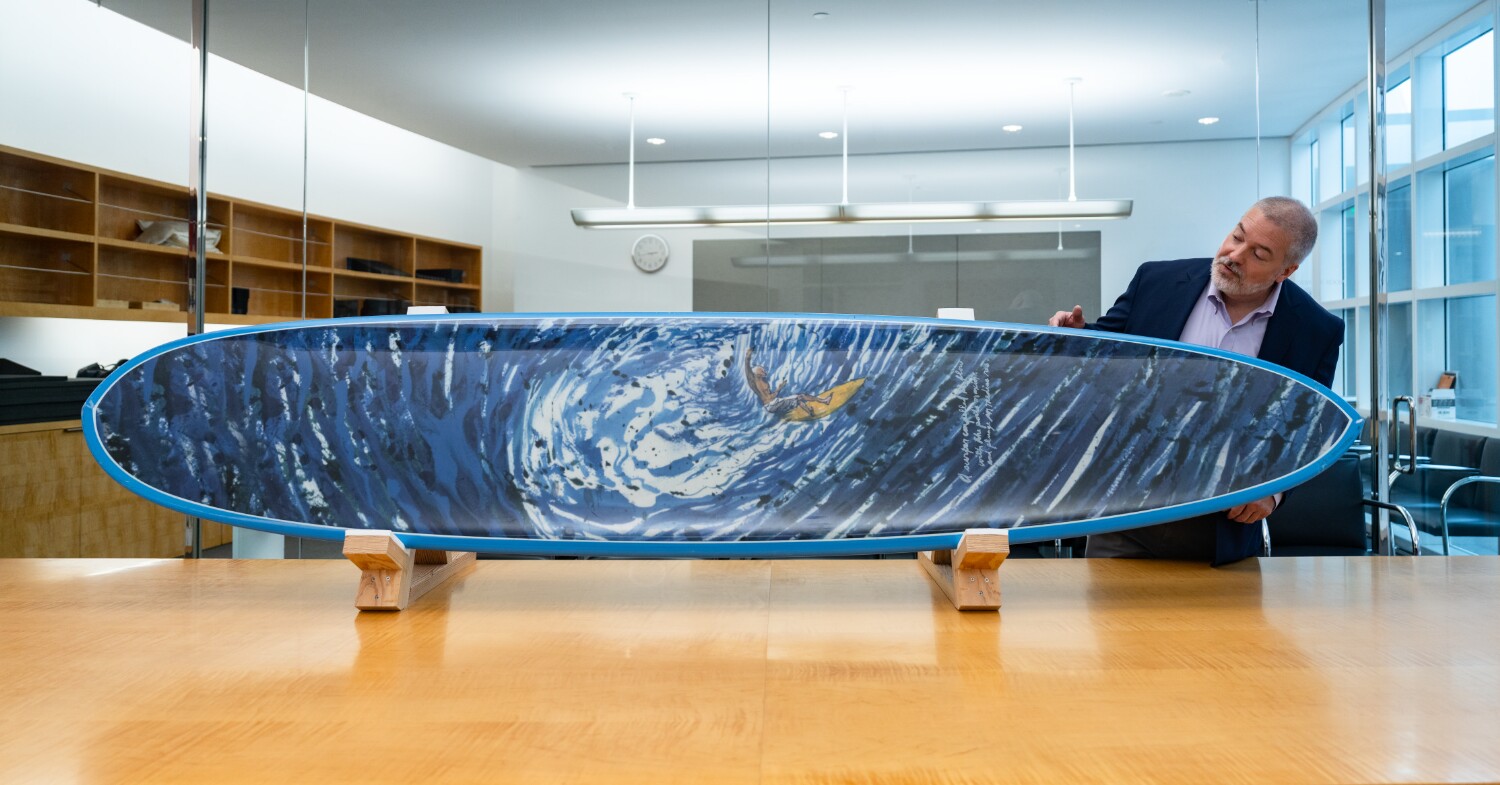
Getty is drawing attention to two distinct offerings this summer: a new account of Raymond Pettibon’s archive that centers on an unusually large surfboard, and a set of family activities tied to ‘The Egyptian Book of the Dead’ at the Getty Villa. The artist story, published by Getty News on July 7, examines how a nine-foot, six-inch surfboard entered the Getty Research Institute’s holdings in 2024 and why the object stands apart within an archive usually built for items that can be boxed, filed, and stacked.
According to Getty, the surfboard was part of the 32 boxes of Pettibon material acquired in 2024. The board is not presented simply as a novelty: it is described as a canvas as well as a surfboard, with a depiction of the interior churn of a mountainous wave rendered in Pettibon’s blue-and-black ink. The image places a tiny surfer inside an oceanic vortex, linking the object to themes that have long run through Pettibon’s work. Getty says the board was appealing in part because of its disruptive scale and resistance to normal archival handling.
The Getty Research Institute’s chief curator, Glenn Phillips, is quoted in the article describing the surfboard as something that “almost makes more sense than the skate decks,” while also noting that it is more surprising. The board, Phillips says, reflects Pettibon as a formalist who can create an abstract painting and recontextualize it as a surfboard. The board was made in the mid-2000s for ‘Art for the Oceans,’ a biennial auction benefiting the Surfrider Foundation, which protects coastal ecosystems and beach access.
Getty’s article situates the object within Pettibon’s broader career. Born Raymond Ginn in 1957 and raised in Hermosa Beach, California, he did not surf as a child, but surf culture remained part of his environment. The piece traces how Pettibon moved from underground zines and hardcore punk flyers in the late 1970s and early 1980s toward larger formats, broader color use, and recurring surf imagery after 1985. Getty connects the surfboard to his long-running interest in what he has called the sublime, citing Romantic landscape painters and the tension in his art between humans and nature, smallness and immensity, solitude and communion.
The surfboard itself carries text that Getty says is difficult to see until one moves close to it. The wording cites Horace’s ‘Ars Poetica’ and reads, “The surfer is compelled to flow with the poet’s maxim: to plunge in media res.” The archive, Getty adds, will allow future researchers to study Pettibon’s flyers, zines, source materials, drawings, and other ephemera, while conservators can examine ink samples and methods across the collection.
Alongside the Pettibon story, Getty is also publicizing free, drop-in family programming at the Getty Villa connected to ‘The Egyptian Book of the Dead.’ Two related events, ‘Artist-at-Work: Papyrus Making’ and ‘Papyrus Scroll Making: Family Workshop,’ are presented in English and Spanish and run on select dates from June 20 through September 13, 2026. Both take place at the Villa’s Outer Peristyle and are free, though the Villa requires a timed-entry reservation and parking carries a fee.
The papyrus programs invite visitors to learn how papyrus paper was made and to create their own papyrus scene inspired by the vignettes in ‘The Egyptian Book of the Dead,’ an exhibition at the Getty Villa running March 4 through November 30, 2026. Getty says the exhibition presents the museum’s Book of the Dead manuscripts and is itself shown in English and Spanish, with related tours, talks, and family activities scheduled through the season.