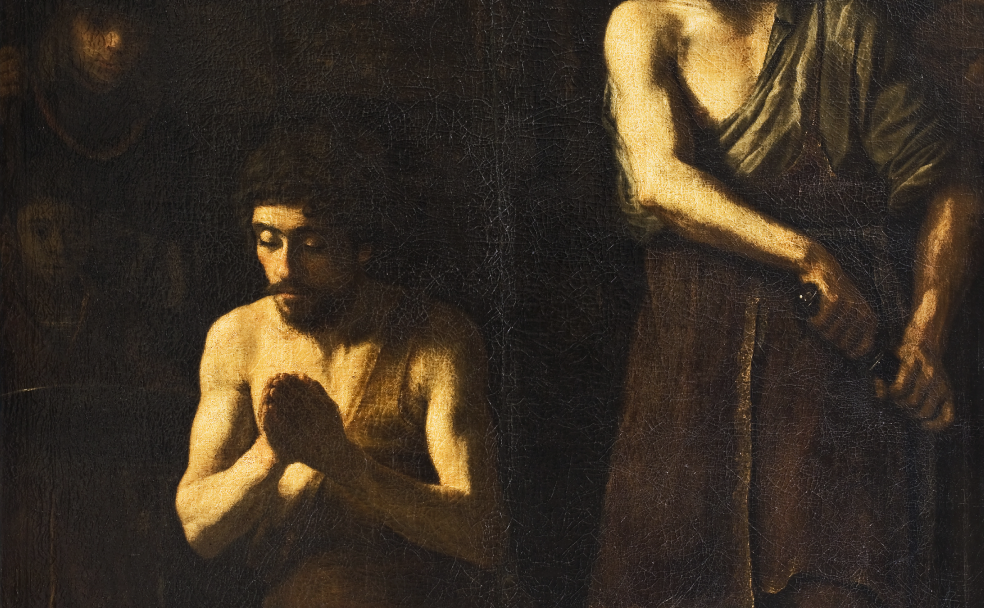
 Image: Pupils of Rembrandt (attributed to Leendert van Beyeren and Reinier van Gherwen), The Beheading of John the Baptist (detail). Pushkin State Museum of Fine Arts, Moscow
The Pushkin State Museum of Fine Arts in Moscow is presenting the results of a restoration that has changed how one of its more puzzling paintings is understood. ‘The Beheading of John the Baptist’, long catalogued as the work of an unknown member of Rembrandt’s school, is on view in its restored state until 22 November 2026, in a display in front of Room 7 of the museum’s Main Building that opened on 6 October.
The canvas shows the executioner, sword in hand, at the moment before he carries out the order of Herod Antipas, ruler of Galilee. Its authorship has shifted repeatedly over the centuries. By the middle of the eighteenth century the painter’s name had been forgotten, and the inventory of Count Heinrich von Brühl’s collection listed it as by an unknown master. In the nineteenth century, at the Hermitage, it was thought to be by Rembrandt himself. After it passed to the Rumyantsev Museum in Moscow it was associated in the early twentieth century with Rembrandt’s school, and in 1956 the art historian Boris Vipper proposed Carel Fabritius as its author, an attribution that was not accepted. The Pushkin Museum’s catalogues have since listed it as the work of an anonymous Rembrandt pupil.
The recent conservation by the museum’s restorer Maria Prilutskaya revealed that the picture is painted on two canvases stitched together, with the seam running vertically down the centre. Removing old overpaint and dirt then exposed the hands of at least two different artists.
On the basis of the figure types and painting style, the exhibition’s curator, Vadim Sadkov, chief researcher in the museum’s department of Old Masters, suggests that Leendert van Beyeren began the composition and painted the executioner on the right. The left half, on the second canvas, is handled more softly, with gentler transitions of light and shade and different facial types; in manner it stands much closer to the work of Reinier van Gherwen, another pupil who was in Rembrandt’s Amsterdam workshop in the late 1640s. Sadkov raises the possibility that Van Beyeren died young and that a fellow pupil completed the picture, while noting that the reason it was divided along the seam is still unexplained.
Sadkov will also give a curator’s lecture on how to tell Rembrandt’s own work from that of his pupils, as part of a programme of tours accompanying the display.