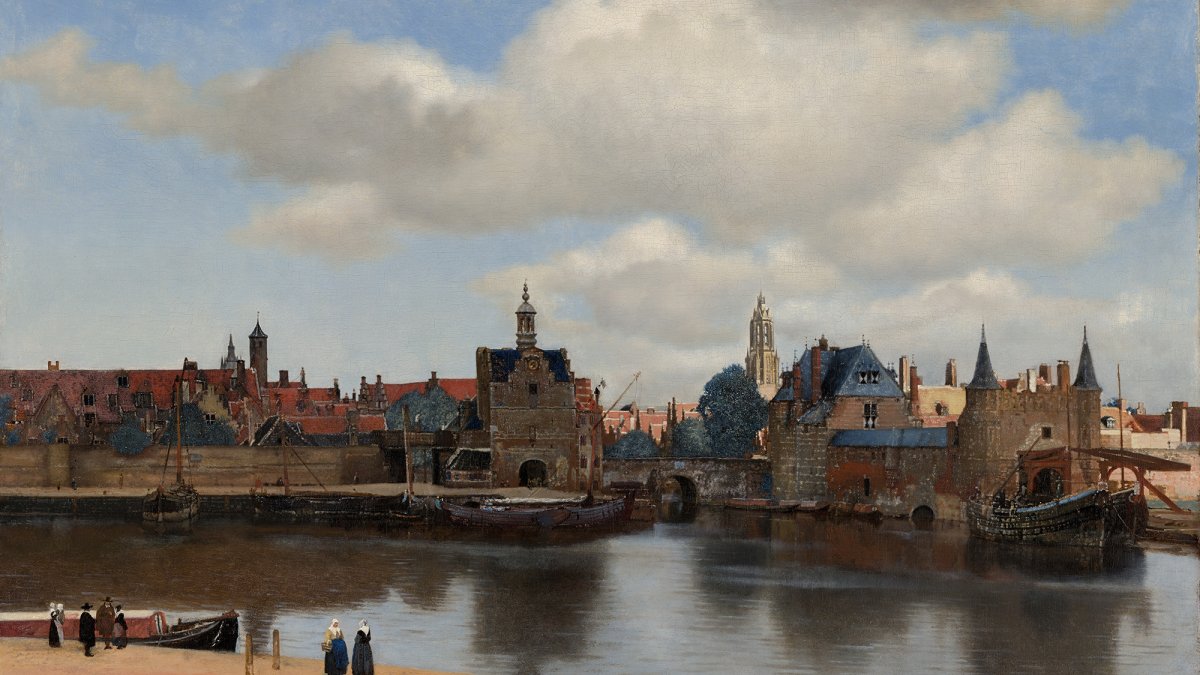
 Image: Johannes Vermeer, View of Delft, c. 1660–1661. Mauritshuis, The Hague
The Museo Nacional Thyssen-Bornemisza and the Mauritshuis in The Hague are simultaneously exchanging twenty-five outstanding works from their permanent collections through a collaboration agreement between the two institutions. In Madrid, an exceptional collection of 17th-century Dutch masterpieces is on display in the classical rooms, a new exhibition space in the museum, close to rooms dedicated to the same school.
The Mauritshuis works on display span Dutch art from 1615 to 1705 and are arranged thematically across three rooms, with 25 paintings presented in total.
The first room is devoted to still lifes and genre paintings, with works by Ambrosius Bosschaert, Jan Baptist Weenix, Adriaen Coorte, Pieter van Anraadt, Gerard ter Borch, Gerrit Dou, Pieter de Hooch, Abraham van Beyeren, Pieter Claesz, Nicolaes Maes and Jan Steen. The second room displays landscapes and figure compositions by artists including Pieter Saenredam, Jan Both, Rembrandt van Rijn, Frans Hals, Jacob van Ruisdael, Salomon van Ruysdael, Gerrit van Honthorst and Hendrick Avercamp.
The final room is devoted to ‘The Garden of Eden with the Fall of Man’ by Jan Brueghel the Elder and Rubens, while Vermeer’s ‘View of Delft’ is displayed in a special space within the room.
The Thyssen-Bornemisza family's ties to the Netherlands date back to the early 20th century, when Heinrich Thyssen-Bornemisza settled in The Hague after the Hungarian Revolution of 1919. In 1959, Rotterdam was chosen as the city to launch the international tour presenting the collection, and the collection of 17th-century Dutch paintings is now one of the museum’s greatest assets.