 Image: Museo delle Porcellane, Florence
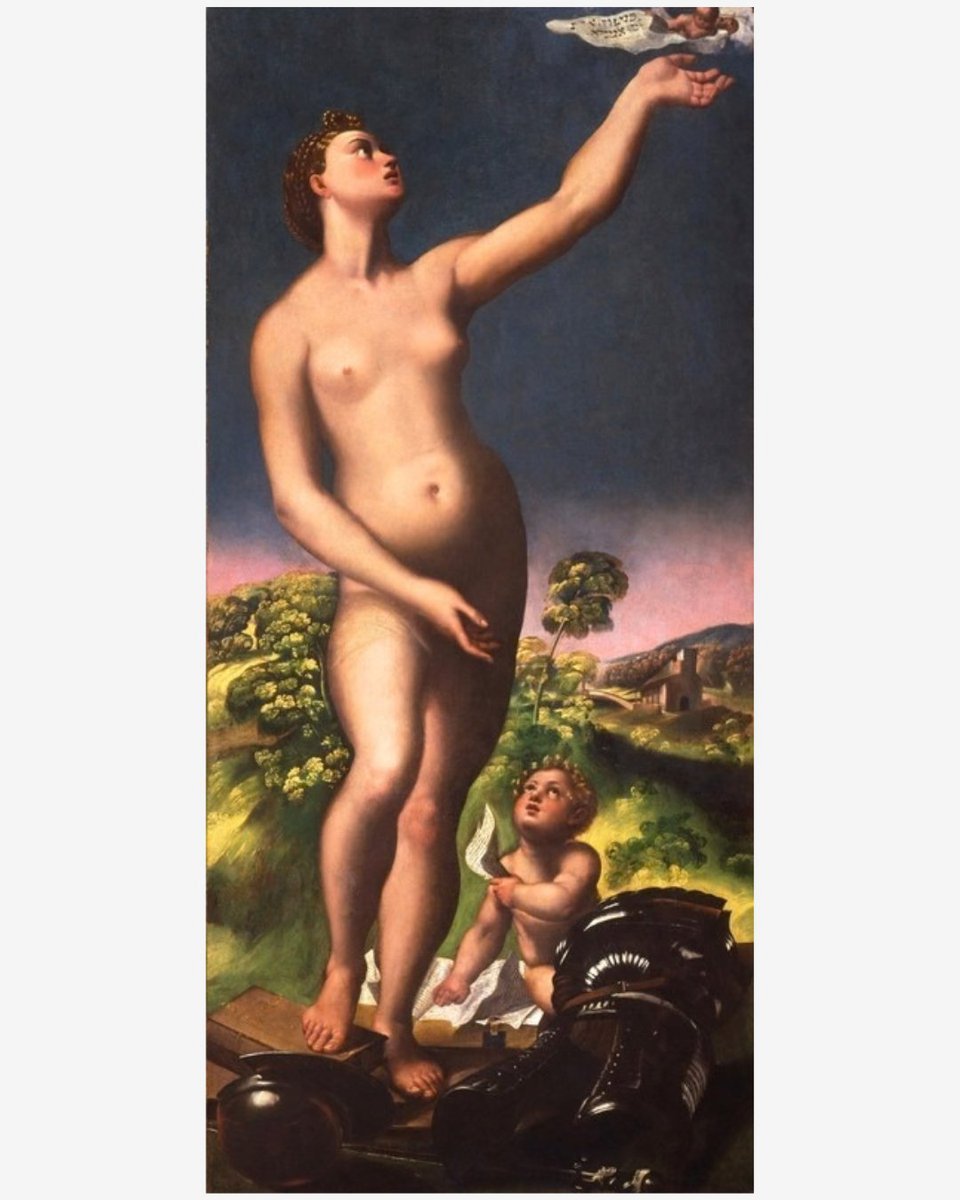
A Uffizi post presents the female beauty in this enigmatic allegory as a symbol of Truth, finally freed from worldly vanities and rising toward the sacred and knowledge.
Set in a fantastical landscape illuminated by twilight, the work shows a voluptuous nude young woman while a putto seated on a book offers her torn pages; another closed volume lies beneath her foot.
The work remains enigmatic: it has recently been compared with a slightly later portrait held by the museum in Tyumen, Russia, but the stylistic and chronological differences are considered too great to suggest a common hand, and its canonical attribution is therefore being maintained.
The landscape’s bright greens, pink atmospheric contrasts and solitary tree, which defines the perspective planes, are identified as features found in the pictorial language of Dosso’s circle. The anonymous author probably also adopted aesthetic models derived from Raphael and Rome, visible in the putto’s pose and features, filtered through artists at the Este court such as Garofalo and Dosso Dossi, or through prints of the period.
A reference to Jewish culture has led to the belief that the work was intended for a Ferrarese commission, since Ferrara had strong relations with its Jewish community and received particular privileges from the Este court. The work probably once belonged to Cardinal Luigi d’Este and was inventoried in the Medici collections in 1598, when it was sent from Palazzo Pitti to the Villa di Artimino; displayed after the Second World War at the Museo Civico di Pistoia, it returned to Florence in 1980, first to Palazzo della Signoria and then to the Uffizi Galleries.