
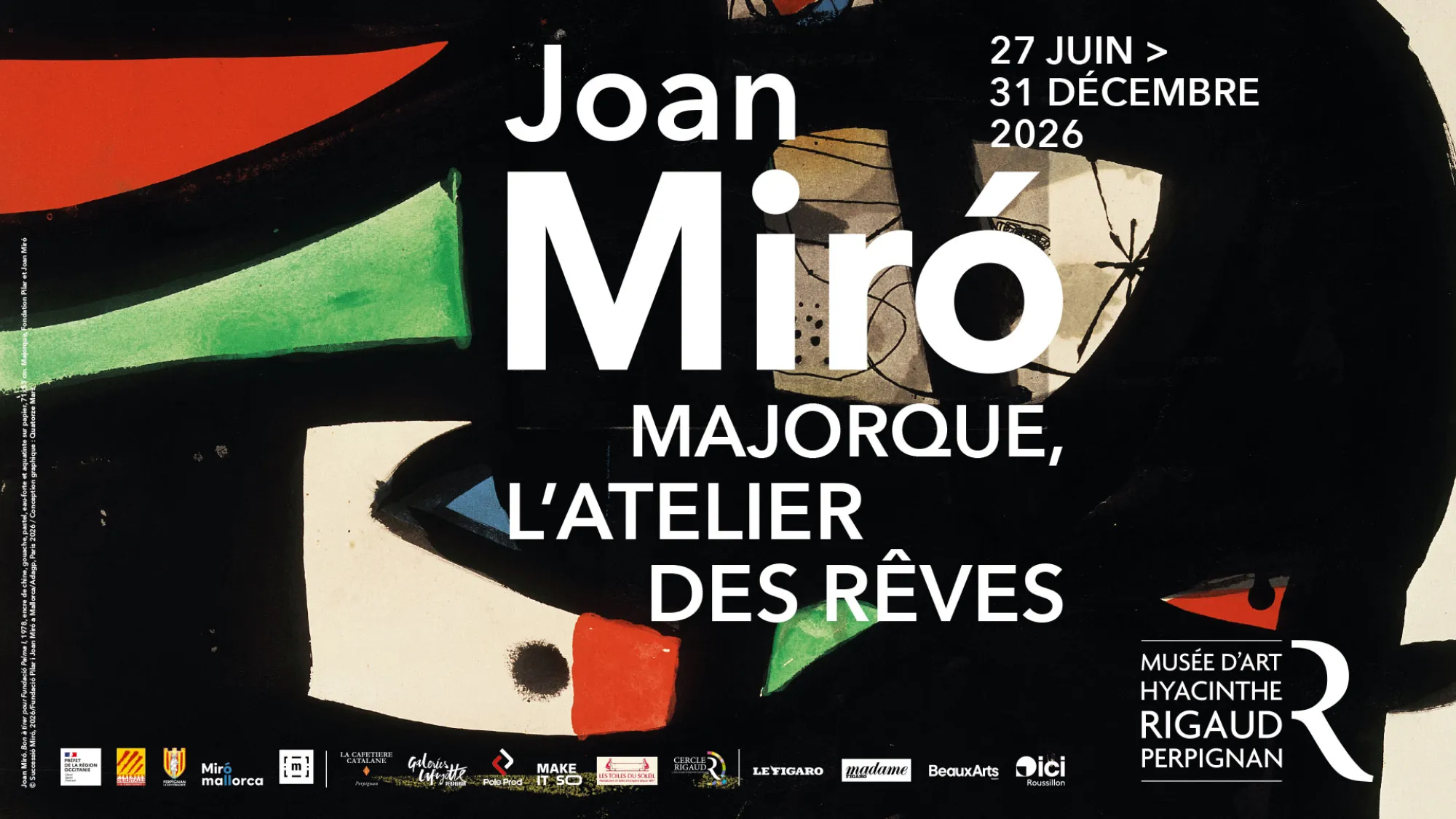
 Image: Musée Hyacinthe-Rigaud, Paris
Musée d’art Hyacinthe Rigaud has opened 'Joan Miró. Majorque, l’atelier des rêves', a major exhibition devoted to the Catalan artist that runs from 27 June to 31 December 2026. The museum describes it as the first large-scale exhibition dedicated to Joan Miró at the institution, and says it is presented in the context of the 2024 jumelage between Perpignan and Palma de Majorque. The project is built on a close partnership with the Fundació Pilar i Joan Miró de Majorque, which is identified as the exhibition’s principal lender.
According to the museum’s press material, the exhibition gathers nearly a hundred works, including paintings, sculptures, ceramics, drawings, engravings and lithographs. The display occupies the temporary exhibition space, about 400 square metres, which has been specially scenographed for the occasion. Rather than offering a strictly chronological retrospective, the show uses Miró’s move to Majorca in 1956 as a central point of reference and presents the island studio as a key lens for understanding the development of his late practice.
The museum frames that Majorcan period as a profound turning point. In the studio at Palma, completed in 1956 and designed by architect Josep Lluís Sert, and in the house of Son Boter, Miró is shown as working in an environment that became at once a laboratory, a refuge and a place of creative freedom. The exhibition text emphasizes his experimentation with gesture, matter and sign, and notes that he spent years giving greater attention to engraving and ceramics before returning to painting at the end of 1959. The museum also says Miró later destroyed some earlier works as part of a process of self-criticism.
The exhibition is organized around several thematic sections. 'Majorque, l’atelier des rêves' focuses on the Majorcan studio and on the idea of the island as an inner world that shaped Miró’s imagination. 'De Miró à Miró, un artiste au-delà de la peinture' traces the evolution from his formative years in Barcelona through encounters with avant-garde circles in Paris and into the development of a distinctive graphic language. 'Une révolution permanente' looks at the later transformation of his work, including the growing prominence of monochrome, black line, collage and assemblage. A further section, 'La charge fabuleuse de la tache', continues that account of formal invention.
The museum’s material also highlights Miró’s work in ceramics, developed from 1944 with Josep Llorens Artigas and expanded especially in the 1950s. It describes this collaboration as one of the major contributions to the revival of ceramics in twentieth-century art. The exhibition includes ceramic pieces, from striking forms to glazed plaques, alongside works that point to the interplay between architecture, space and material in Miró’s practice.
Another strand of the project points beyond the core exhibition. Under the heading 'Autour de l’exposition : photographies d’Antoine Schneck', the museum notes a parallel presentation of photographs by Antoine Schneck, with related activity listed until 6 September. The museum’s programme for July also extends the Miró focus through guided adult tours, flash visits, family workshops and storytelling sessions, including 'Visite contée - Miró, la tête dans les étoiles' for children from age two. The exhibition is open through 31 December 2026 at Musée d’art Hyacinthe Rigaud in Perpignan.
!['Là où elle pose' to open at the Théâtre de Privas in October [f1, f2, f9]](/uploads/newsletter-12933-85cae116dafc.jpg)