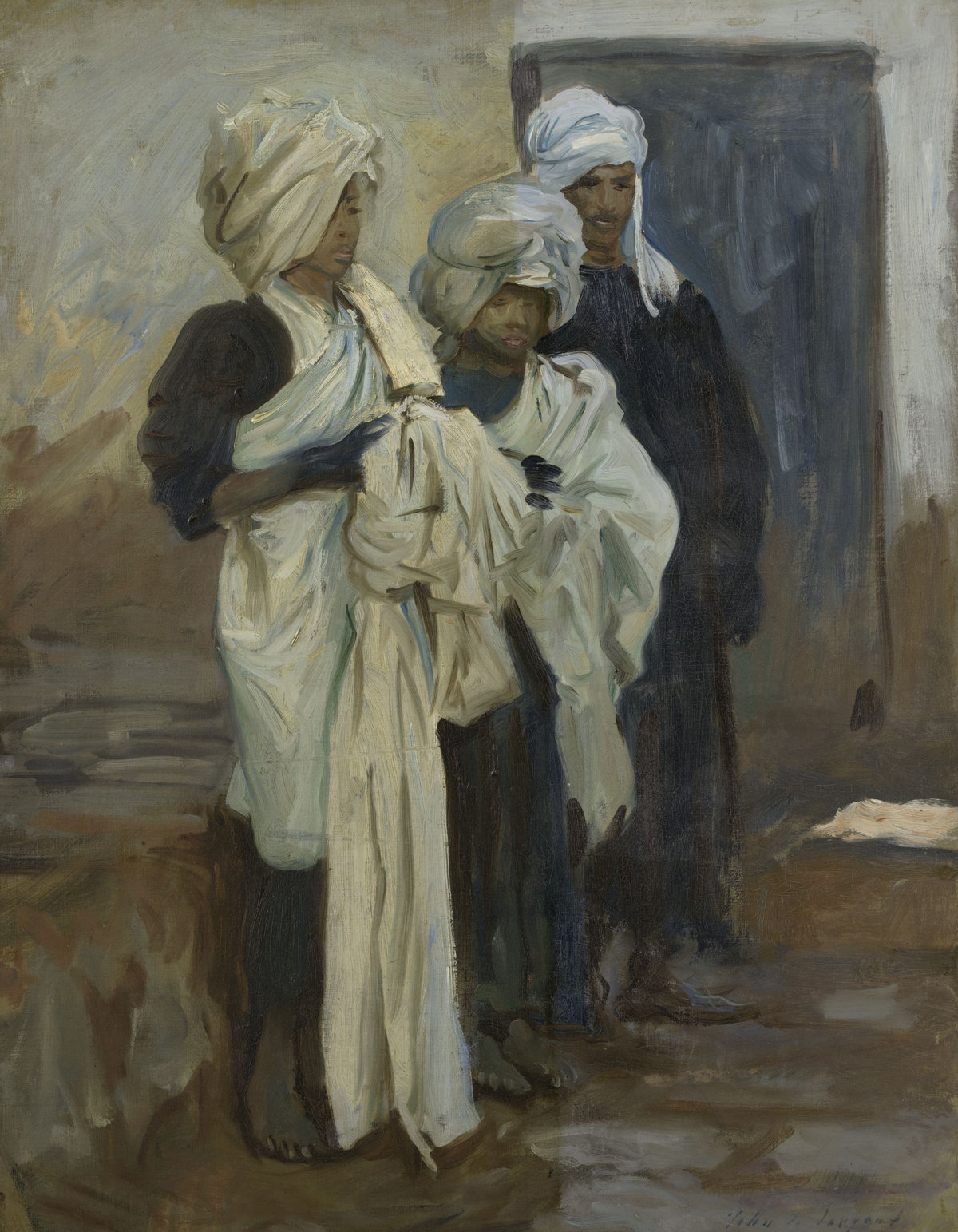
 Image: John Singer Sargent, Egyptian Indigo Dyers, 1891. Oil on canvas, 81 × 63.5 cm
The Mesdag Collection in The Hague has published the results of a restoration and technical study of "Egyptian Indigo Dyers," an 1891 oil sketch by John Singer Sargent (1856–1925). The museum says it is the only public collection in the Netherlands holding a work by the American painter. The canvas, 81 by 63.5 centimeters and signed lower right in blue, was treated in the restoration studio in Amsterdam.
The painting shows three indigo dyers in deep blue clothing, with the dye visible on their pieces of cloth and on their hands and forearms. Sargent spent time in Egypt in 1891, where indigo dyeing was a long-established craft.
Taking off surface dirt and a yellowed varnish brought out the range of color, notably the varied whites, blues and greens and the purple and pink accents, and made the quick, loose brushwork of an outdoor sketch easier to read. The cleaning also exposed fingerprints along the edges, probably left when the canvas was moved while still wet, as well as other marks where the wet surface seems to have rested against something. According to the museum, these traces, along with dust embedded in the paint, show that Sargent worked fast and moved the picture before it dried.
Tubes labeled "indigo" were found in one of Sargent's paint boxes, but their contents are unknown, as is whether he took the color to Egypt. A non-invasive macro-XRF scan showed that he used at least cobalt blue and ultramarine. Indigo and Prussian blue have been neither confirmed nor ruled out, which would require other methods.
The scan also detected mercury, pointing to vermilion, a red absent from the visible composition. Turned 180 degrees, the mercury map shows two legs and feet with part of a hand above them. Infrared reflectography confirmed the lower half of a standing figure in what appears to be a short cloak, and a supplier's stamp on the back sits off-center rather than in the usual symmetrical position. The museum suggests that Sargent cut up a canvas bearing an existing, probably unfinished picture and reused its lower part upside down in Egypt.
The legs and cloak closely resemble those in Velázquez's "Don Juan de Austria," which Sargent copied at the Prado in Madrid in 1879. His copy of the jester's head is in a private collection in Paris, yet the hidden figure is a mirror image of Velázquez's original, leaving open whether it is an unknown later copy or a portrait in the Spanish manner. Ana Martins, heritage scientist in the Van Gogh Museum's research department, carried out the scanning and interpreted the results.