 Image: Museo delle Porcellane, Florence
The Uffizi has drawn fresh attention to Fra Filippo Lippi’s 'Incoronazione di Maria', a major tempera-on-panel altarpiece now in the Florentine museum’s collection. The work is dated to about 1439-1447 and is presented by the museum as part of its painting collections, with a location in the gallery sequence alongside Paolo Uccello, Filippo Lippi and Piero della Francesca.
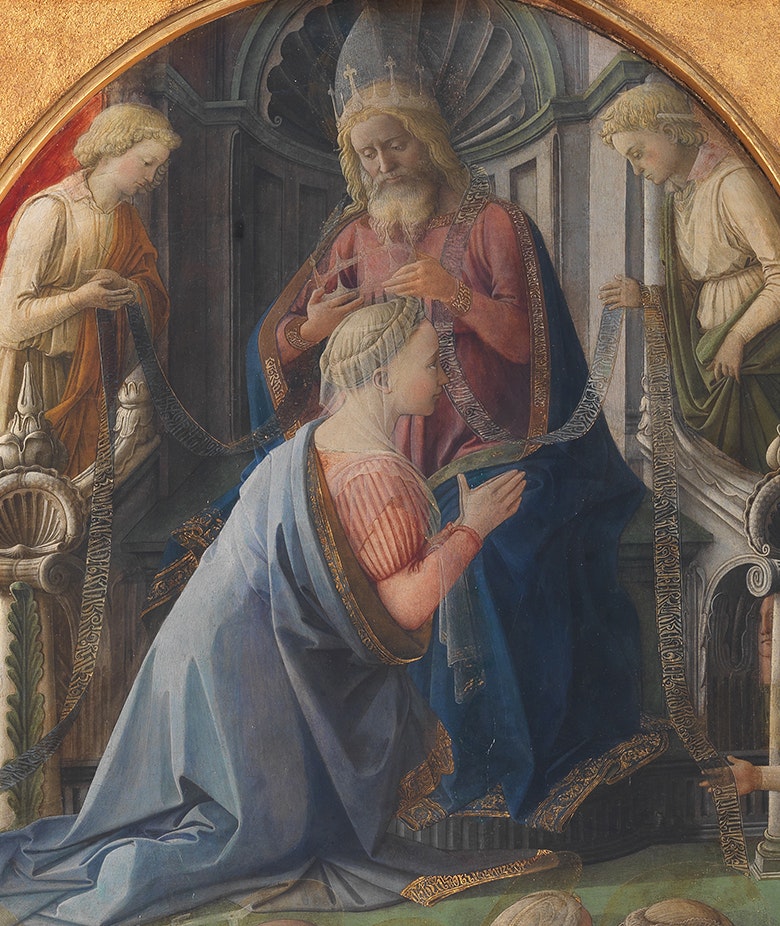
The museum’s online entry describes the painting as a scene in which God the Father, seated on a throne, crowns the Virgin Mary in the presence of numerous angels and saints. The composition places the kneeling Virgin at the center of the devotional image, while angels nearby hold the papal stole and others carry white lilies, symbols associated with Mary’s purity. Behind the figures, concentric bands of blue and azure suggest the heavens in a medieval cosmological sense.
The panel was originally made for the high altar of the church of Sant’Ambrogio in Florence, specifically for the Benedictine convent of Sant’Ambrogio. According to the Uffizi’s text, the painting was commissioned by the canon Francesco di Antonio Maringhi, procurator of the monastery, and was completed by 1447 after Maringhi’s death in 1441 and a substantial testamentary bequest. The museum notes that the work cost more than 400 gold florins.
The entry also identifies several figures in the sacred assembly. A bishop on the left is recognized as Saint Ambrose, the church’s titular saint, while Saint John the Baptist appears at right, patron of Florence. In the foreground stands a family of martyrs associated with the persecutions under the Roman Empire: Saint Eustace, his wife Theopista and their sons Theopistus and Agapius. The donor kneels below the Baptist, marked by an angel unfurling a scroll that reads 'IS… PERFECIT OPUS', indicating the patron’s completion of the work.
The museum’s text says the painter may have included a self-portrait, placing himself in the left background as a kneeling friar dressed in white with dark hair looking outward. It also notes that Fra Filippo worked with collaborators on the altarpiece, naming Fra Diamante, Piero di Lorenzo and Bartolomeo di Giovanni Corradini among those involved. The painting’s spatial arrangement was designed with the nuns of the nearby monastery in mind, since they viewed the altarpiece from a raised choir area in the church.
The Uffizi entry further traces the work’s later history. After being moved to the sacristy, it was stolen after 1755, entered the collection of the art dealer Angelo Volpini, passed in 1813 to the Galleria dell’Accademia in Florence, and has been at the Uffizi since 1913. The museum records the surviving panel as oil-free tempera on wood, measuring 200 by 287 centimeters, and notes that a surviving predella fragment showing a miracle of Saint Ambrose is now in Berlin, in the Gemäldegalerie of the Staatliche Museen.