 Image: Secession Building, Vienna
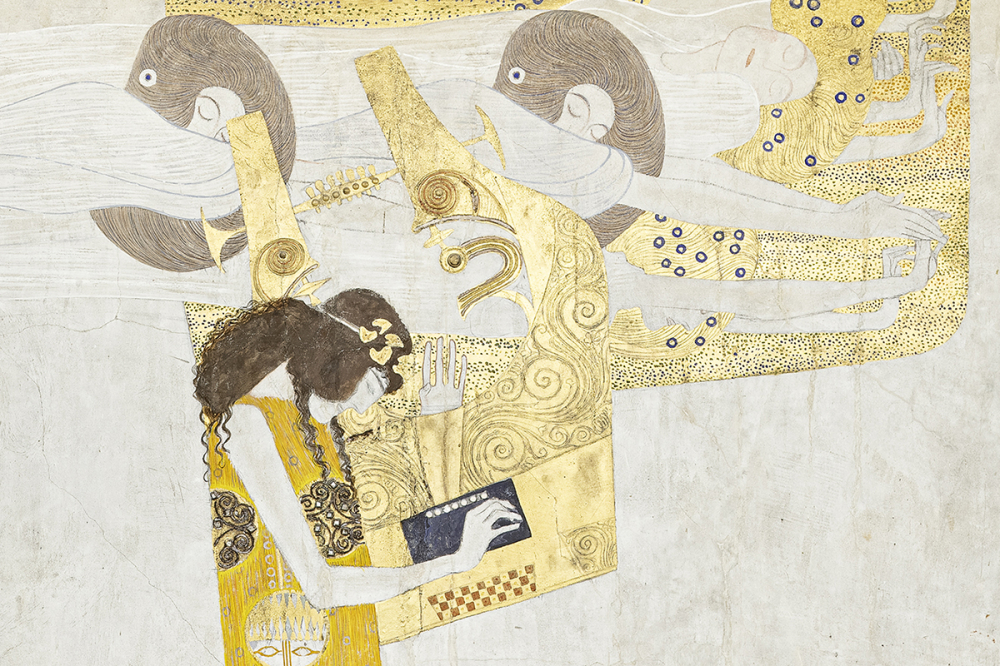
Vienna’s Secession is foregrounding Gustav Klimt’s Beethoven Frieze as one of the defining works of Austrian modernism, using the building’s own history to show why the mural still matters more than a century after its debut. The institution’s online material on the frieze revisits the work’s original context in the Secession’s XIV. Ausstellung in 1902, when Klimt created the monumental wall cycle for an exhibition dedicated to Ludwig van Beethoven.
That exhibition, held from 15 April to 27 June 1902, was conceived as a tribute to Beethoven and as an ideal expression of the Secessionist Gesamtkunstwerk, or total work of art. Under the direction of Josef Hoffmann, 21 artists participated. At the center of the main hall stood Max Klinger’s Beethoven statue, while Klimt’s frieze, along with wall paintings and decorations by Alfred Roller, Adolf Böhm, Ferdinand Andri and others, helped link architecture, painting, sculpture and music into a single exhibition environment.
The Secession emphasizes that Klimt’s mural occupied the left side room entered first by visitors, with a wall opening offering a direct view toward Klinger's Beethoven statue. That spatial choreography was central to the exhibition’s concept: the art was meant to emerge through the interaction of room design, mural painting and sculpture rather than as isolated objects. In that sense, the Beethoven Frieze was not simply displayed inside the exhibition, but built into the exhibition’s argument about how the arts should work together.
The 1902 show became one of the Secession’s greatest public successes, drawing nearly 60,000 visitors. It also became important for Klimt’s subsequent development and for the wider network of artists around him. The institution notes that the exhibition’s model of collaboration was taken forward by the Wiener Werkstätte, underscoring the lasting impact of the Beethoven project on Viennese art and design beyond the single event.
The frieze itself has a particularly complex history. It was originally intended as a temporary work that would be removed and destroyed after the exhibition, but it survived. The Secession’s account traces its subsequent movements through private ownership, storage, wartime dispossession and eventual state acquisition. After the Republic of Austria bought the work in 1972, it was restored over a ten-year period under the supervision of Manfred Koller of the Austrian Federal Monuments Office. Since 1986, it has been permanently accessible to the public in a specially created lower-ground-floor room in the Secession, on loan from the Belvedere.
The institution’s renewed attention to the Beethoven Frieze arrives alongside current programming at the Secession, where the building’s historical role as a site for ambitious exhibitions continues to frame new work. The house currently links the Klimt mural to contemporary practice through a broader exhibition program and public offerings, including guided visits to the Beethoven Frieze and the building itself. That continuity matters: the Secession is not presenting Klimt as a sealed monument, but as part of an ongoing institution that still understands itself through experimentation, collaboration and the fusion of the arts.
In the wider art world, the Beethoven Frieze remains significant because it marks a moment when modernism, exhibition design and large-scale mural painting were reimagined together. The Secession’s presentation underscores that its importance lies not only in Klimt’s decorative language, but in the way the work helped define a new relationship between art, architecture and spectatorship at the turn of the 20th century.