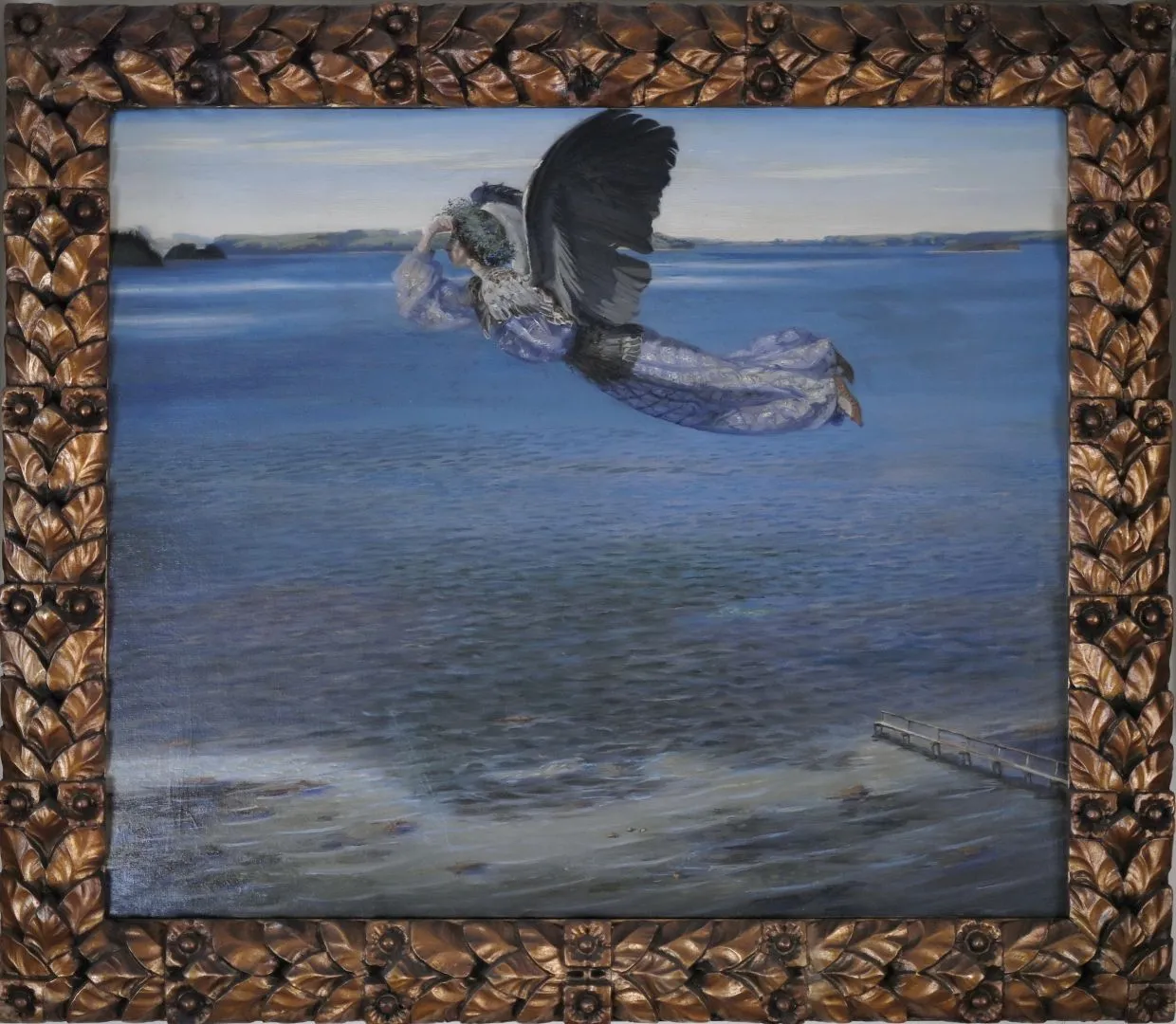
 Image: Fuglsang Art Museum, Toreby L
Agnes Slott-Møller’s painting ‘Jomfru Blidelil’ will soon leave Fuglsang Art Museum in Toreby, Denmark, for temporary loans to exhibitions at other museums. Fuglsang has announced that visitors’ final opportunity to see the work at the museum this year will be 16 September 2026. The painting is expected to be away for approximately six months; the receiving museums and exhibition details have not been specified.
Painted in 1899, ‘Jomfru Blidelil’ depicts a young woman floating above blue water on borrowed bird wings. The museum’s account identifies the scene as part of a folk ballad: Blidelil has been bewitched by a man named Tidemand and borrows her sister’s wings to reach him. The lovers later die after misunderstanding one another, making the painting’s airborne moment part of a larger tragic narrative.
The work is an oil painting on canvas measuring 76 by 94 centimetres. Fuglsang acquired it in 2023 with money raised through crowdfunding among the museum’s visitors and followers, alongside support from the Augustinus Foundation, the Lizzie and Ejler Ruge Art Foundation, the Louis-Hansen Foundation, the Danish Agency for Culture and Palaces, and the museum’s friends’ association.
Fuglsang director Anna Schram Vejlby places the painting within a strand of Danish art concerned less with everyday life and labour than with medieval stories, folk traditions and symbolism. Slott-Møller, who lived from 1862 to 1937, worked alongside her husband, Harald Slott-Møller, and rejected contemporary trends that focused on modern life in favour of subjects drawn from the Middle Ages and folk poetry. The museum describes this interest as part of the movement now known as medievalism.
Vejlby also links Slott-Møller’s choice of subject to the debates around gender roles at the turn of the 20th century. The museum’s director notes that medieval narratives offered the artist access to female characters who could appear more active and unconventional than the roles commonly associated with women in the 19th century. Until the acquisition of ‘Jomfru Blidelil’, this aspect of Danish art history was only weakly represented in Fuglsang’s collection, according to the museum.
The painting’s visual tension depends on the contrast between its naturalistic setting and supernatural subject. Slott-Møller painted the water and landscape with close attention to detail after working on the picture during the summer of 1899 on Fænø, where she and Harald had rented a house overlooking the Little Belt. Transparent layers of oil create the appearance of sand, seaweed and changing colours beneath the surface, while the large bird wings introduce the painting’s impossible central event. The decorative frame incorporates roses associated with Tidemand’s enchanted gifts, and a bathing jetty at the bottom of the composition reinforces the contrast between ordinary landscape and flight. ‘Jomfru Blidelil’ remains viewable at Fuglsang through 16 September 2026.