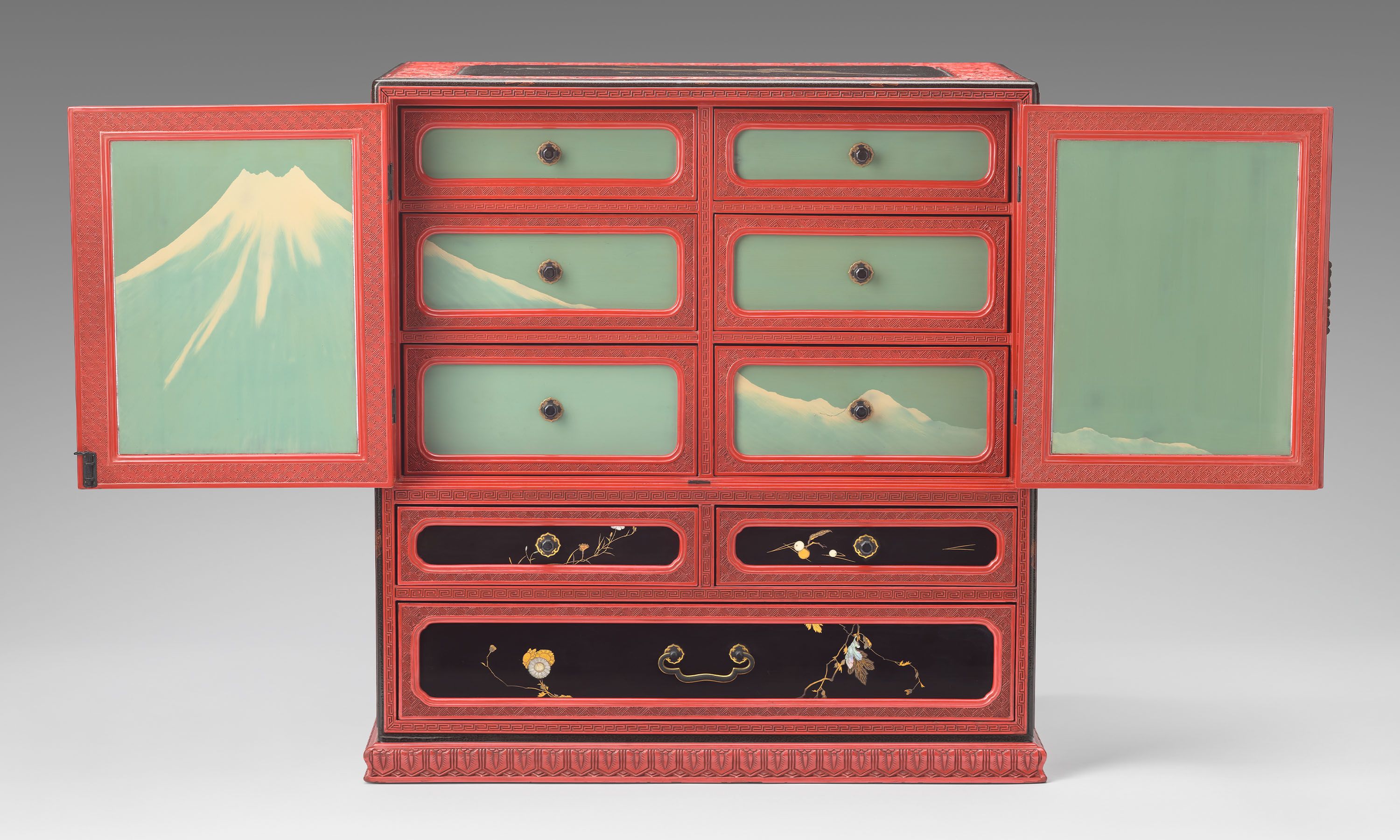
 Image: Cabinet with design of Plants of the Four Seasons and Mount Fuji, 19th century, Artist/maker unknown, 1916-237. Philadelphia Museum of Art
The Philadelphia Museum of Art is presenting ‘Japan at the World’s Fairs,’ an ongoing installation examining how Japan used international expositions to present itself to global audiences. On view in Galleries 341–343 of the museum’s Main Building, the presentation brings together Japanese ceramics, lacquerware, metalwork, and sculpture from the institution’s collection.
The installation commemorates the 150th anniversary of the 1876 Philadelphia Centennial, as well as the beginning of the Philadelphia Museum of Art’s Japanese collection. The objects on display either appeared at one of the world’s fairs discussed in the presentation or closely resemble works that were exhibited there.
The museum places Japan’s participation in the broader history of international exhibitions. Japan’s first official appearance at a world’s fair took place at the 1867 Exposition Universelle in Paris, the year before the dissolution of the country’s feudal system. Japanese representation continued at the 1873 Vienna, 1876 Philadelphia, 1893 Chicago, and 1904 St. Louis expositions, where the Meiji government was among the participants showing the largest number of objects.
The installation also extends the story into the postwar period. In 1970, Japan became the first Asian country to host a world’s fair, and in 2025 the country hosted Expo 2025 in Osaka. Video footage of that event forms part of the Philadelphia presentation, connecting the museum’s historical objects with Japan’s continuing engagement with global expositions.
Among the works identified in the museum’s online presentation are an anonymous 19th-century ‘Cabinet with design of Plants of the Four Seasons and Mount Fuji’; a vase dating to around 1875 by Fukaumi Suminosuke; and a late-19th-century ‘Incense Burner with Design of Landscape’ by Namikawa Yasuyuki. The installation also includes a vase from around 1868–75 by Fukagawa Eizaemon VIII, an early-20th-century ‘Incense Burner, Cover and Stand’ by Keida Masatarō, and a haniwa tomb guardian dated to the third through fifth centuries.
Xiaojin Wu, the Luther W. Brady Curator of Japanese Art, is listed as the curator. ‘Japan at the World’s Fairs’ is ongoing, with no closing date stated by the museum, and is free with museum admission at 2600 Benjamin Franklin Parkway.