 Image: Galerie de l’UQAM, Montreal ; david stjernholm
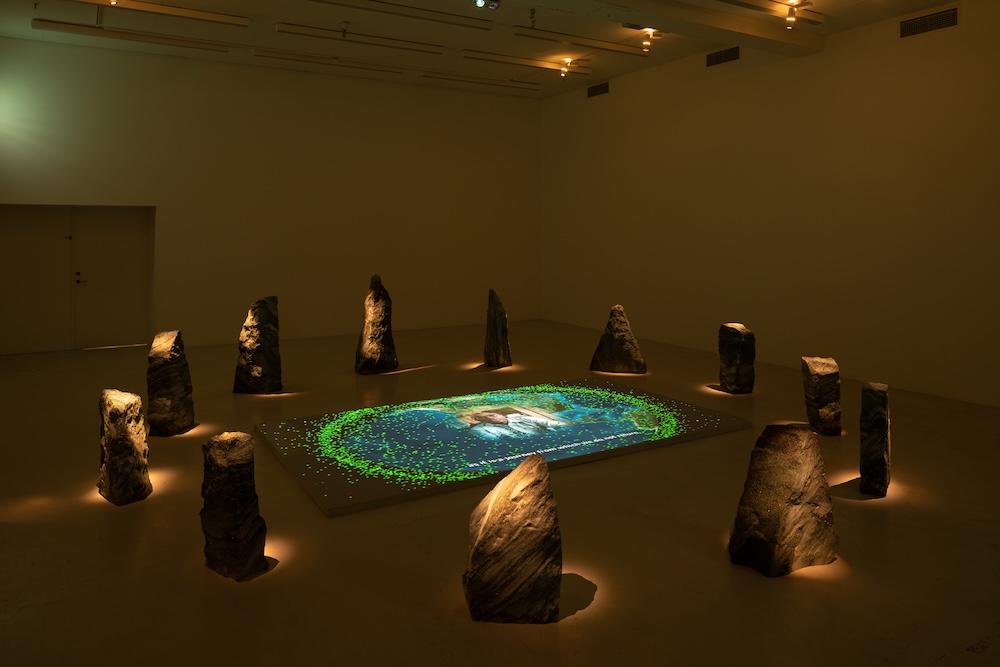
Galerie de l’UQAM in Montreal will present ‘An Assembly for the Cosmos’, a group exhibition examining alternative, anticolonial and non-extractive relationships to the cosmos. Curated by Antoine Bertron, the exhibition will bring together works by Marcela Armas and Gilberto Esparza, Tabita Rezaire, Skawennati, Suzanne Treister and Patricia Domínguez, and Jesse Tungilik. It will be on view at Galerie de l’UQAM from September 4 to October 17, 2026, with an opening scheduled for September 3 at 5:30 p.m.
The project is co-produced by Galerie de l’UQAM and MICA | Institut d’art contemporain de Montréal, in partnership with ESPACIO MÉXICO Montréal. Although the exhibition dates supplied by the gallery refer to its Montreal campus venue, the wider project extends across three sites: Galerie de l’UQAM, MICA | Institut d’art contemporain de Montréal, and Adélard, located in Bishop Stewart Memorial Church in Frelighsburg. The exhibitions and public programme in Montreal are part of the coproduction between the university gallery and MICA.
Galerie de l’UQAM is the contemporary-art gallery of the Université du Québec à Montréal. Its exhibition space is located in the Judith-Jasmin Building at 1400 Berri Street, in room J-R120. During the exhibition, the gallery lists its regular hours as Tuesday through Saturday, noon to 6 p.m. Admission is free.
The exhibition responds to the growing prominence of narratives around space colonisation, particularly those advanced through the influence of private industry and renewed national ambitions. Its framework asks how contemporary art might foreground different imaginaries and sociocultural perspectives, along with ancestral, Indigenous, community-based and more-than-human forms of knowledge, in discussions of the cosmos.
Rather than treating the cosmos solely as a domain of technological expansion, ‘An Assembly for the Cosmos’ proposes a field of planetary and interplanetary relations. The project’s stated concerns include the enrichment of worldviews and the amplification of anticolonial and non-extractive perspectives in the construction of shared, sensitive and plural futures. It also asks whether contemporary art can help establish an assembly grounded in solidarities within and across planetary forms of life.
The participating artists approach these questions through a range of practices and perspectives, though the source material does not specify individual works or installation details for each participant. The exhibition’s title and curatorial premise instead position the artists collectively within an inquiry into how social, cultural, ancestral, Indigenous, communal and more-than-human knowledge can reshape relationships with the cosmos. ‘An Assembly for the Cosmos’ opens at Galerie de l’UQAM on September 4, 2026, and remains on view there through October 17.