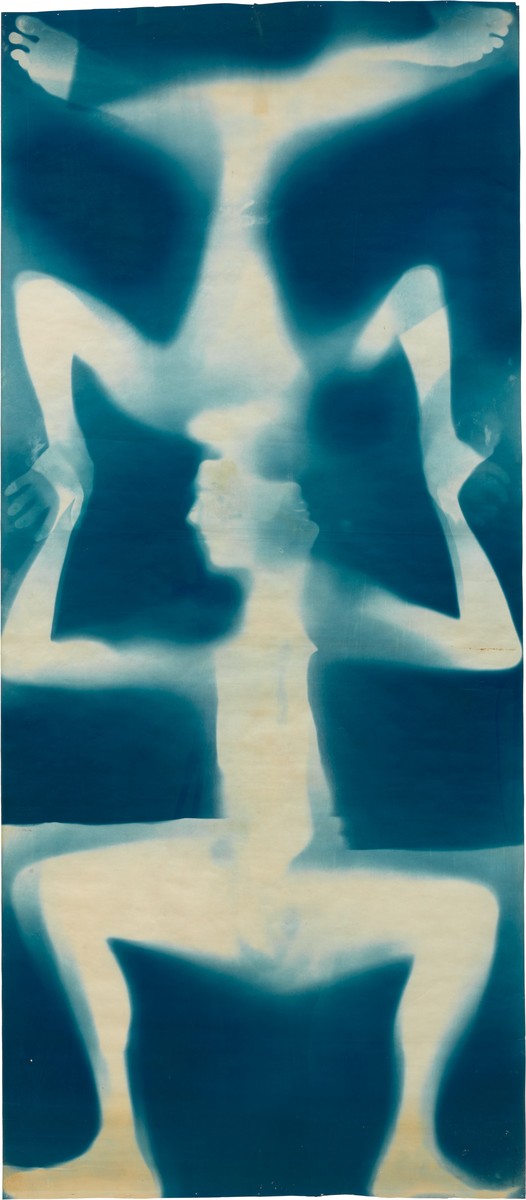
 Image: Robert Rauschenberg and Susan Weil, Untitled, 1950, cyanotype. © 2026 Robert Rauschenberg Foundation/Artists Rights Society (ARS), New York. Photo: Owen Conway. Gagosian, New York
Gagosian has extended ‘Robert Rauschenberg: Important Early Works from the Cy Twombly Foundation’ through September 26, 2026, at 980 Madison at 76th Street in New York. The exhibition brings together six early works by Rauschenberg from the Cy Twombly Foundation, including one of the artist’s earliest known surviving sculptures, a life-size photogram, and examples from his ‘Elemental Sculpture’ and ‘Combine’ series.
The presentation opened on April 25 during the centennial of Rauschenberg’s birth. It accompanies an exhibition of works by Marcel Duchamp at the same address, a historic building whose new ground-floor space was inaugurated by the two presentations. The Rauschenberg exhibition remains on view Monday through Friday, from 10 a.m. to 6 p.m.
Among the works shown is an untitled 1950 assemblage made from glass bottles, a twig, arrow fletching, plaster and a glass tube. The sculpture is described as one of Rauschenberg’s earliest known surviving examples. Much of the artist’s production from 1950 and 1951 was lost, destroyed or incorporated into later works, while this piece was preserved by Twombly.
The exhibition also includes ‘Untitled’ (1950), a cyanotype measuring more than six feet tall and made by Rauschenberg and Susan Weil. The life-size photogram belongs to the pair’s collaborative ‘blueprint’ works, produced shortly before their marriage. Other works on view include ‘Black Painting’ (c. 1952), made with oil, newspaper, paper towel and gravel; ‘Untitled (Elemental Sculpture)’ (1953), constructed from wood, nails, rope and stone; and an untitled 1961 work combining metal, wire, a tin can, an electrical cord, a light bulb and a stool.
The works’ provenance connects the exhibition to the artistic relationship between Rauschenberg and Twombly. The two artists met in 1951 at the Art Students League of New York and later attended Black Mountain College near Asheville, North Carolina. They traveled together through Italy, Morocco and Spain in 1952 and 1953, while also exchanging ideas and works. The exhibition’s source material describes the works from Twombly’s collection as especially significant in light of their close friendship and sustained creative exchange.
The exhibition situates Rauschenberg’s early experiments across several forms and materials. The photogram records his collaborative engagement with photographic processes, while the assemblage and sculptural works bring found or ordinary materials into relation with plaster, wood, metal, light and stone. The ‘Black Painting’ and later ‘Combine’ work likewise point to his use of nontraditional materials within painting.
A 68-page hardcover catalogue published for the exhibition reproduces all six works, with catalogue entries and details by Gillian Pistell. It also includes studio photography, handwritten correspondence between Rauschenberg and Twombly, and Susan Davidson’s illustrated essay ‘Cy and Bob: An Enduring Friendship.’ The exhibition continues at 980 Madison at 76th Street through September 26, 2026.