 Image: Museum Yamato Bunkakan, Nara
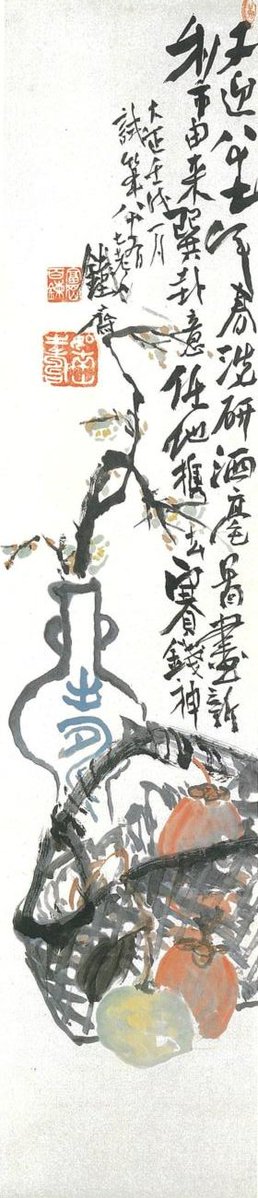
Museum Yamato Bunkakan in Nara has introduced Tomioka Tessai’s ‘Saichōzu’, a New Year painting made as the artist’s first brushwork of the year. The work brings together plum blossoms, a vase bearing an archaic character for longevity, and a group of auspicious visual and linguistic references intended to express good fortune.
The museum describes Tessai as a modern Japanese literati painter and identifies the painting as a work created for ‘saishitsu’, the traditional New Year practice of making the first calligraphic or painterly work of the year. Rather than presenting a scene of celebration through figures or a written greeting alone, Tessai builds the composition around objects whose forms and sounds carry symbolic meaning.
At the center of the image, plum blossoms are arranged in a white vase. The vase is marked with the archaic form of the character ‘寿’, meaning longevity or long life. The combination of flowering plum branches and the longevity character gives the image an explicitly celebratory character suited to the New Year, according to the museum’s description.
The foreground contains two persimmons and a large citrus fruit. Their significance depends on a Japanese wordplay: the sound associated with persimmon is linked in the composition to ‘事’, or affairs and matters, while the citrus fruit is connected by sound to ‘吉’, meaning good fortune. Two persimmons together with the large citrus create the phrase ‘事事大吉’, which the museum glosses as meaning that everything will go well.
The arrangement therefore operates on several levels at once. The painting presents recognisable plants and fruit, while the vase inscription and the sounds of their names form a series of wishes for longevity, favorable circumstances and universal success. The museum characterises the work as particularly appropriate for celebrating the New Year.
The introduction was published by Museum Yamato Bunkakan in a post dated August 22, 2026. The source does not provide an exhibition title, display dates or information about a related programme, so the work’s current presentation details are not specified. Museum Yamato Bunkakan is located in Nara, Japan.