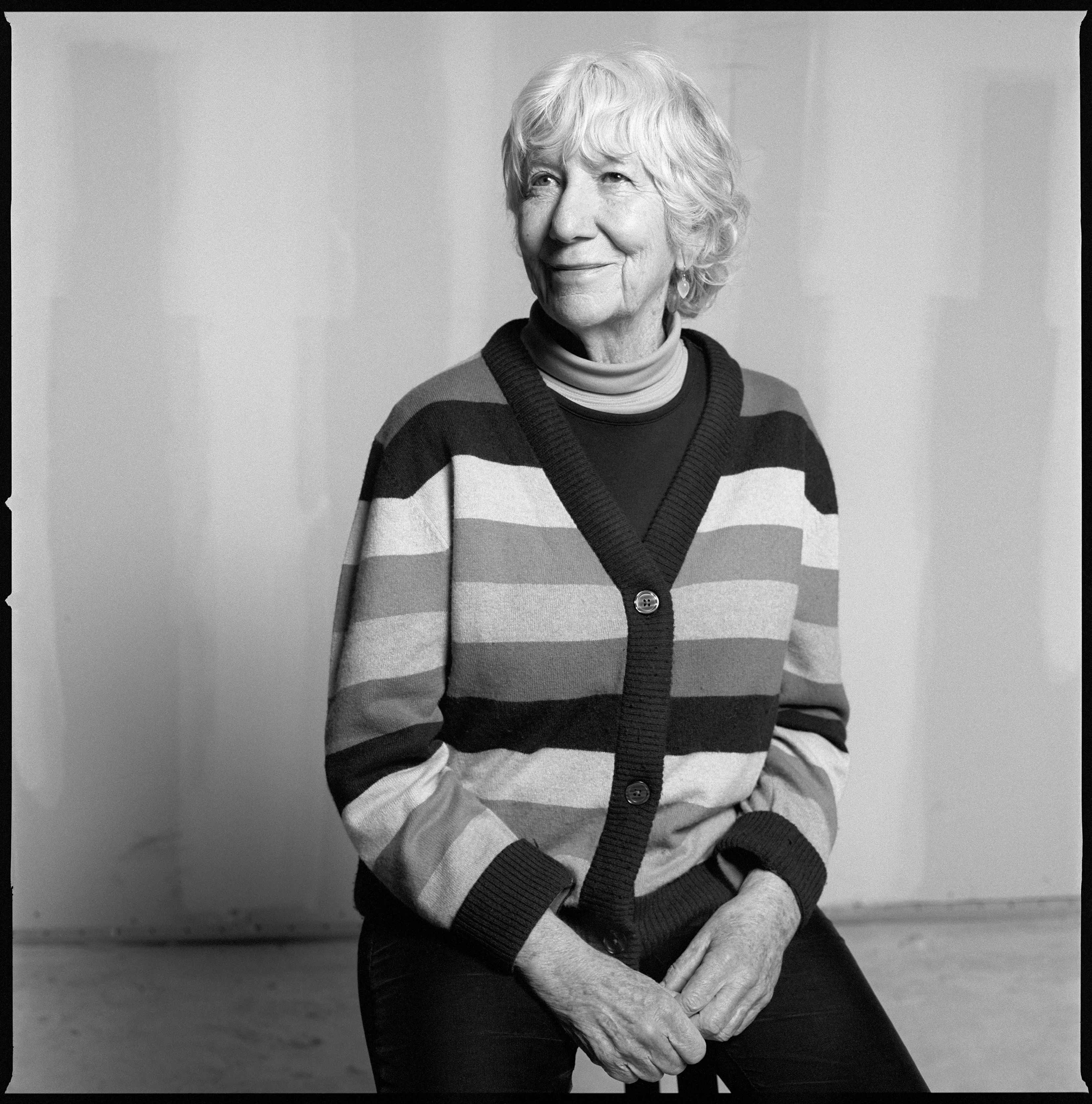
 Image: Mary Heilmann, New York, 2020. Photo: Brigitte Lacombe
Mary Heilmann, whose wavy, rainbow-hued abstractions brought an expansive sense of joy and human presence to postwar painting, died on August 14 at a hospital in Riverhead, New York. She was 86. Her studio said that the artist died following complications from a fall the previous week.
Working primarily in acrylic, Heilmann developed canvases marked by bleeding stripes, irregular grids and staggered hard-edge forms. Her paintings combined an apparent geometric order with visible evidence of their making, often beginning with a gestural underlayer before she masked and painted a second, more structured surface. The resulting works could suggest oceans, highways, music or other personal and popular references while remaining firmly rooted in abstraction.
Heilmann’s practice extended beyond painting. She began with large-scale sculpture, particularly ceramics, and later worked with wood, fiberglass and Styrofoam. She also made ceramic wall pieces and brightly colored sculptural chairs. The chairs were intended not only as artworks but as usable objects, inviting visitors to sit and look at the paintings around them. Her work was shaped by the surf culture and free-speech movements of the California environment in which she grew up, as well as by her interest in community and everyday experience.
Born Mary Anne Heilmann on January 3, 1940, in San Francisco, she grew up in the Bay Area and later near Los Angeles. She studied at the University of California, Santa Barbara, where a pottery class led to an interest in ceramics, and earned an MFA from the University of California, Berkeley, under the ceramicist Peter Voulkos. Heilmann moved to New York in 1968, initially drawn by the city’s experimental sculpture scene and by the work of Donald Judd. She turned to painting at a moment when the medium was widely regarded as exhausted, but soon established a distinctive approach that resisted the impersonal character associated with both Minimalism and mechanical production.
Her early recognition included inclusion in the 1972 Whitney Annual Exhibition. Wider institutional attention followed later in her career, with exhibitions at the Orange County Museum of Art in Newport Beach in 2007, Kunstmuseum Bonn in 2013, the Whitney Museum of American Art in New York in 2015 and Whitechapel Gallery in London in 2016. Heilmann joined Hauser & Wirth in 1997 and remained represented by the gallery until her death. Alongside her studio practice, she taught ceramics at Stony Brook University and taught for two decades at the School of Visual Arts in New York.
At Dia Beacon in upstate New York, Heilmann’s ‘Starry Night’ series was on long-term view from 2023 to 2025. A site-specific installation and several of her chairs were also presented at the Whitney earlier in 2026. Her work is held by institutions including the Hammer Museum in Los Angeles, the Museum of Modern Art in New York, the National Gallery of Art in Washington, DC, and Museum Ludwig in Cologne. Heilmann received an Anonymous Was a Woman Foundation fellowship and grants from the National Endowment for the Arts and the Guggenheim Foundation.