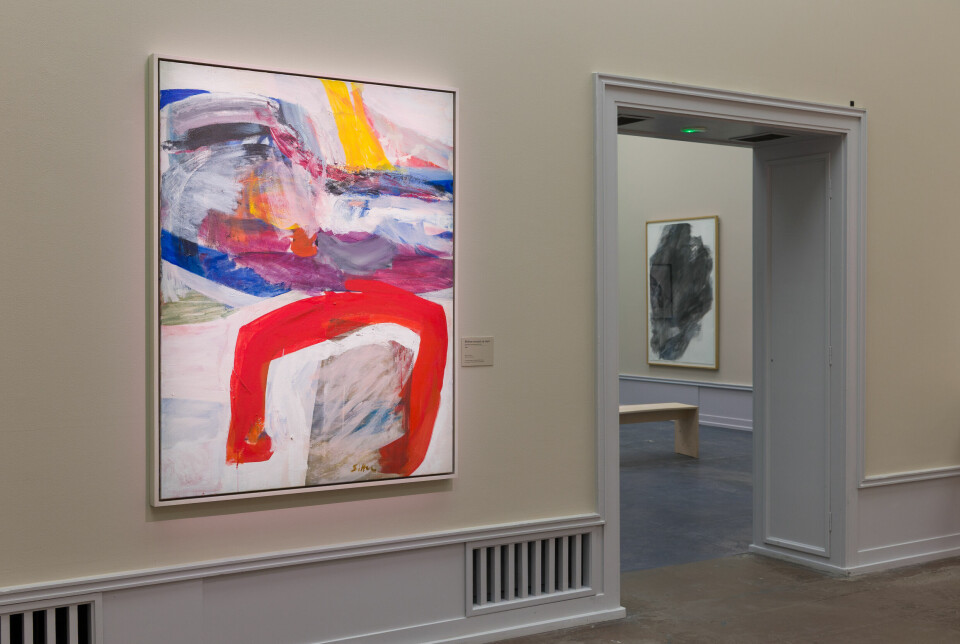
 Image: Installation view, ‘Inger Sitter. Naturfølelse.’, works by Inger Sitter © BONO. Trondheim kunstmuseum, Trondheim
A review published on 21 August has praised ‘Inger Sitter. Naturfølelse’, an exhibition at Trondheim kunstmuseum that presents the Norwegian artist as a pioneering modernist. The review, published by Morgenbladet, describes Sitter’s paintings as demanding an encounter beyond the comfort of recognizable, concrete motifs.
Written by critic Carina Elisabeth Beddari, the review argues that Sitter’s work asks viewers to accept uncertainty rather than insist on immediate understanding. In a passage highlighted by the museum’s newsletter, Beddari writes that Sitter taught audiences that art does not require everything to be translated into “safe, concrete motifs,” and that viewers must be willing to “lose their footing.”
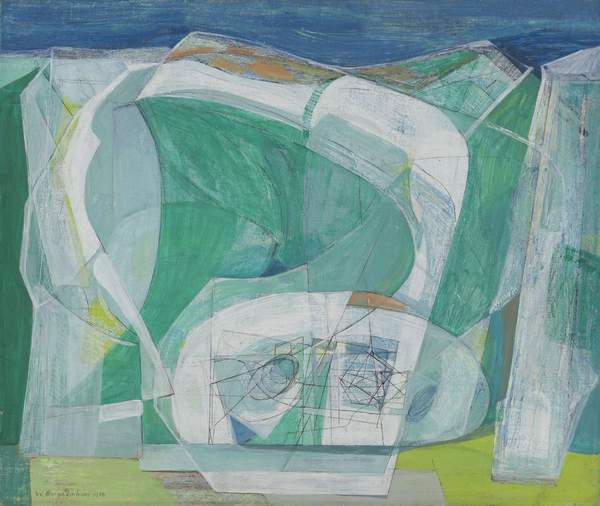
The review further characterizes an encounter with Sitter’s paintings as an invitation to set aside the fear of not understanding. It describes the paintings in terms of pure form, luminosity, weight and “illuminated darkness,” emphasizing the physical and perceptual force of the artist’s practice rather than treating the works primarily as representations of the visible world.
The exhibition’s framing of Sitter as a modernist pioneer is also reflected in the review’s headline and introduction. Its accompanying image identifies ‘Mellom morgen og regn’ from 1966, with the work credited to Inger Sitter and reproduced with permission from BONO.
According to Trondheim kunstmuseum, ‘Inger Sitter. Naturfølelse.’ is the museum’s 2026 summer exhibition and is on view from 4 June to 20 September 2026 at TKM Bispegata, its main building beside Nidaros Cathedral. The museum presents Sitter (1929–2015) as one of Norway’s foremost painters of lyrical abstraction, and describes the formations and elements of nature as the sustained inspiration of a practice that sought a directness comparable to weather and wind. Its introduction to the exhibition also traces connections between natural forms and the human body, and notes a career spanning eight decades and more than 80 exhibitions across painting, printmaking, drawing, sculpture, stage design and textiles, alongside public commissions; Sitter received the Order of St. Olav in 1998 for her contribution to Norwegian visual art. The museum does not publish a work checklist for the exhibition.
The museum is also scheduling a related programme titled ‘Se langsomt: Inger Sitter. Naturfølelse’. Listed as a guided event at Trondheim kunstmuseum, it is described as a “temporal art experience” focused on the act of looking: how long people look at art, what may become visible when they take more time, and what it means to look slowly. The booking page gives the event period as 1–17 September, while the newsletter specifies sessions on 1 September from 1–2pm and 17 September from 3–4pm.
The exhibition’s appearance in the museum’s autumn newsletter is accompanied by separate announcements for the institution’s public and educational activities. These include a three-day autumn-holiday art camp at the TKM Bispegata workshop from 5–7 October 2026, for children aged nine to 13, with activities involving masks, busts, drawing and collage. The camp’s stated theme is “monsters and mystery”; it is separate from the Inger Sitter exhibition and its related slow-looking sessions.