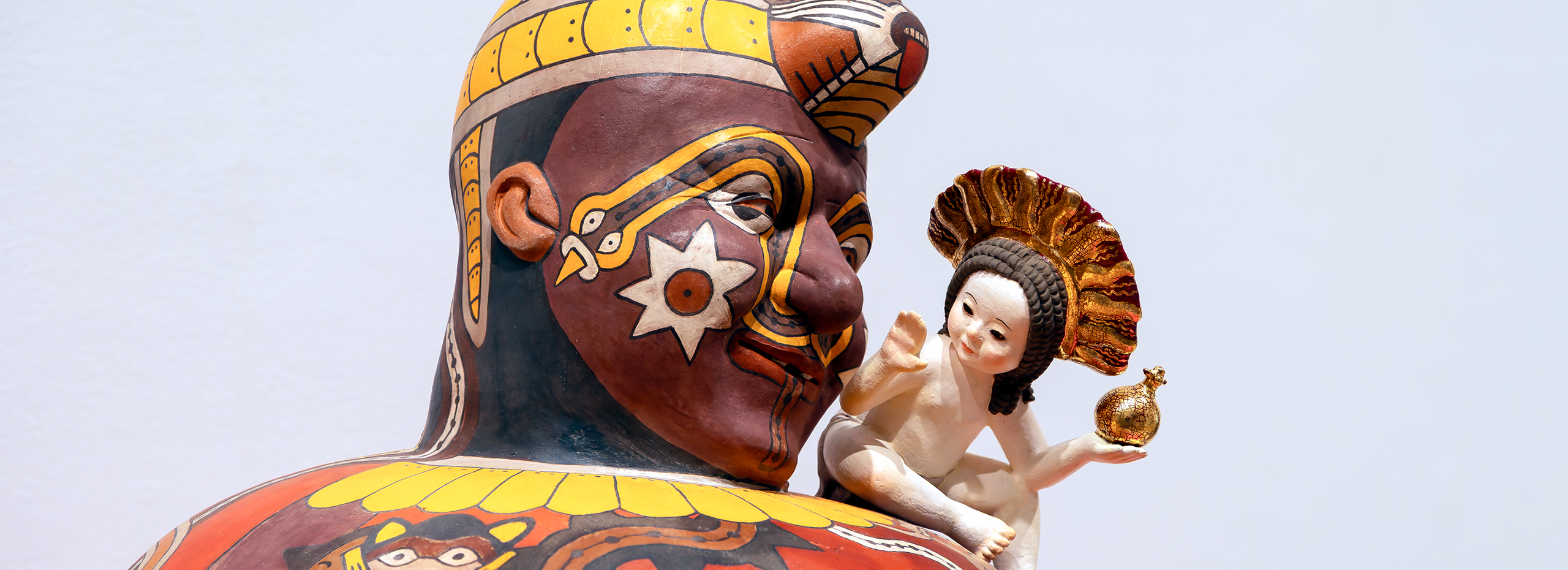
 Image: Kukuli Velarde, ‘San Cristobal’, from the series Corpus (detail). Installation image for the exhibition ‘San Cristobal by Kukuli Velarde’, Herbert F. Johnson Museum of Art, Cornell University, Ithaca, New York. Courtesy Herbert F. Johnson Museum of Art
Kukuli Velarde’s sculpture ‘San Cristobal’ is on view at the Herbert F. Johnson Museum of Art at Cornell University, in the Opatrny Gallery on Floor 2L, from 11 July 2026 through 7 February 2027. The presentation was curated by Hugo C. Ikehara-Tsukayama, the museum’s Harris Family Curator of the Arts of the Americas, and supported in part by the Russell ’77 and Diana Hawkins Exhibition Fund.
Velarde, born in Lima in 1962, made the work for her series Corpus, fifteen sculptures prompted by the annual Corpus Christi celebration in Cusco. The museum says the series draws on visual codes from ancient and contemporary Indigenous civilizations to challenge the idea of a universal aesthetic — one it describes as shaped by European canons of beauty and imposed by centuries of oppression.
The museum sets out the history behind the figure. In the sixteenth century the Spanish replaced Andean religious celebrations and local divinized entities with Corpus Christi and the Catholic pantheon, and the festival came to signify domination over the Indigenous population, who processed in recognizable ethnic garments during the viceregal era. Velarde’s mother witnessed a large rock being attached to the float carrying San Cristóbal — potentially a huaca, an animate entity of Andean cosmology. Executed in an aesthetic drawn from the ancient Nasca style, the sculpture is presented as an image of syncretism that also reveals the other presence disguised as the Christian saint, and as a testament to resistance against cultural, aesthetic and religious impositions.
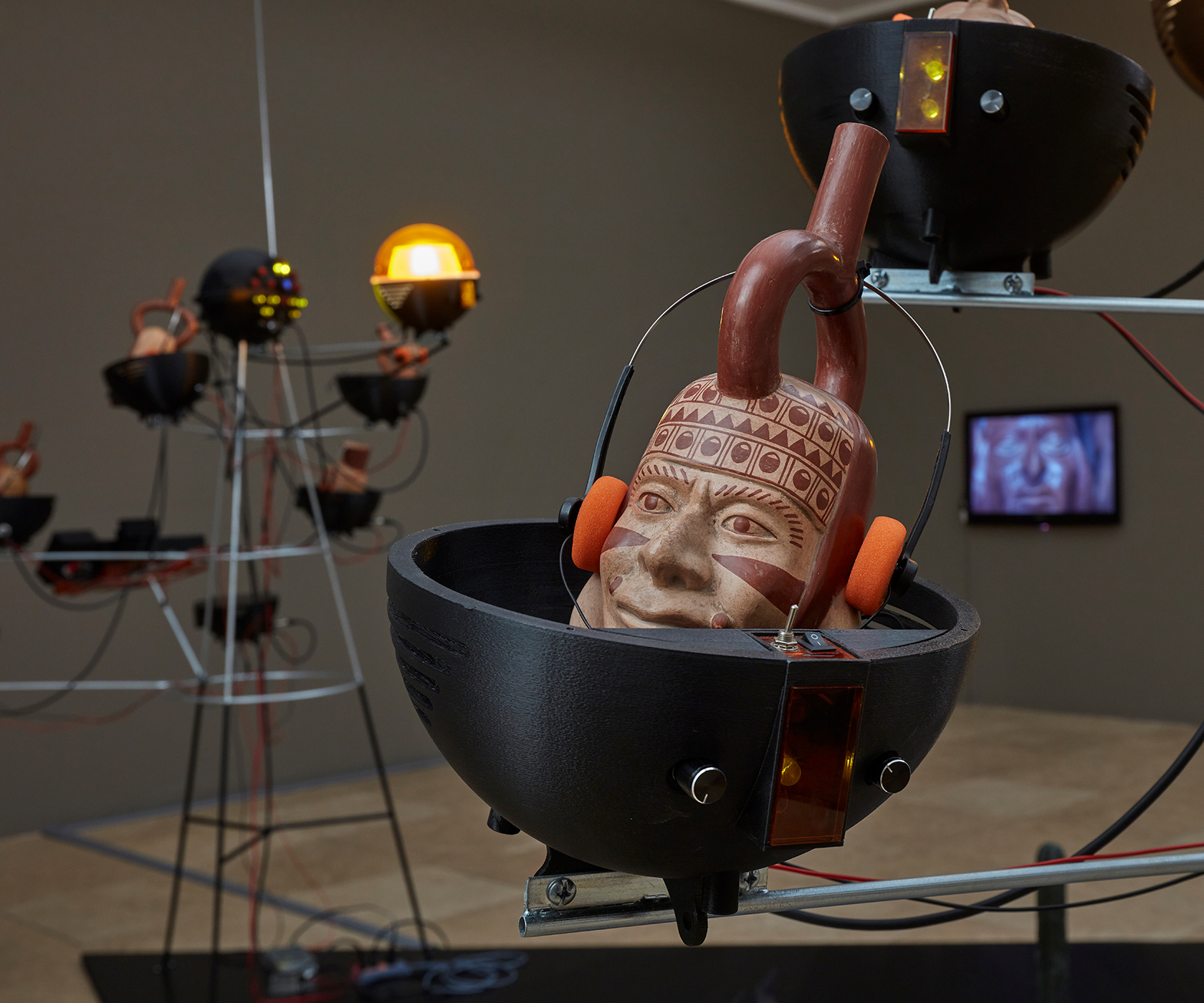
The sculpture complements ‘Checán Stereo’ in the adjacent wing gallery on the same floor, an installation by the Lima-based Peruvian artist Fernando “Huanchaco” Gutiérrez, born 1978, running from 28 August 2026 to 7 February 2027. Through reproductions of words in Muchik, an extinct Indigenous language, and a video of the Peruvian North Coast landscape, it forces a reconnection between Moche sculptures of 400–850 CE and their origins, arguing that objects removed from their archaeological context lose their histories, meanings and cosmological connections. Ikehara-Tsukayama curated that exhibition as well; it is cosponsored by the Consulate General of Peru in New York. Gutiérrez will discuss the work with Paulina Velázquez Solís at the museum on Friday, 28 August at 5 p.m., with a reception to follow.
The Johnson Museum holds more than 40,000 works and is at 114 Central Avenue, Ithaca, New York. Admission is free, and the museum asks visitors to check its website for current hours.