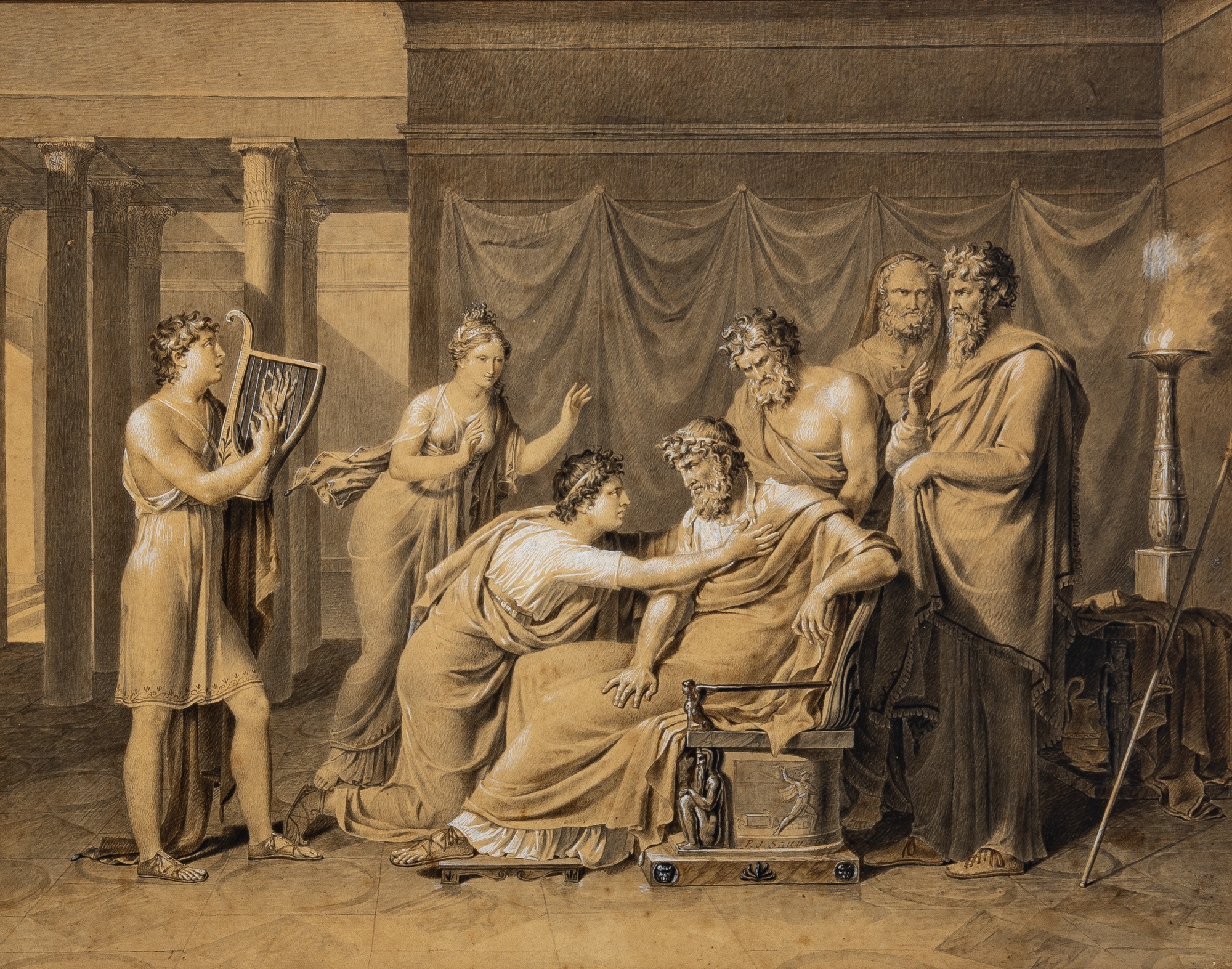
 Image : Attributed to Piat-Joseph Sauvage, Priam Mourning the Death of Hector
Cette actualité est affichée en anglais en attendant que sa traduction soit prête.
Two Neoclassical works that take the Trojan War as their subject have been singled out by the New York auction house Doyle for the rarity of the episodes they depict: an ink drawing dated 1772 and an oil painting from the circle of Jean-Auguste-Dominique Ingres.
The drawing, attributed to Piat-Joseph Sauvage and executed in black and brown ink, shows King Priam of Troy at the moment he learns that his son Hector has been killed by Achilles in single combat. Collapsed on his throne, the king is surrounded by relatives trying to console him. At the left, Paris holds a lyre beside Helen, who appears visibly shaken, while another Trojan prince leans forward to embrace his father. Three grieving older men stand behind the throne; Doyle suggests they may be further members of the family.
The sheet carries the signature ‘P. J. Sauvage’ and the date 1772 on the base of the throne. Doyle links this signature to the Flemish painter Piat Joseph Sauvage (1744–1818), who worked in Paris as a decorative painter during the 1770s. He is known mainly for trompe-l’oeil oil paintings that imitate bas-reliefs, painted in grisaille, a monochrome manner close to that of this drawing. On that basis, the auction house considers it very likely to be a rare narrative composition by the artist.
The second work is an unsigned oil painting by a follower of Ingres, probably made in the 1830s, showing Minerva (Athena) and Neptune (Poseidon) restraining the anger of Achilles. According to Doyle, it is a highly unusual choice of subject, drawn from Book 21 of the Iliad.
In Homer’s account, Achilles has killed so many Trojans beside the river Xanthus that their bodies choke the stream and stain it with blood. The offended river god takes human form and orders the hero to fight elsewhere; when Achilles refuses, Xanthus floods its banks and chases him across the plain. Close to drowning, Achilles calls on Zeus, and Poseidon and Athena appear beside him. This is the instant the painter chose. Poseidon assures Achilles that the river will not overcome him and sends him back to drive the Trojans toward their city, promising him glory once Hector is dead.
Doyle describes the scene as a turning point in the epic. From here on, Achilles knows that he will defeat Hector and that, although he is fated to die young at Troy, he will be remembered as the greatest of the Greek warriors. The auction house reads the episode as a distillation of the Homeric view of life and destiny.