 Image: Hidden, Bristol
Hidden Gallery in Bristol is presenting ‘Richard Long: The Art of Leaving a Trace’, a selection of works by the British artist whose practice has been shaped by direct encounters with landscape for six decades. The gallery’s materials frame the presentation around Long’s long-standing focus on walking, marking and leaving traces in nature, with works on paper and editions that turn those encounters into objects for the wall.
Long is widely associated with Land Art and Conceptual Art, and the gallery’s text places his work at the point where action and image meet. It recalls ‘A Line Made by Walking’ (1967), made while Long was still a student, when he repeatedly walked backwards and forwards across a field until the grass was marked by a visible line. That gesture established an approach in which an action in the landscape could itself constitute the work, rather than simply inspire it. Hidden stresses that print and paper have been part of Long’s practice since early in his career, citing MoMA’s holding of ‘Dartmoor Walks’ (1972), made as a screenprint and lithograph.
The selection brings together a range of media that have remained central to Long’s practice. Hidden lists lithographs, offset lithographs, a monotype in mud, a screenprint based on slate rubbings and a recent photopolymer etching. Among the works highlighted are ‘Untitled (A, B, C - Horizontal)’ (1994), ‘Waterlines’ (1989), ‘Mud Finger Piece’ (1984), ‘A Double Drawing of a Cornish Slate’ (1995) and ‘War Paint on Slate’ (2023). The gallery presents the group as evidence of the variety within Long’s editions and works on paper, while stressing the physicality of the materials themselves.
‘Waterlines’ is described as relating to a 560-mile journey Long made across Portugal and Spain, from the Atlantic to the Mediterranean, during which he poured a line of water from his bottle each day along his route. The resulting print combines flowing water marks with a short text recording the journey. ‘Mud Finger Piece’, by contrast, is a monotype in which Long applied mud directly to cardboard, with the marks of his hand forming the image. Hidden says the work is part of a wider practice in which he used his hands and feet to spread, wipe and apply mud rather than treating it as conventional paint.
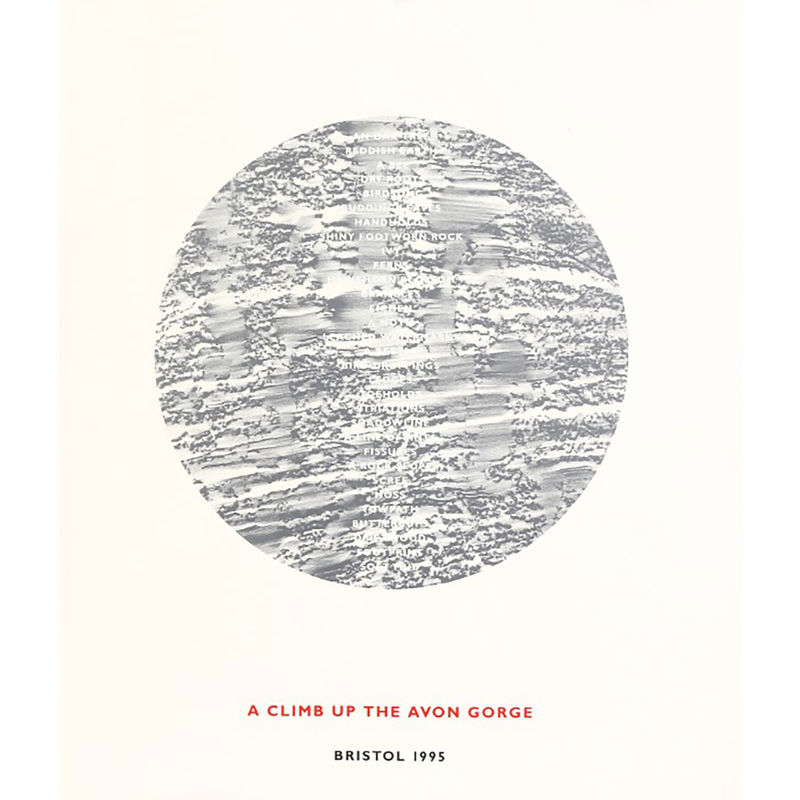
The slate-based works extend that interest in material and trace. ‘A Double Drawing of a Cornish Slate’ began with two pencil rubbings taken from the surface of Cornish slate, later combined into a single screenprint, and Hidden notes that the British Council holds an example of the work in its collection.
The Bristol gallery also emphasises the wall presence and physical scale of the prints. ‘Untitled (A, B, C - Horizontal)’ is offered as a set of three lithographs on handmade hemp paper, each signed, dated and numbered in red pencil, and Hidden says the works have been float-mounted in its framing workshop to bring out the textured paper and hand-torn edges. ‘Waterlines’ is described on the gallery site as a substantial work on the wall.
The gallery lists prices, edition sizes and sheet dimensions alongside each work and invites enquiries. The selection spans different points in Long’s career, including the 2023 print ‘War Paint on Slate’, which the gallery says was released by Migrate Art in 2023 to raise funds for earthquake relief in Syria and Lebanon, with proceeds supporting The White Helmets and The Great Oven.