 Image: NTT InterCommunication Center, Tokyo
Tokyo’s NTT InterCommunication Center is presenting 'ながれくるハミング | Audible Current' (2025), a new installation by media artist Keita Miyashita that treats urban power infrastructure as a large-scale acoustic device. The work reimagines the electrical grid not simply as a system of supply, but as a source of vibration, hum and measurable signal that can be heard and experienced as sound.
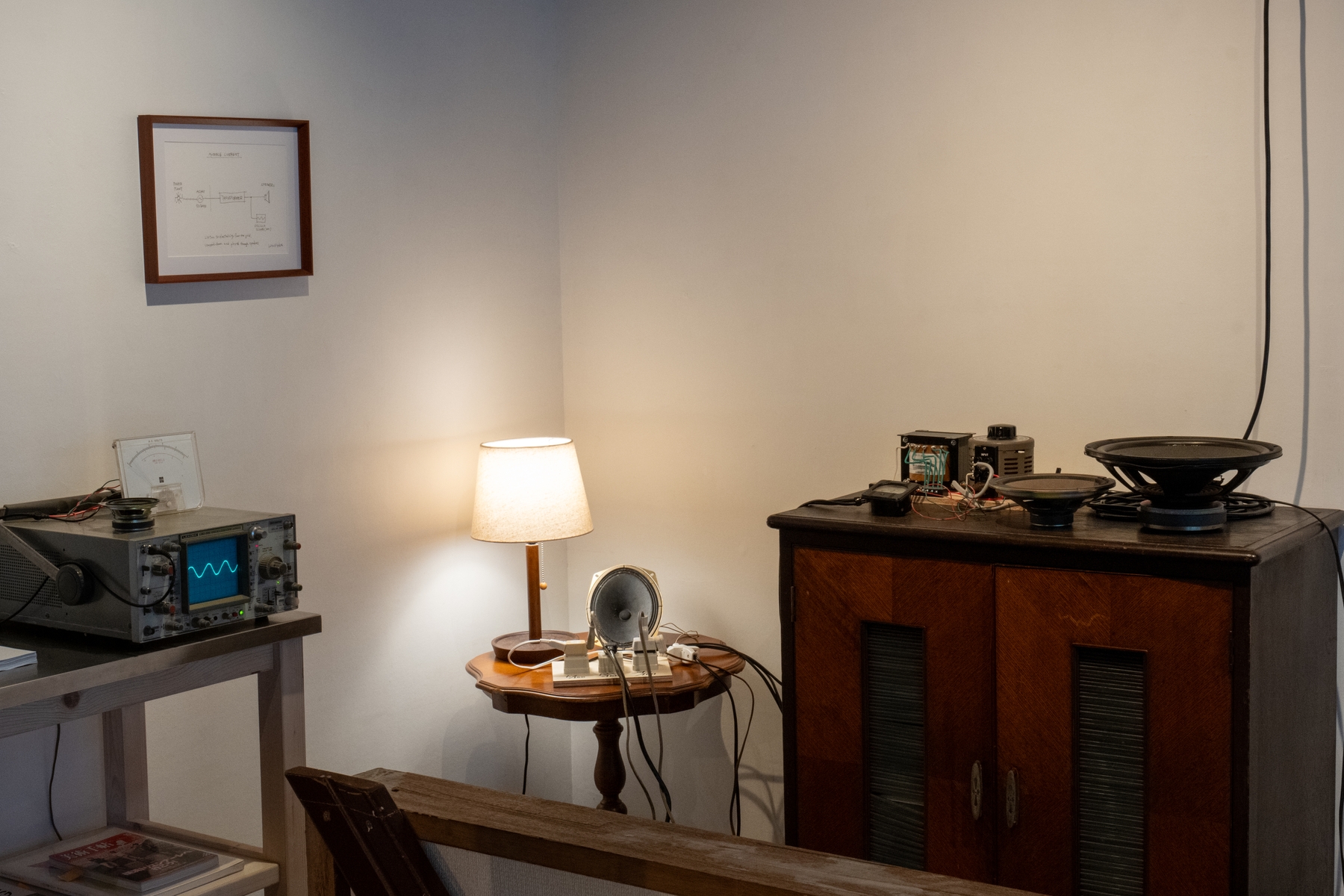
According to the artist’s project page, the installation is built from commercial power equipment, transformers, oscilloscopes, voltage meters, speakers, power taps and wiring. Speakers placed throughout the space emit continuous low hums, while some objects set on top of them rattle in response to the vibration. The work also uses devices that visualize electrical fluctuation, linking sound, movement and measurement within the exhibition environment.
Miyashita’s practice has focused on technology as infrastructure, including information networks, electricity and communications systems, and on the ways such systems structure human relationships to technology. In 'Audible Current', that inquiry turns to the hidden acoustics of everyday electricity use. The artist describes the project as an attempt to foreground the “background” hum of modern life by letting commercial AC100V power be heard as sound.
The installation also includes recordings made from multiple electrical supply regions in Japan. The project page notes that Japan is divided into 10 regional power-supply areas and that eastern Japan uses 50Hz while western Japan uses 60Hz. Among the recordings available in the work are sounds gathered from six supply regions and 18 locations, with the recordings also made available online. The piece raises comparisons between regional electricity quality, transmission routes and the effects of connected devices and noise.
Miyashita frames the work within a longer history of electrification and sound technologies. His statement refers to developments from the introduction of alternating-current distribution in Japan in 1889 to the ways music and sound have increasingly been produced, recorded and amplified through electrical systems. In this context, the installation presents electrical current itself as something both ordinary and audibly present, even if normally unheard.
The artist’s project page says the work is an installation from 2025 and gives its title in Japanese and English as 'ながれくるハミング | Audible Current'. The news item linked to NTT InterCommunication Center identifies the presentation as an exhibition in Tokyo in 2025.