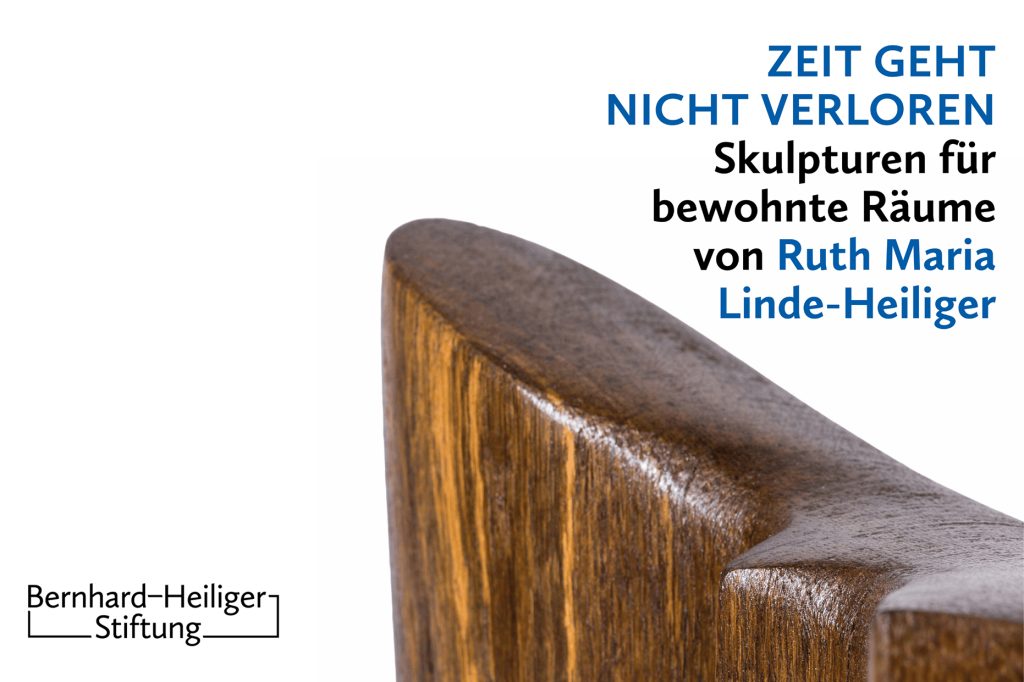
 Image: Maria Linde, Untitled (sculpture), 1993 (detail). Collection Dr. Anita Heiliger, Munich. Photo: Markus Hilbich. Design: Peter Nils Dorén
The Bernhard-Heiliger-Stiftung will open "Zeit geht nicht verloren – Skulpturen für bewohnte Räume von Ruth Maria Linde-Heiliger" ("Time Is Not Lost: Sculptures for Inhabited Spaces") at the Kunsthaus Dahlem in Berlin on the evening of 24 October 2026. The exhibition runs from 25 October to 14 February 2027 and is the first presentation of Linde-Heiliger's wooden sculptures in the former studio of the sculptor Bernhard Heiliger, 30 years after her death.
Ruth Maria Linde was born in Berlin on 18 August 1916 and began sculpting at around 17. She studied with Johannes Itten at the Werkkunstschule in Krefeld and then with Milli Steger in Berlin. In 1938 she met Bernhard Heiliger, whom she married and with whom she had three children, Jutta, Stefan and Anita; the couple later divorced. From 1966 she lived and worked in Osterhever on the Eiderstedt peninsula in northern Germany, in a converted cottage that served as both home and studio. She died in 1996.
Working under the name Maria Linde and usually signing her pieces R.M.L.H., she carved by hand without machines, often using driftwood and wood that she found or was given. Her sculptures frequently take animal or organic forms, among them seals, hares, birds and cats, and most are untitled and undated. The museum places her work within a diverse German tradition of animal sculpture that began with August Gaul in the 19th century and reached a high point in the 20th with Renée Sintenis in Berlin and Ewald Mataré in the Rhineland.
The works on view come from the collections of her children and, according to the museum, offer an overview of her sculptural practice. Among them are a seal and a hare, a tall relief and an untitled sculpture from 1993.
At the opening, Prof. Stefan Heiliger will give a welcome address, followed by an introduction from Dr. Friedrich Meschede and Friederike Brüggen, a member of the foundation's board. A catalogue is published by Hatje Cantz, and the exhibition is supported by the Berliner Sparkasse's "Mehr Kultur" programme.