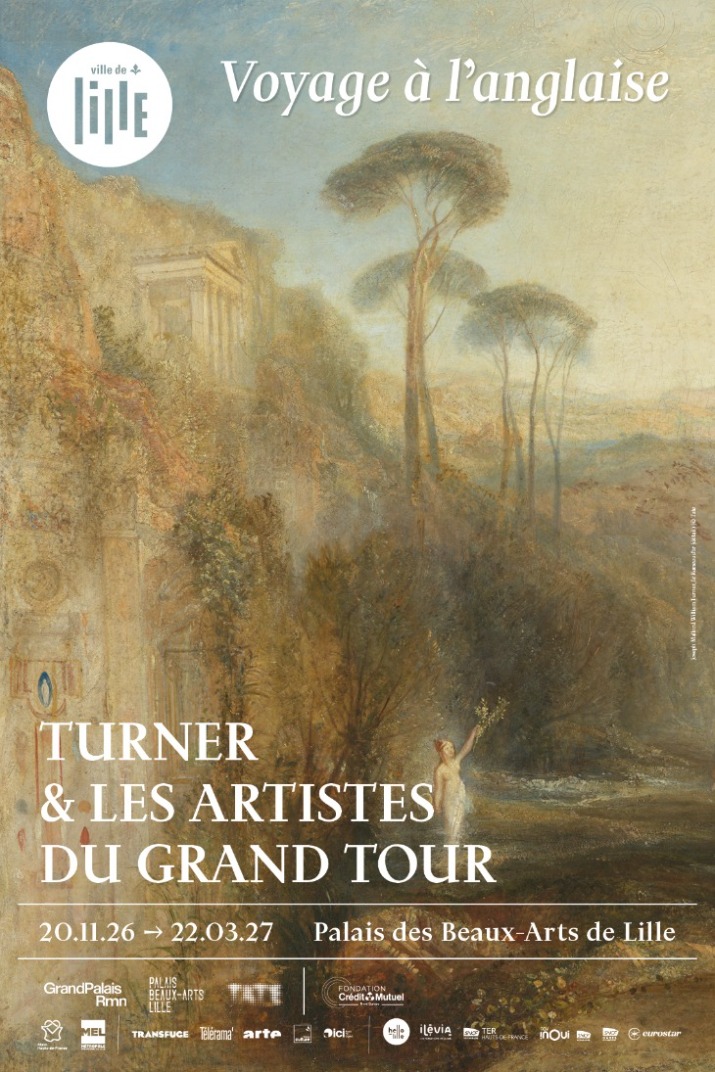
The Palais des Beaux-Arts de Lille will present "Voyage à l'anglaise: William Turner (1775–1851) et les artistes du 'Grand Tour'" (Grand Tourists to Turner: British Artists in Europe) from November 20, 2026, to March 22, 2027. The exhibition follows the British painters who left their island in the 18th and 19th centuries to travel across Europe, and traces how those journeys reshaped landscape painting in Britain.
The Grand Tour was a journey of several months, usually financed by wealthy aristocrats, undertaken to discover foreign landscapes, historic sites and cultures. According to the museum, the color, atmospheric effects and changing seasons the artists encountered in France, Germany and above all Italy had a decisive effect on their work. Watercolor and drawing from life gave them a way to record their heightened response to these new surroundings, and their works point toward Romanticism and anticipate Impressionism.
Turner is at the center of the show, with 18 works by the artist himself and 16 from his studio. Around him the exhibition brings together John Robert Cozens, Francis Towne, Thomas Jones, Joseph Wright of Derby and Richard Wilson, a generation the museum describes as unjustly overlooked in France. The focus is on how travel to unfamiliar places changed the way these painters saw and worked. The museum notes that Turner's work is rarely shown outside British museums, which hold most of it.
The exhibition is the result of a partnership between Tate Britain and the Palais des Beaux-Arts / Ville de Lille, with support from the Fondation Crédit Mutuel Nord Europe, and is coproduced with GrandPalaisRmn. Its scientific curator is David Blayney-Brown, honorary chief curator at Tate Britain; general curators are Juliette Singer, director of the Palais des Beaux-Arts and the Musée de l'Hospice Comtesse, and Alex Farquharson, director of Tate Britain, with Alice Fleury, the museum's director of collections, as associate curator.
An accompanying program of concerts, screenings, talks and guest appearances will turn the exhibition period into what the museum calls an "English season."