 Image: Lougher Contemporary, Bristol
In 1986, David Hockney used an office colour photocopier as both camera and printing press, feeding Arches Text Wove paper through the machine to create his experimental Home-Made Prints. The process made the copier serve two functions at once: it operated as the device that captured the image and as the press that transferred it to paper.
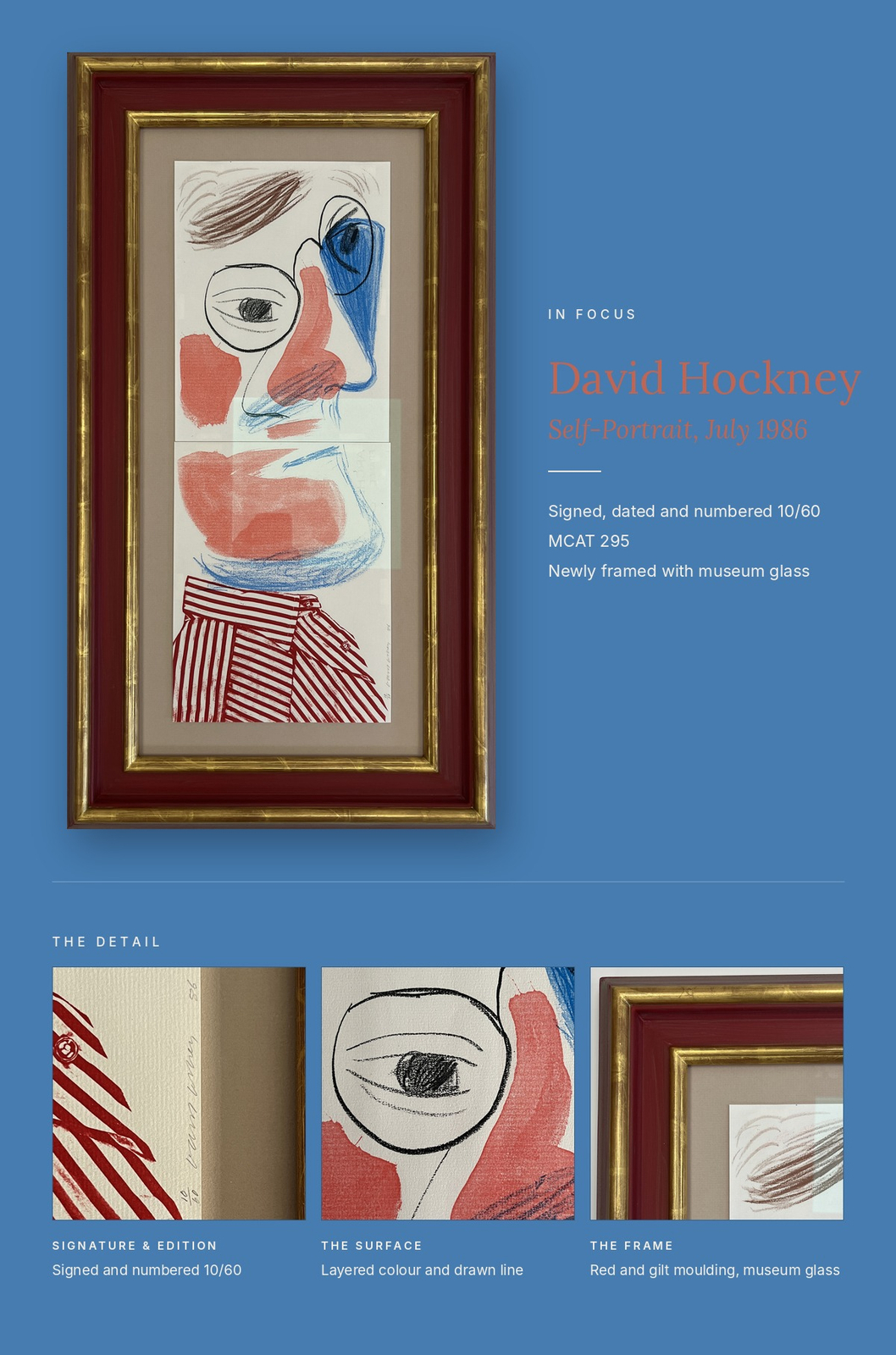
Because the copier could print only on small sheets, Hockney composed 'Self-Portrait, July 1986' across two sheets of Arches paper.
The result is described as having the richness, texture and presence of a lithograph, rather than the flat, utilitarian quality associated with an office copy.
'Self-Portrait, July 1986' is intimate and saturated with colour, capturing Hockney in the act of looking and making.
Home-Made Prints are presented as among the most inventive works of Hockney’s career and as a direct forerunner of the iPad drawings that followed decades later.
The work is a signed and dated 1986 print from an edition of 60, with impressions held by the Smithsonian’s National Portrait Gallery and LACMA. Those institutional holdings identify examples of the print in the collections of both museums.