 Image: Aomori Museum of Art
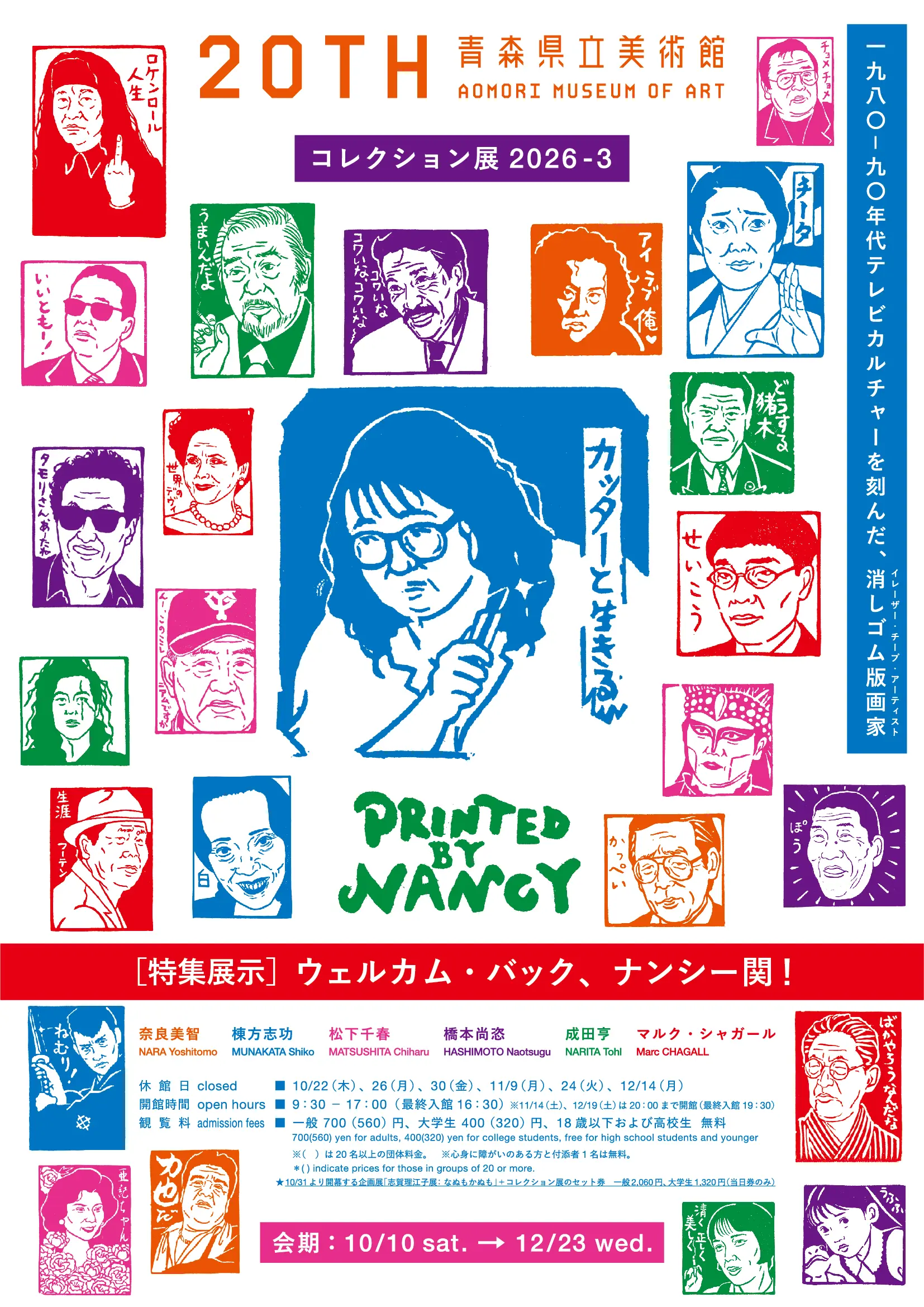
It will be the museum’s first exhibition of Seki’s work since her work appeared in the 2011 exhibition ‘Art of Aomori.’
Seki combined sharp, accessible writing that invited laughter with eraser portraits inserted beside her columns, creating a distinctive form of criticism. The exhibition is aligned with a digital-archive project launched in 2025 amid concern that Seki’s eraser stamps may deteriorate; the project is a joint initiative of the Nancy Seki Bon Research Institute and Kyoto Institute of Technology KYOTO Design Lab.
Hideki Mochizuki, the archive project’s representative, describes preserving Seki’s work as also preserving an archive of television culture. During the intervening period, the media environment changed rapidly through the spread of streaming services and social media and the emergence of AI, while people’s disengagement from television progressed.
Born in Aomori City in 1962, Seki began publishing eraser prints and short texts in 1985; more than 5,000 of the eraser prints she produced during her lifetime survive, and she died in 2002 at the age of 39. The exhibition presents eraser stamps that Seki made during her lifetime and related materials, introducing the eraser prints alongside works by an Aomori printmaker.