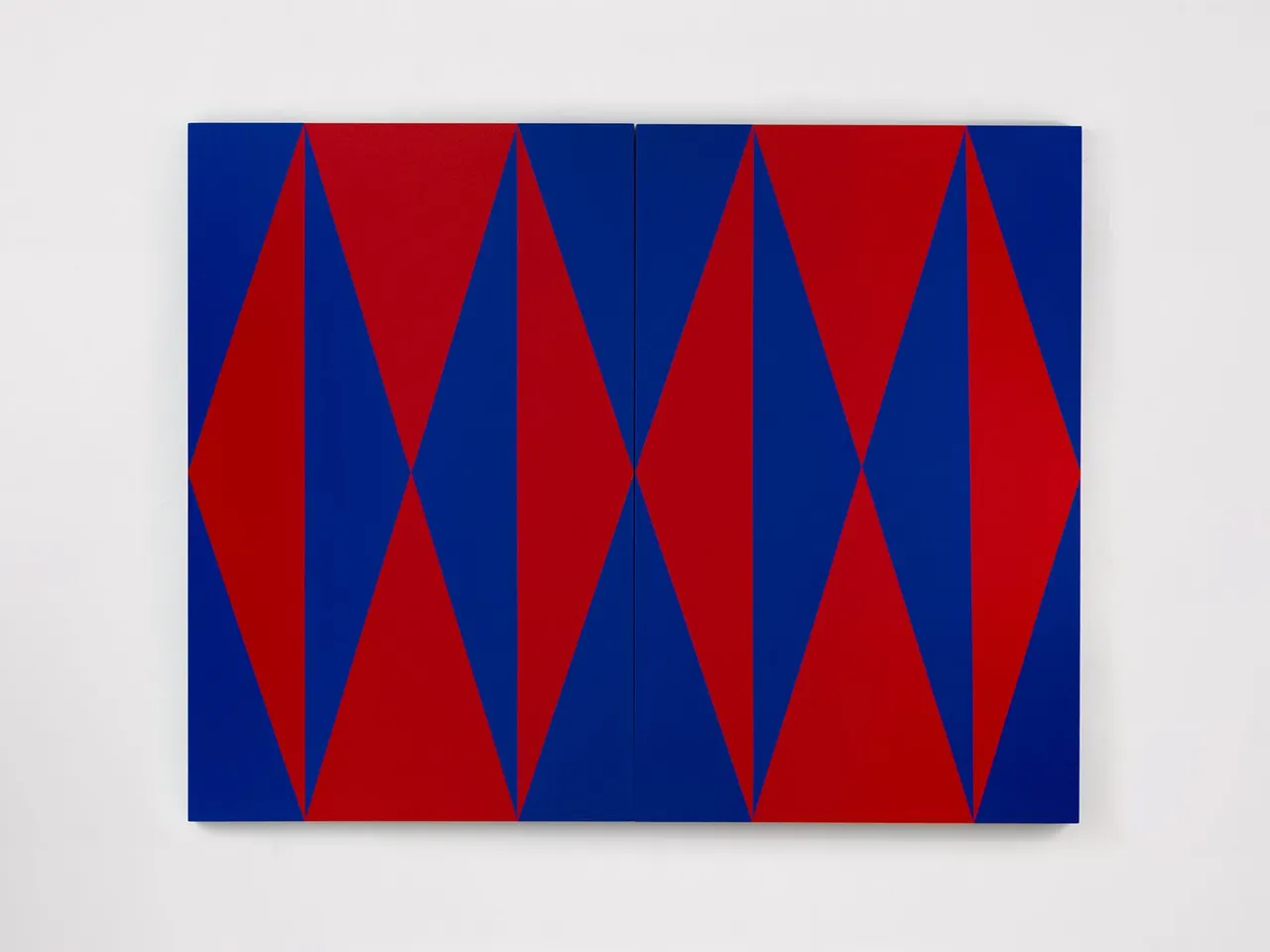
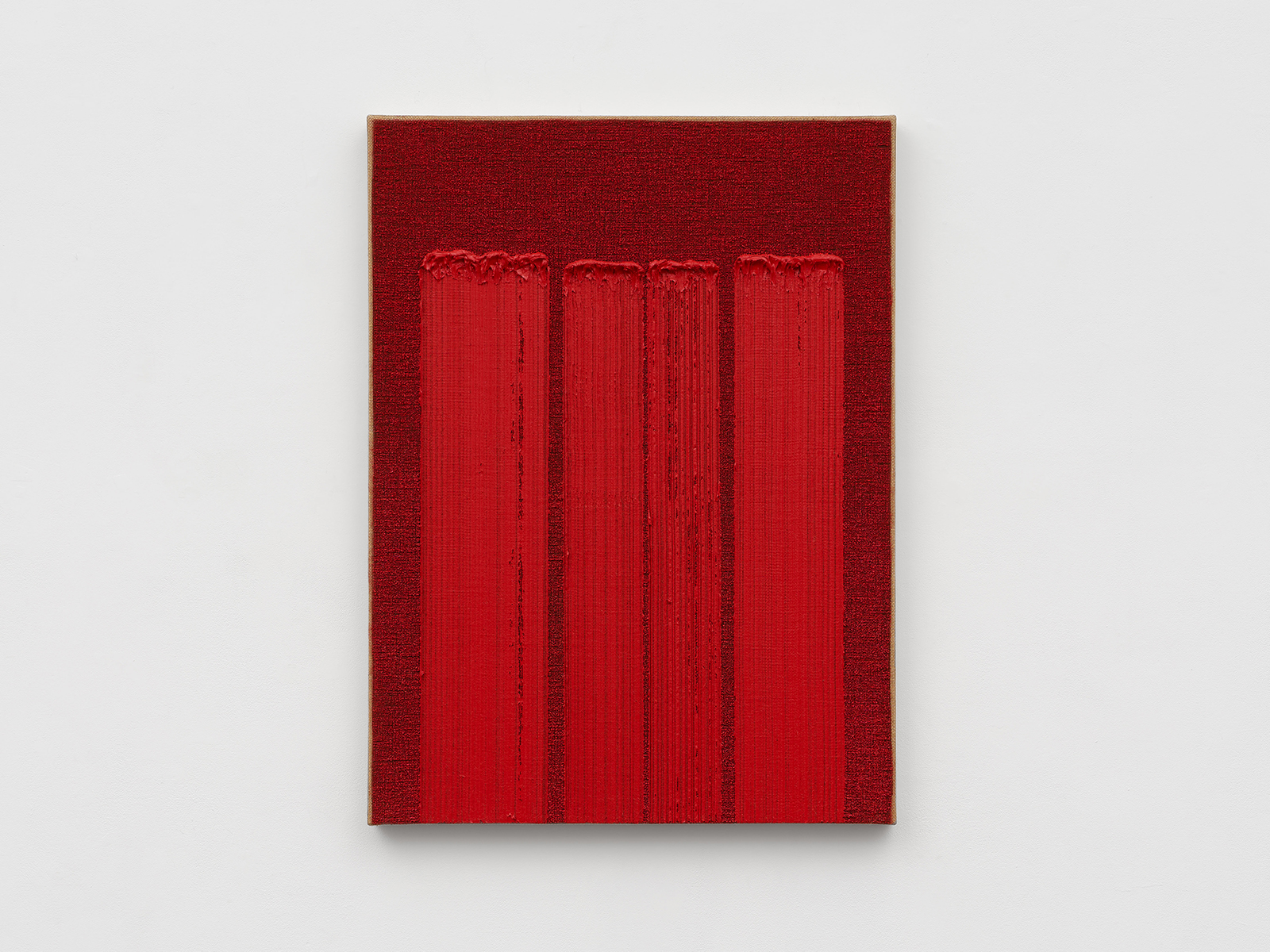
 Image: Ha Chong-Hyun, Conjunction 20-118, 2020, Oil on hempcloth, 130 x 97 x 5.5 cm; © Ha Chong-Hyun
Lisson Gallery opens a survey of Ha Chong-Hyun’s work in London on 24 September, running until 7 November 2026. It is the Korean painter’s first exhibition with the gallery and his first in the city since 2020, and it reaches back across six decades to include some of the earliest work by him that still exists.
The first room sets out where he began. A geometric piece built from woven and painted strips, drawn from his early Naissance works, hangs alongside a folded and rippled canvas from the late 1960s. Lisson reads both as evidence that he was already treating a painting as an object to be examined from every side, while noting that he never described them as sculpture: the question he was putting was where a painting’s surface stops and its support starts.
Works from the 1970s push harder at the material itself. He burned thickly loaded surfaces and fixed coiled springs and barbed wire into them. The gallery connects these directly to conditions in South Korea at the time — long stretches of martial law and military rule — and to how little in the way of materials was available to artists.
The method he settled on at the start of that decade is what the exhibition centres on. Working from behind a coarse hemp canvas, he forces oil paint through the weave rather than laying it onto the front. What appears on the visible side is shaped by how the cloth resists the pressure, so the result owes more to compression and persistence than to any gesture of the brush. He has continued this line of work, gathered under the title Conjunction, ever since, varying texture, tone and the direction in which the paint travels.
From the 2000s the gallery identifies a further phase, described as Post Conjunction, which opens out colour, scale and spatial rhythm while keeping the same principle of pressure against surface.
Ha was born in Sancheong, South Korea, in 1935 and graduated from Hongik University in 1959; he has worked in Seoul ever since. In 1969 he became a founding member and chairman of the Korean Avant-Garde Association. He was later counted among the figures of Dansaekhwa, the Korean monochrome tendency, though Lisson records that he was never persuaded by the way that term was defined.
A retrospective of his work opens at the Asian Art Museum in San Francisco the day after this show, on 25 September, and remains on view there until 25 January 2027.