 Image: Aichi Prefectural Ceramic Museum
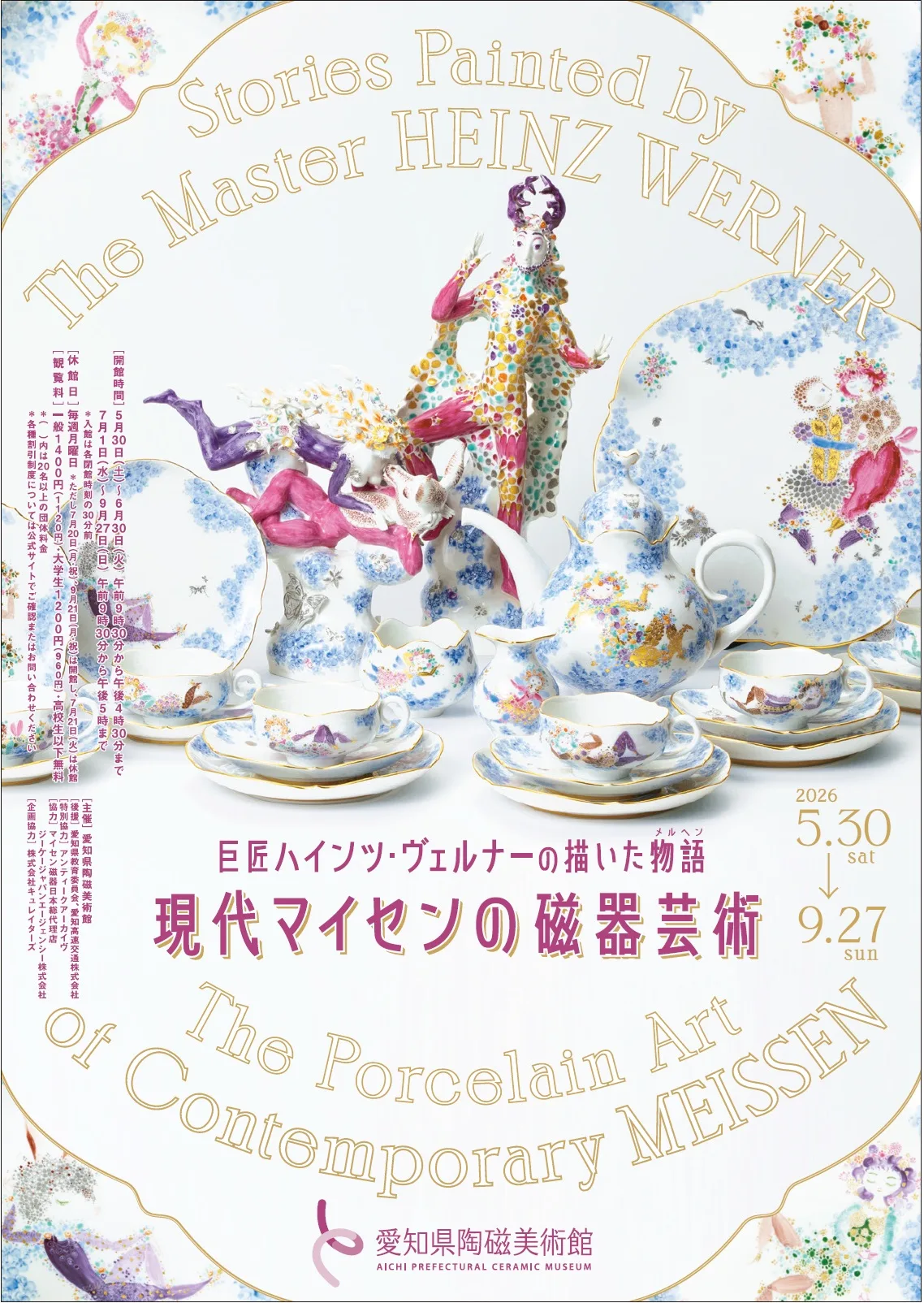
The Aichi Prefectural Ceramic Museum in Seto is presenting 'Stories Painted by The Master HEINZ WERNER: The Porcelain Art of Contemporary MEISSEN' through September 27, 2026, with the museum describing it as the first exhibition to focus on Heinz Werner, a key designer associated with modern Meissen porcelain. The show runs in Exhibition Rooms 1-A and 1-B and is being presented as the largest version of the touring exhibition to date, with additional works added at the Seto venue.
The exhibition centers on Werner, who lived from 1928 to 2019, and on the modern Meissen tradition that developed from around 1960. According to the museum, Meissen—founded in the Saxon town of the same name in the 18th century—became Europe’s first porcelain manufactory, and later generations built on that legacy with technically advanced porcelain that combined modeling, design and figural work. The museum frames these works not simply as decorative objects, but as examples of what it calls porcelain art.
Among the series and objects featured are 'Arabian Nights', 'Summer Night' and 'Blue Orchid', along with service ware and plaque works designed by Werner. The museum notes that Werner trained at the Meissen school, which it says was established in 1764 as a branch of the Dresden Academy of Art, and later went on to design a range of signature works. The exhibition also places his output in relation to earlier Meissen history, showing 18th-century examples alongside Japanese Imari ware and other source material that informed Meissen’s early development.
A recurring theme in the exhibition is Werner’s connection to Japan. The museum quotes him as having said, “Japan is my second home,” and says he created designs inspired by Japanese motifs. The exhibition also includes works tied to literary and imaginative themes, including the Shakespeare-inspired 'Summer Night' tea service and the fairytale-driven 'Munchausen (Baron Munchausen)' coffee service. Other highlighted pieces include 'Hunting', 'Vision', 'Aphrodite', 'Impression', 'Masquerade' and 'Dragon Melody'.
The exhibition is structured into a prologue and four chapters: the birth of the famous kiln, the early development of Werner’s career, the era of major series, a period focused on light and color, and an epilogue on his later years and the continuation of his influence. The museum says Werner began with early 1960s works and later moved toward designs in which vivid color, line and surface play a larger role. It also notes that he visited Japan for the first time in 1975 and created works depicting Japanese scenery.
The museum is also offering a set of related programs. These include a commemorative talk on May 30 with Masaki Arakawa of Gakushuin University and Tatsuya Katsukawa of Antique Archive, gallery talks on June 6, July 3 and August 9, and family and café programs tied to the exhibition. A hands-on food program called 'The Charm of German Cuisine Invited by Meissen' has already closed for applications, while the café event 'The Charm of Heinz Werner’s Coffee Cups' is scheduled for September 21 with advance registration. Admission is 1,400 yen for adults and 1,200 yen for university students, with free entry for high school students and younger.