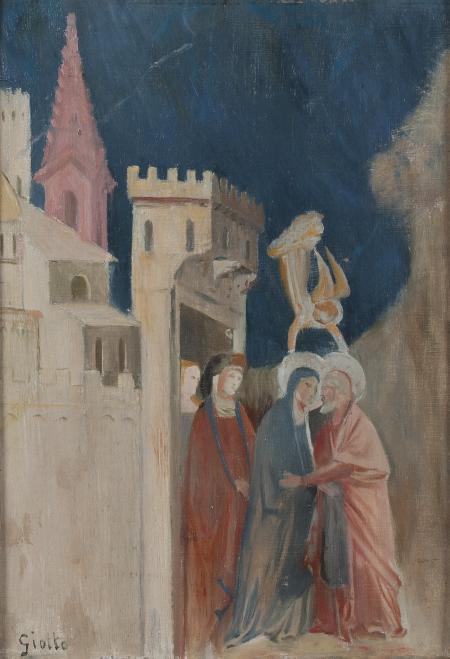
 Image: Cau Ferrat Museum, Sitges
The Cau Ferrat Museum in Sitges is highlighting a small oil painting by Santiago Rusiñol, 'L’abraç de Sant Joaquim i Santa Anna', a 1894 copy of a fragment from Giotto that now belongs to the museum’s collection. The work measures 38.5 by 27 centimetres and is identified in the museum’s materials as part of the Santiago Rusiñol collection under inventory number 32.015. The museum presents the painting as one of the copies that are central to the character of Cau Ferrat, where reproductions acted, in the institution’s words, like windows opening onto major moments in Western art history.
According to the museum text, Rusiñol made the copy in Florence during the spring of 1894, while on a journey through Tuscany that also took him to Pisa and Fiesole. The visit formed part of his wider engagement with medieval Italian art, and especially with the artists grouped around Giotto, Gozzoli and Orcagna. The museum says Rusiñol and Ignacio Zuloaga were searching for the mystical and metaphysical qualities they associated with the Italian primitives, and that many of the reproductions now hanging in the Cau Ferrat came from that trip.
'L’abraç de Sant Joaquim i Santa Anna' depicts a scene from the lives of Saints Joachim and Anna, known as 'The Meeting at the Golden Gate', a subject that was popular in mural painting of the 13th and 14th centuries. The source text notes that although the copy carries a Giotto signature, the original work is not by Giotto. Instead, the museum cites attribution to Nardo di Cione, brother of Orcagna, or, according to another theory, to a member of his workshop. The painting’s subject also appears in Giotto’s more famous cycle in Padua, but the Sitges copy refers to the Florentine version Rusiñol saw during his travels.
The museum’s account places the painting in the Basilica of Santa Maria Novella, where Rusiñol is said to have been fascinated by the setting and by the frescoes and altarpieces he encountered there. Guided by an unnamed Italian artist he knew in Paris, Rusiñol visited the Green Cloister, the Capellone degli Spagnoli and the Chiostrino dei Morti. It was under the vault of the Chapel of Saint Anna, the museum text says, that he set up his easel to copy the scene. The passage links the work to the atmosphere of cloisters and cemeteries that Rusiñol found especially evocative in Florence.
The museum also uses the painting to point to broader questions in art history. Its text notes that at the end of the 19th century Nardo di Cione was little known, before later scholarly debates on the attribution of medieval painting complicated earlier assumptions about Giotto’s authorship. In that period, Giotto was still widely regarded as the driving force behind major innovations in early Italian painting. The museum’s discussion suggests that Rusiñol, visiting Florence before those debates fully took shape, likely accepted attributions that later scholarship would challenge.
Cau Ferrat’s presentation of the work underlines Rusiñol’s role not only as an original painter but also as a copyist who studied technique through replication. The museum says most of the Italian reproductions in the house collection are his own work. As part of the September 2016 'La Peça del Mes' feature, 'L’abraç de Sant Joaquim i Santa Anna' is framed as one of the clearest examples of how Rusiñol’s Florentine pilgrimage shaped the visual identity of the museum’s collection.