 Image: Charles Hosmer Morse Museum of American Art, Winter Park
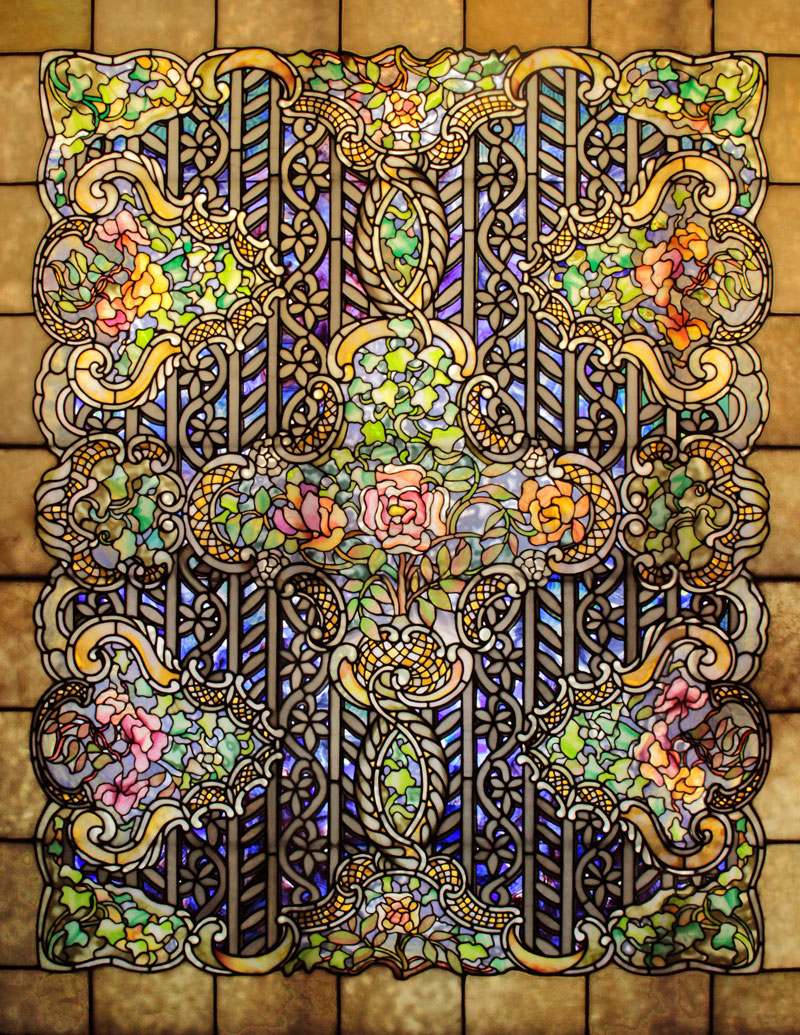
The Rose window is currently on view in the exhibition ‘Breaking Tradition: Distinguishing American Stained Glass.’ It is part of the Morse collection. The leaded-glass work was made by Tiffany Studios in New York, designed by Louis Comfort Tiffany, and dated circa 1910.
Its design features intricate floral motifs, Rococo elements, and delicate lace-like patterns. Those lace-like patterns are reminiscent of study photographs collected by Louis Comfort Tiffany.
In 1935, the Louis Comfort Tiffany Foundation purchased the Rose window from Tiffany Studios and installed it in a stair hall at Laurelton Hall. Laurelton Hall was in Long Island, New York, and the window’s recorded setting identifies it specifically with the property’s stair hall.
The work was exhibited at numerous salons, societies, and world’s fairs, including the Jamestown Ter-Centennial Exposition in Norfolk, Virginia, the Salon of the Société des Artistes Français in Paris, and the Chicago Architectural Club. These appearances gave the window exposure to potential clients.
In the 1870s, Louis Comfort Tiffany and John La Farge began experimenting with opalescent glass, a semi-opaque, light-diffusing material used primarily in pressed-glass tableware. When adapted to new American glass windows, opalescent glass radically transformed the industry.