 Image: David Krut Projects, New York
David Krut Projects has published a new account of William Kentridge’s 'Headlines', a woodcut portfolio developed in 2025 that revisits the Dada movement and its challenge to the authority of wartime language. The series takes its cues from the historical conditions of 1916, when artists in Zurich formed Dada as a rejection of the logic, nationalism and cultural systems that had contributed to the First World War.
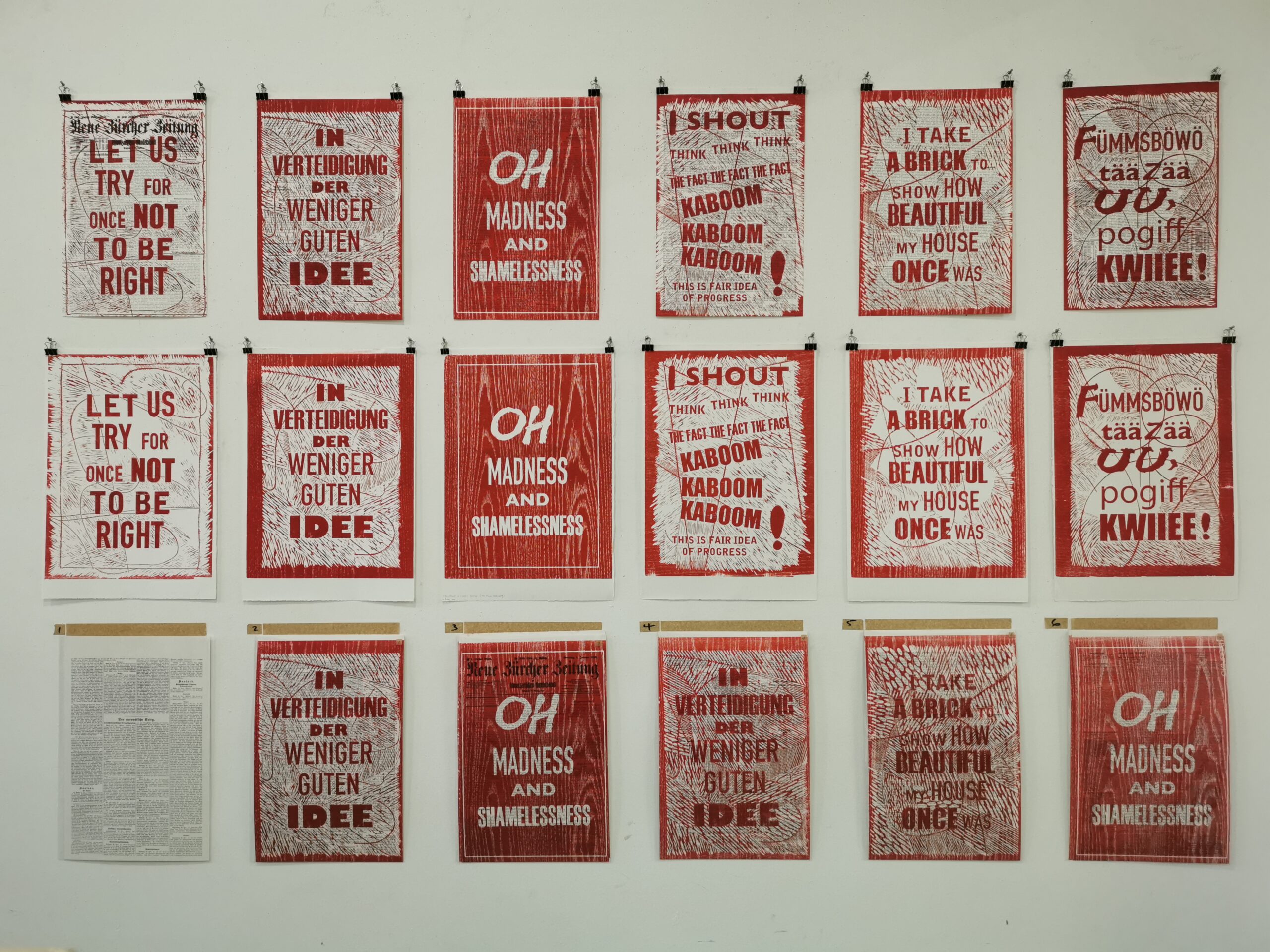
According to the project text, 'Headlines' transforms newspaper pages into what the gallery describes as sites of visual protest and critical reflection. The prints use oversized typography, fractured headlines and a graphic immediacy linked to street posters, protest banners and revolutionary pamphlets. Rather than preserving the newspaper page as an untouched record, Kentridge breaks it apart, turning the headline into something unstable, theatrical and open to interruption.
The portfolio was developed through a collaboration involving master printer Sbongiseni Khulu of the David Krut Workshop in Johannesburg, Lightfarm Studios in Braamfontein, the Swiss newspaper Neue Zürcher Zeitung, and the Hamburg-based international art organization P-ART, which coordinated the exchange. The works are printed over digital reproductions of a Neue Zürcher Zeitung page dated 1 February 1916, anchoring the series to the period when Dada first emerged publicly at Zurich’s Cabaret Voltaire.
'Headlines' consists of six large-format, text-based woodcuts: 'Let Us Try For Once Not To Be Right', 'In Verteidigung der Weniger Guten Idee', 'Oh Madness and Shamelessness', 'I Take a Brick to Show How Beautiful My House Once Was', 'KABOOM KABOOM KABOOM!', and 'Fümmsböwö tää zää.' The texts draw on avant-garde sources associated with Dada and its orbit, including Tristan Tzara’s Dada manifesto, Kurt Schwitters’ sound poem 'Ursonate', and a line by Bertolt Brecht.
The project text says that all but one of the six woodcuts were fully hand-carved into blocks of white ash and oak. The exception, 'In Verteidigung der Weniger Guten Idee', includes laser engraving around the text as well as hand-carving, which was used to compare methods before the rest of the series was carved entirely by hand. Kentridge also drew onto the woodcuts before carving began, leaving his red pencil line as part of the works’ final surface.
David Krut Projects describes the series as operating in the tradition of political print and public address, with the headline format echoing the voice of authority while simultaneously fragmenting it. The gallery’s text links the works to Dada’s impulse to dismantle language in order to expose how meaning is manufactured, and to the broader history of woodcut as a medium associated with pamphlets, posters and agitation. The article was posted by David Krut Projects on 20 May 2026.