 Image: The Huntington Library, Art Museum, and Botanical Gardens, San Marino
The Huntington Library, Art Museum, and Botanical Gardens has acquired and opened for research an archive documenting the Integratron, the domed Mojave Desert landmark conceived by George Van Tassel, and the postwar UFO community that developed around him in Southern California. The collection brings together architectural plans, photographs, audio recordings, film footage, books, and other records spanning the history of a structure where aerospace, experimental architecture, alternative spirituality, wellness culture, and speculative science intersected.
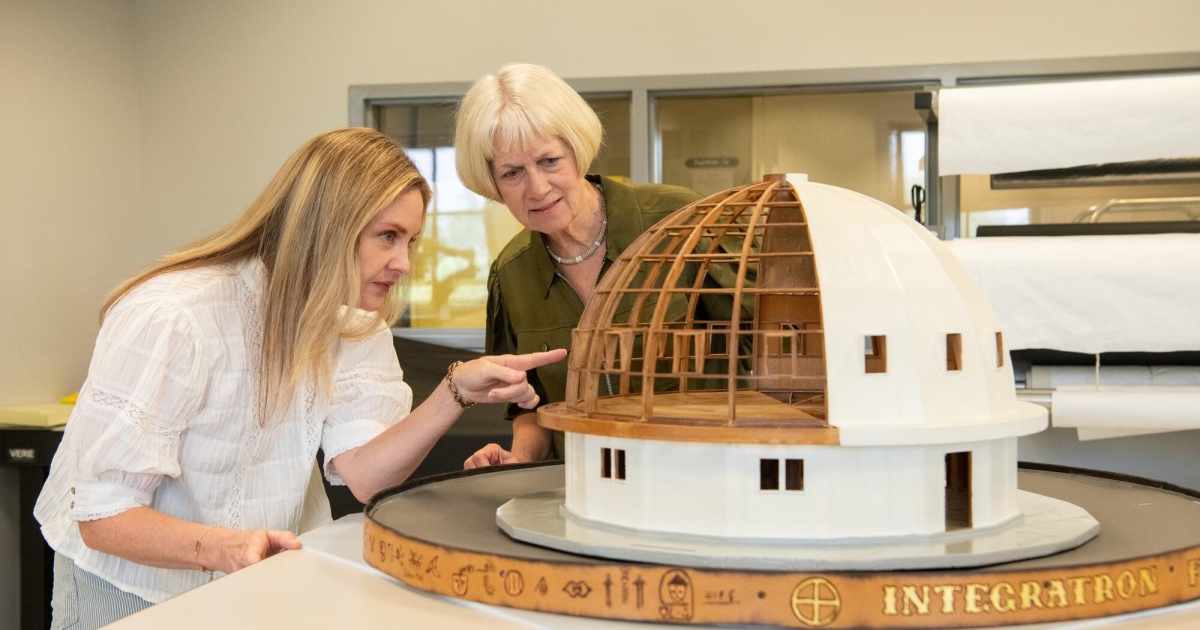
Known as the ‘McKinney Collection of George W. Van Tassel Papers,’ the archive is focused principally on the 1950s through the 1970s, although its materials span the 1910s through the 1990s. It includes an architectural model, six blueprints, approximately 630 photographic prints, negatives, and slides, about 250 audiotapes and cassettes, 8 mm film footage, an oil painting, books, and other publications. The audiovisual materials record the ideas and public programs associated with Van Tassel’s College of Universal Wisdom, the organization through which he promoted his teachings and research.
Sandra Brooke Gordon, Avery Director of the Library at The Huntington, said the archive documents “a place unlike any other, where aerospace, architecture, spirituality, and speculative science came together in the Southern California desert.” She added that the materials provide researchers with access to the Integratron and to the broader culture of “technological ambition, alternative belief, and community” that shaped postwar California.
Van Tassel, who lived from 1910 to 1978, worked in Southern California’s aviation industry, including as a test-flight inspector on the Lockheed Constellation aircraft project. He moved to the Mojave Desert in 1947, operated an airport and café near Giant Rock, and began organizing meditation gatherings and programs focused on extraterrestrial contact. From 1954 to 1977, he also organized Interplanetary Spacecraft Conventions at Giant Rock, attracting thousands of visitors each year for lectures and discussions about UFOs, extraterrestrial communication, science, and spirituality.
The Integratron was designed for a site in Landers, near Joshua Tree. Van Tassel hired architect Howard P. Hess to formalize the design in 1954, construction began in 1958, and the primary structure was completed by 1960. The two-story dome stands 38 feet high and measures 55 feet in diameter. Its structural frame contains no metal, instead relying on glue-laminated wood and wooden dowels. Van Tassel claimed that the building could rejuvenate human cells, enable antigravity, extend lifespans, and facilitate time travel, but the machinery required to make it fully operational was never installed.
Erin Chase, The Huntington’s associate curator of architecture and photography, described the Integratron as “a distinctly Southern Californian work of architecture” and said the collection expands the architectural histories preserved by the institution. The archive complements The Huntington’s holdings in aerospace, technological innovation, architecture, the built environment, alternative religious and spiritual movements, and the history and culture of Southern California and the American West. After Van Tassel’s death, the materials were stewarded by Don and Dayle McKinney, who obtained them from George Riddell of the College of Universal Wisdom. The collection is fully processed and available to qualified researchers by appointment through the Huntington Library’s Reader Services. Related programming is scheduled for ‘Strange Science,’ taking place October 30–31, 2026, with architectural historian Daniel Paul and podcast host Jack Wagner discussing the Integratron.