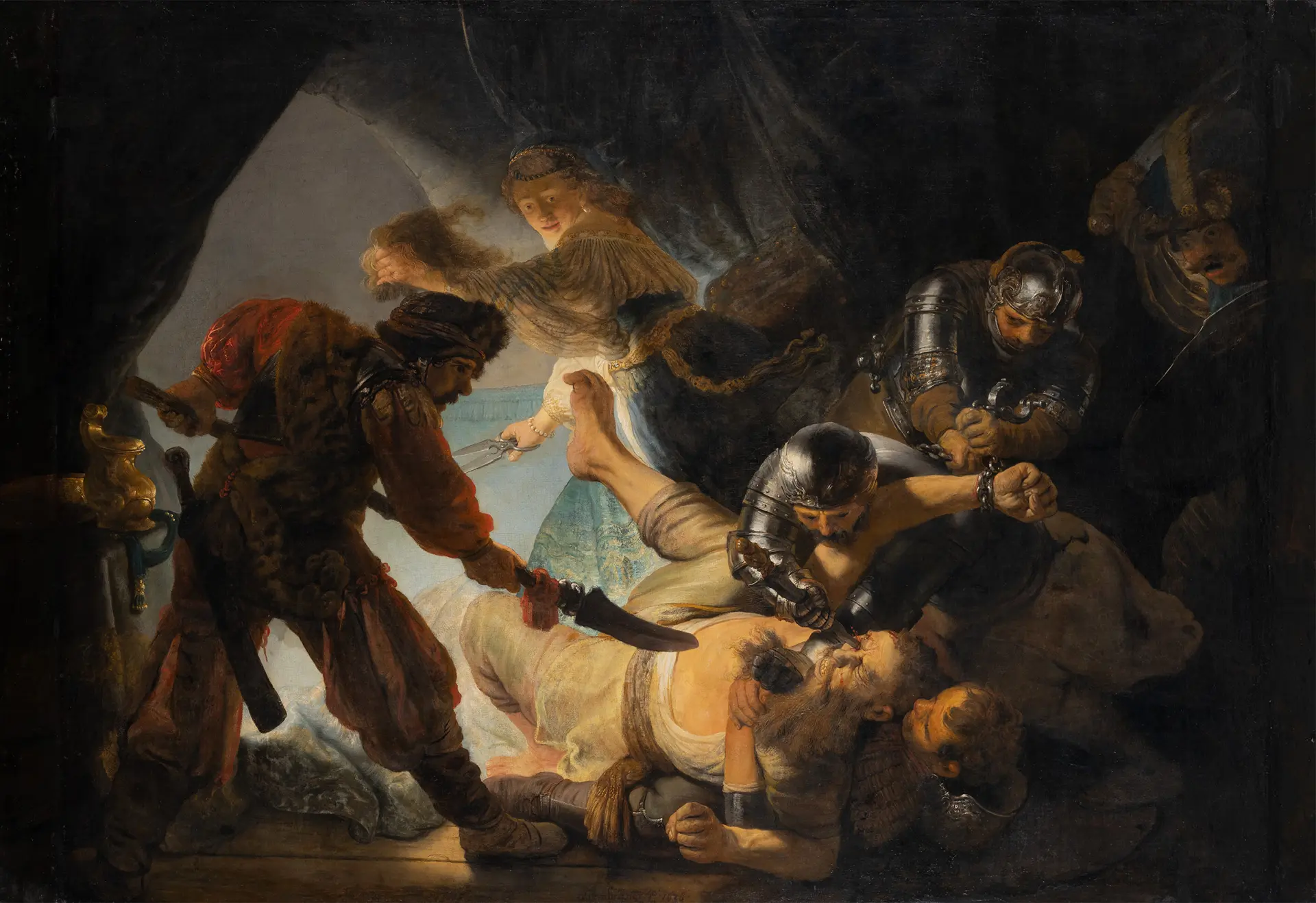
 Image: Rembrandt Harmensz. van Rijn, Die Blendung Simsons, 1636, Städel Museum, Frankfurt am Main
The Städel Museum in Frankfurt has begun conservation and restoration work on Rembrandt Harmensz. van Rijn’s ‘The Blinding of Samson’, a major work in the museum’s collection of 17th-century Dutch painting. The 1636 canvas is being treated to address a yellowed and darkened varnish layer, a fine network of cracks and several modern retouches that have affected its appearance.
The museum said the treatment is intended to make the painting’s original brilliance and contrasts more visible, bringing its presentation as close as possible to Rembrandt’s artistic intentions for a work that is nearly 400 years old. The conservation is being carried out by Stephan Knobloch and Linda Schmidt in the museum’s restoration workshop. No completion date has been announced.
‘The Blinding of Samson’ depicts the climax of the biblical account of Samson and Delilah. Samson, whose extraordinary strength is attributed to his uncut hair, has revealed his secret to Delilah, who cuts his hair while he sleeps and summons his enemies. Rembrandt captures the moment when the attackers overpower Samson, chain him and blind him, while Delilah remains nearby with the scissors and the severed hair.
The Städel’s account of the work emphasizes the painting’s tightly concentrated drama and psychological detail. Samson’s physical pain is conveyed through the violent movement of his body, while the expressions of Delilah and the surrounding figures combine surprise, triumph and horror. The scene’s theatrical intensity has been linked by the museum to contemporary Amsterdam, where public theatre was gaining prominence; the Schouwburg, designed by Jacob van Campen, opened in 1637, one year after the painting was completed.
The biblical subject also carried historical resonance in the Dutch Republic. The museum notes that scenes from the Old Testament were especially popular during Rembrandt’s period, when the Dutch viewed their prolonged struggle against Spanish rule through the lens of narratives about a chosen people overcoming a seemingly stronger enemy. The story of Samson likewise combines betrayal and defeat with a later reversal, as the hero’s strength returns and he brings down his enemies at the cost of his own life.
The need for treatment became apparent in the painting’s upper varnish layer. According to the Städel, the varnish had yellowed and darkened over time and had developed a microscopic crack pattern. The edges of these cracks refract and scatter incoming light, creating a thin grey veil that is particularly visible in the darker passages. Modern retouches also interfere with the work’s overall aesthetic effect. Scientific investigation accompanying the restoration includes micro-X-ray fluorescence scanning, or µ-XRF, with the museum publishing workshop and examination images as part of its documentation.
The conservation and restoration of ‘The Blinding of Samson’ is supported by the Bank of America Art Conservation Project. The Städel Museum is located at Schaumainkai 63 in Frankfurt am Main, where the painting forms part of the institution’s Old Masters holdings. The museum plans to return the work to permanent public display once the treatment has been completed.