 Image: Kumamoto Prefectural Museum of Art
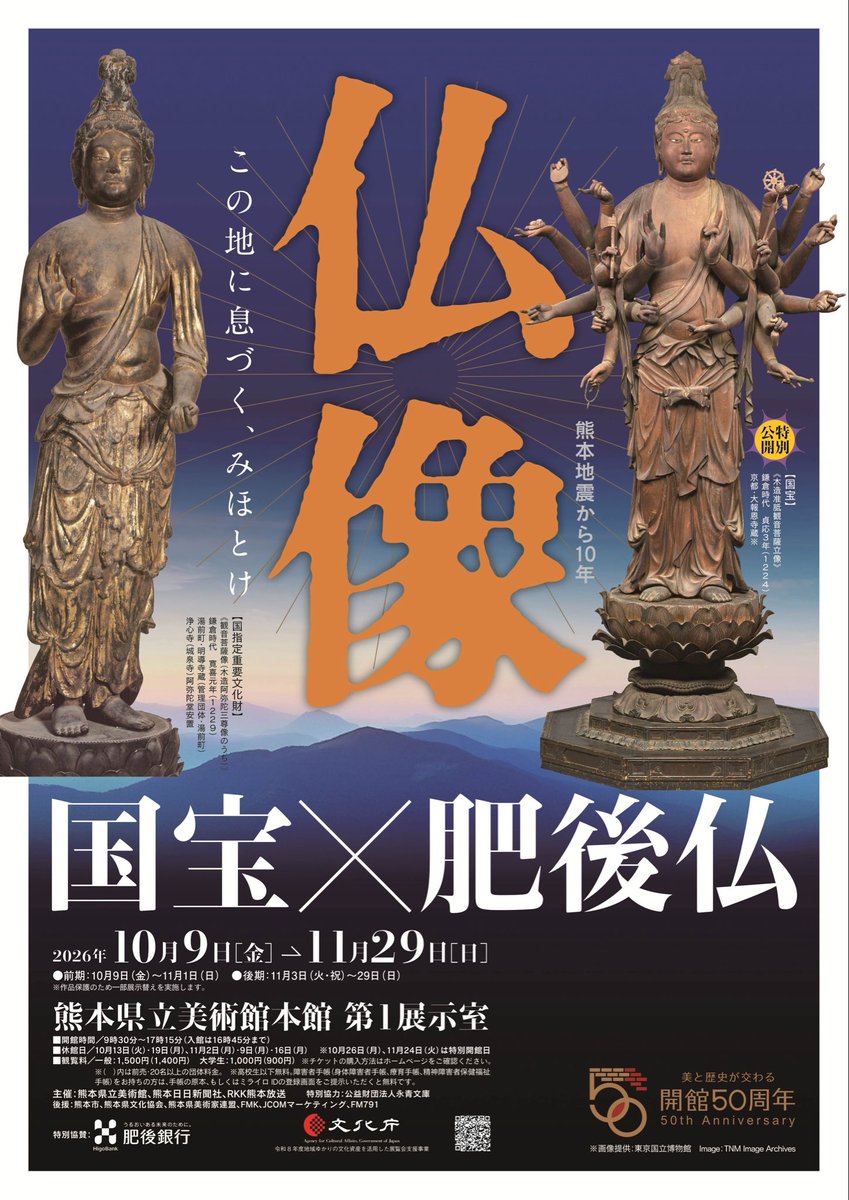
The Kumamoto Prefectural Museum of Art will present ‘Buddhist Sculptures: National Treasure × Higo Buddhist Sculpture—10 Years Since the Kumamoto Earthquake,’ an exhibition bringing together Buddhist sculptures connected with Kumamoto and a National Treasure from Kyoto. The exhibition will run from October 9 to November 29, 2026, in Gallery 1 of the museum’s Main Building in Kumamoto, Japan.
The presentation marks the museum’s 50th anniversary. Since shortly after its opening in 1976, the institution has investigated objects handed down through temples and shrines across Kumamoto Prefecture. According to the museum, that research has documented Buddhist sculptures that have attracted devotion across generations, as well as changes in the forms and practices of worship associated with them.
A central work will be the National Treasure ‘Standing Wooden Cundi Bodhisattva,’ made by Higo Jōkei in 1224 during the Kamakura period and held by Daitoku-ji’s Daihōon-ji in Kyoto. The museum describes the sculpture as a National Treasure with deep connections to medieval Higo, the historical region corresponding broadly to present-day Kumamoto. It will be shown alongside selected works identified through the museum’s research into Buddhist sculpture in the prefecture.
The planned loans and displays include the Important Cultural Property ‘Stone Bodhisattva in Half-Lotus Position,’ dating to sixth-century Northern Wei China and held by Eisei Bunko in Tokyo. Other works include the ninth-century ‘Standing Wooden Jizō Bodhisattva’ from Kōhei-ji in Yamaga, which will be displayed only during the first period; the Important Cultural Property ‘Seated Wooden Amida and Standing Attendants,’ made by Jitsumyō in 1229 and held by Myōdō-ji in Yunomae; and the sixteenth-century ‘Standing Wooden Thousand-Armed Kannon Bodhisattva’ by Genchiku, from the former R立福寺 Kannon Hall in Kumamoto. The planned display also includes a 1409 bronze hanging image of Fudō Myōō with Bishamonten attendants from Aoi Aso Shrine in Hitoyoshi.
The exhibition is framed around the 10th anniversary of the 2016 Kumamoto earthquake and the continuing work of protecting cultural properties during disasters. The museum notes that cultural-property rescue operations have involved cooperation among specialists inside and outside the prefecture, with its research contributing to the initial assessment of damaged objects. The exhibition will also address the people who have preserved these sculptures and the role of the objects as records of local communities and their histories.
The exhibition’s first display period runs from October 9 through November 1, followed by a second period from November 3 through November 29. The museum will be open from 9:30 a.m. to 5:15 p.m., with admission ending at 4:45 p.m.; the published schedule includes several closure dates and two special opening days. Related programming includes a November 8 lecture by Daiki Inoue, a Cultural Affairs Agency cultural-property investigator, gallery talks, a museum seminar led by curator Keisuke Manno, a sutra-copying workshop and a children’s workshop combining Buddhist-figure costumes with bead-making.