 Image: The Bookstore, National Gallery of Canada, Ottawa
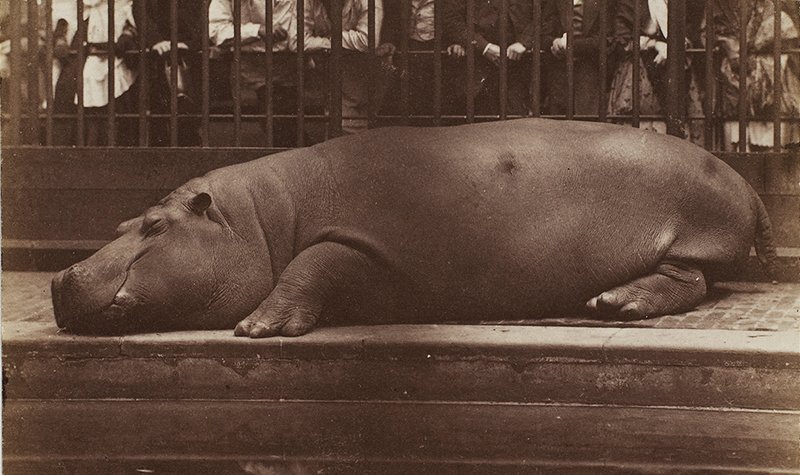
The National Gallery of Canada has published a collection feature on Count de Montizón’s 1852 photograph ‘The Hippopotamus at the Zoological Gardens, Regent’s Park’, examining the early photographic techniques used to portray London Zoo’s first hippopotamus and the public fascination he inspired. The salted-paper print, held by the National Gallery of Canada in Ottawa, records an animal whose arrival became a major attraction in Victorian London.
Obaysch reached the Zoological Gardens on 25 May 1850 after being captured on the island from which he took his name. His journey to England began in 1849, when he was loaded onto a specially built boat and transported up the Nile to Cairo. There, he was kept in a yard at the British consulate while arrangements were made for his passage to Britain. The animal was presented to Queen Victoria by Abbas Pasha of Egypt through the diplomatic efforts of Sir Charles Augustus Murray, then British consul general.
According to the National Gallery’s account, Obaysch became unexpectedly tame and formed a particular attachment to his trainer, Hamet Saaffi Cananna. Murray described the young hippopotamus as “as tame and playful as a Newfoundland puppy,” adding that he recognized his keepers and followed them around the courtyard. His popularity helped reverse declining public interest in the zoo, with attendance rising to approximately 10,000 visitors a day.
The craze surrounding the animal became known as “hippomania.” Obaysch appeared in drawings, inspired silver hippopotamus souvenirs and was even commemorated in a polka written in his honour. The phenomenon demonstrates how a single zoological display could become a broad cultural subject, circulating through popular entertainment, consumer objects and the new medium of photography.
Montizón’s image also documents the technical development of nineteenth-century photography. The print was made from a wet-plate collodion negative using a “double lens” and “instantaneous exposure,” a method described by the French photographer Louis Alphonse de Brébisson in an 1853 publication. The relatively short exposure times made the process suitable for photographing live animals. In Montizón’s composition, Obaysch lies beside a pool, his reflection visible in the water, while visitors appear behind the bars separating them from the zoo’s inhabitants.
The photographer was born Don Juan Carlos María Isidro de Borbón in Madrid in 1822 and adopted the name Count de Montizón; he was also known as Mr. Montfort. A founding member of the Royal Photographic Society of Great Britain, he published in the society’s journal and contributed at least 166 photographs to exhibitions. Most of his subjects were animals, apart from a small number of copies of paintings. ‘The Hippopotamus at the Zoological Gardens, Regent’s Park’ was later reproduced as plate 9 in ‘The Photographic Album for the Year 1855’. The National Gallery acquired the 11.2-by-12.4-centimetre print in 1973.