 Image: Brattleboro Museum and Art Center
Richard Haynes’s exhibition ‘Learning to See’ is on view at the Brattleboro Museum & Art Center in Vermont through November 1, 2026. Bringing together paintings, drawings and photographs, the exhibition examines racial perception, human connection and the possibility of seeing others without condition. Haynes’s work transforms histories of division into images of unity, compassion and shared experience.
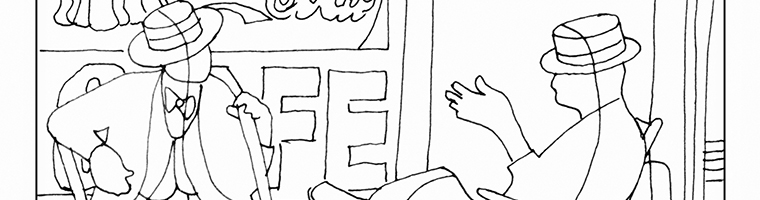
The exhibition centers on Haynes’s sustained inquiry into how people look at—and understand—one another. In his figurative works, he often leaves out facial and racial details or replaces naturalistic skin tones with colors drawn from the rainbow. These choices challenge the idea that vision is neutral, suggesting instead that perception is shaped by personal experience, cultural background and knowledge. As Haynes writes in the exhibition’s curatorial text, “When we learn to really look one another in the eye, I will start drawing people with eyes.”
Haynes’s approach developed from his own experience of feeling invisible as a Black man, despite his service in the U.S. Air Force and accomplishments as a commercial photographer. The museum’s account of the exhibition also describes a period of profound despair, followed by a renewed sense of purpose through faith and community. He began making images of the world as he wanted it to be: vibrant, compassionate and whole.
That idea of wholeness appears in Haynes’s newest works, including circular paintings whose forms evoke the world itself. The series ‘World Leaders in Moral, Spiritual Decline’ addresses war, famine, displacement and persecution, while questioning the ability of political leaders to resolve such crises. Haynes’s work instead points toward collective action grounded in compassion. His broader practice encompasses semi-abstract figurative painting and drawing as well as studio photography, with an emphasis on creating images that offer viewers a restorative experience.
Born into a family of sharecroppers in Charleston, South Carolina, Haynes grew up within the Great Migration of African Americans from the South to the urban North and Midwest. His family moved to Harlem before settling in the Bronx, where a seventh-grade teacher encouraged his artistic development. After graduating from New York City’s High School of Art and Design and serving in Vietnam, he earned a BFA in painting from Lehman College and an MFA in photography from Pratt Institute. He moved to New Hampshire’s Seacoast in 1989 and is now director of the Office of Admissions for Recruitment and Access at the University of New Hampshire. His work is held by institutions including the Currier Museum of Art, the University of New Hampshire and the Schomburg Center for Research in Black Culture at the New York Public Library.
Founded in 1972 and located in Brattleboro’s historic Union Station building, the Brattleboro Museum & Art Center is a nonprofit organization whose mission is to illuminate art and ideas in ways that inspire, inform and connect people. The museum will host an art talk with Haynes and curator Alison Crites on August 29 at 5:30 p.m. The free program will focus on the ways his work asks viewers to reconsider how they see one another and imagine a more connected world. ‘Richard Haynes: Learning to See’ remains on view at the museum, 10 Vernon Street, Wednesday through Sunday from 10 a.m. to 4 p.m., with admission set at whatever visitors wish to pay.