 Image: Ishikawa Nanao Art Museum
The Ishikawa Nanao Art Museum has added 52 works to its core Ikeda Collection, bringing the collection’s total to 341 objects. The museum says all of the newly donated works are being shown publicly in Nanao for the first time, and it highlights two Japanese paintings in the latest edition of its ‘Nanabi NOW!’ information series, published on 21 August 2026.
The museum, in Nanao, Ishikawa Prefecture, describes itself as the only comprehensive museum in the Noto region. Nanao is the birthplace of the Momoyama-period painter Hasegawa Tōhaku, whose work forms a second focus of the museum’s holdings alongside the Ikeda Collection. The new donation expands one of the institution’s central collections and is being introduced through a temporary display rather than a separately titled exhibition.
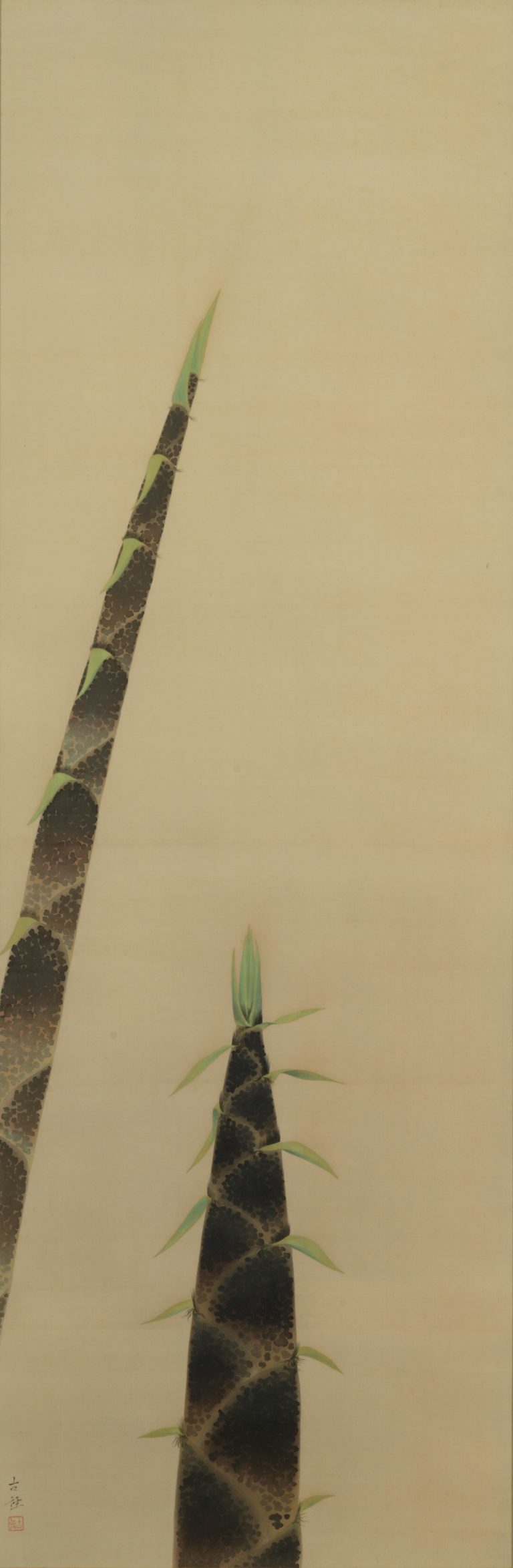
Among the works presented is Kobayashi Kokei’s ‘Takenoko’ (‘Bamboo Shoots’). The museum describes a composition in which one thick bamboo shoot rises forcefully from the lower centre of the image, reaching about a third of the way up, while a second, thinner shoot extends diagonally upward from the lower left. The shoots are rendered with generally dark, rounded pointillist marks, with changes in density and blurred passages used to suggest volume and surface.
The museum places the work around the early Taishō to early Shōwa periods, based in part on the character of its signature. The notice does not provide a precise date. Its description instead focuses on the painting’s unusual structure and the contrast between the strongly rising forms and the dark, textured treatment of the bamboo.
The second work is Kawabata Ryūshi’s ‘Asagao’ (‘Morning Glory’). The painting places blue morning-glory flowers and dark leaves in the lower-left area, extending toward a lighter group of leaves—described by the museum as resembling medake, a slender bamboo—in the open space to the right. The institution points to the variation in ink and colour as well as a Rinpa-style tarashikomi technique, in which pigment or ink is allowed to pool and diffuse, creating the work’s soft tonal transitions.
The museum notes that Ryūshi used the morning glory as a subject in 1926 and dates this painting more broadly to the late Taishō or early Shōwa period, when the artist’s handling had become more mature. As with Kokei’s painting, the date is presented as an approximate attribution rather than a specific year.
The two featured works remain on display through 13 September 2026 at the Ishikawa Nanao Art Museum. Admission is ¥500 for general visitors and ¥350 for university students, and the museum is closed on Mondays. The institution says further works from the 52-piece donation will be introduced in future issues of ‘Nanabi NOW!’.