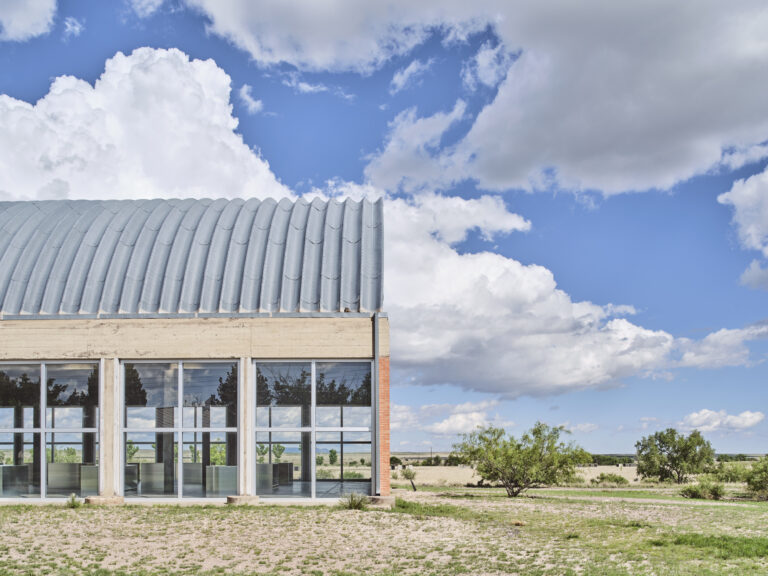
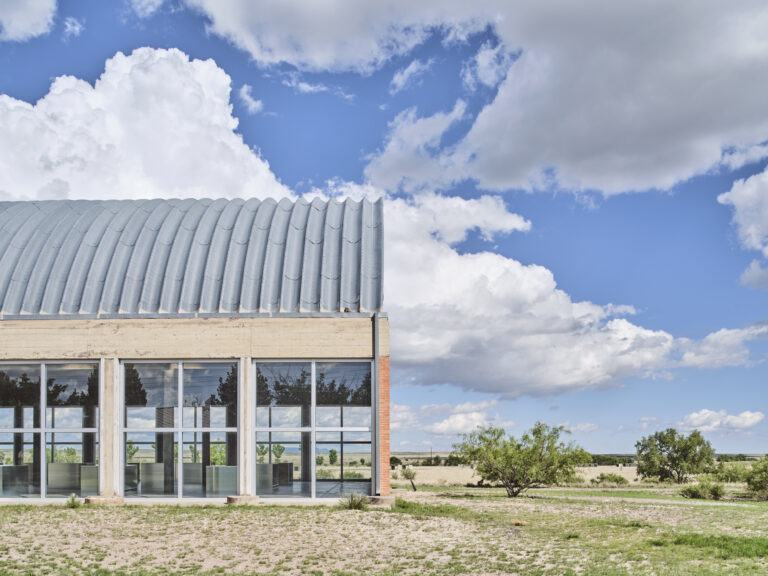
 Image: Donald Judd, Artillery Sheds, 1982-1986, exterior. The Chinati Foundation, Marfa, Texas. Photo by Alex Marks, courtesy of The Chinati Foundation
The Chinati Foundation in Marfa, Texas, has announced that it will restore the Artillery Sheds, the two former military buildings that Donald Judd (1928-1994) converted to house his permanent installation "100 untitled works in mill aluminum" (1982-1986). The sheds and the installation will be closed to the public throughout the multi-year project.
The buildings were constructed in 1939 by the U.S. Army Corps of Engineers for Fort D.A. Russell. Beginning in 1980 Judd replaced their garage doors with quartered glass windows of his own design and added curved metal roofs that doubled the buildings' height, finalising the installation in 1986, the year Chinati was established. The restoration follows the buildings' expanded recognition on the National Register of Historic Places in 2025 as part of the Donald Judd Historic District, and opens the public phase of Chinati's "Art as Intended" capital campaign.
The work addresses urgent physical needs. Roofs and gutters will be repaired and redesigned to prevent water infiltration, with angled steel supports preserving the form of the curved roofs; more than 10,000 square feet of quartered window glass will be replaced with high-performance glazing; low-energy systems will reduce temperature and dust damage without introducing visible equipment, artificial lighting or constant mechanical noise; brick and concrete will be cleaned and repaired; and new pathways, bioswales and rainwater storage will be added. Architectural design is led by Troy Schaum, whose ongoing preservation work at Chinati included the John Chamberlain Building restoration completed in 2022, alongside Chinati's director of preservation and planning, Stephen Martin.
Before construction, all 100 works will be documented and moved for the first time since their original installation, under a plan developed with Alfred Lippincott, one of the works' original fabricators, and the Getty Conservation Institute. Conservators will be able to examine previously inaccessible areas and build a record for future care; the works will be returned to their original positions afterwards.
Executive director Caitlin Murray describes the aim as sustaining the balance Judd established between art, architecture and land so that the work is perceived with the same clarity and intensity. The 39th annual Chinati Weekend, 9-11 October 2026, is billed as one of the final occasions to see the Artillery Sheds and the aluminium works before construction begins. The rest of Chinati's collection remains accessible through guided tours and open viewing, together with special exhibitions, artist residencies, educational activities and public programmes.