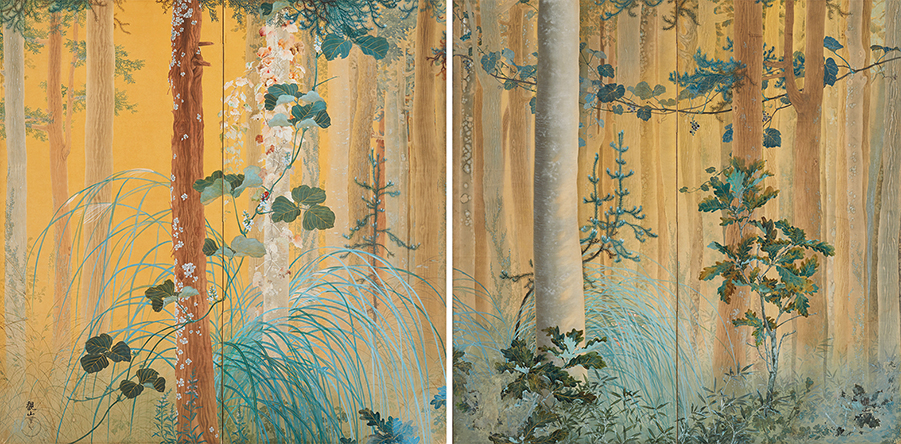
 Image: Okura Museum of Art, Tokyo
The Wakayama Prefectural Museum of Modern Art has opened a major retrospective of Japanese painter Shimomura Kanzan (1873–1930), bringing together more than 150 works and related materials across two sections. The exhibition runs from 30 May to 20 July 2026 in the museum’s first-floor exhibition rooms, and the institution describes it as the first retrospective in 45 years to be held in Wakayama, the artist’s birthplace, and more broadly in western Japan.
The show focuses on Kanzan’s career as a painter associated with the development of modern Japanese art. Born in what is now Wakayama City, he came from a family of Noh performers who had served the Kii Tokugawa household during the Edo period. According to the museum’s exhibition text, he moved to Tokyo at age eight, studied under Kano Hogai and Hashimoto Gaho, and entered Tokyo School of Fine Arts as part of its first graduating class, where he worked under Okakura Tenshin. After graduation, he taught at his alma mater, then left with Tenshin to help found the Japan Art Institute alongside Yokoyama Taikan and Hishida Shunso.
The exhibition narrative traces how Kanzan broadened his practice through copy and reproduction projects and a two-year stay in Britain. After returning to Japan, he developed paintings that absorbed traditional techniques such as yamato-e and Rimpa while fusing them with expressions derived from Western painting. The museum presents that synthesis as central to his role as one of the leading figures shaping new directions in Japanese painting in the modern era.
The retrospective is organized into two parts. The first, 'Tracing the Career: Life and Art', gathers major works, especially pieces shown in exhibitions of the Japan Art Institute, to chart the artist’s development from his early years through his mature career. Sections cover his youth and training, his British period, his post-return years before the reorganization of the institute, and his later prominence after its revival. Works listed by the museum include 'Kumano kanko' (1894), 'Diogenes' (1903–05), 'Konoma no aki' (1907), 'Bijin to shari' (1909), 'Yoroboshi' (1915), 'Gyoran Kannon' (1928) and 'Takenoko' (1930).
The second part, 'Unpacking the Practice: Era and Society', looks at how Kanzan’s art related to tradition, identity and patronage. One section examines his engagement with classical Japanese and Chinese painting, while another considers the role of Noh imagery in a modern national culture. A further section studies the social spaces in which his works lived, including commissions from shrines, temples, the imperial family, former daimyō households and business leaders. The museum also highlights the support network known as 'Kanzankai', associated with Shibusawa Eiichi, and the ways in which Kanzan’s paintings circulated among figures in politics and industry.
Several works are shown only in Wakayama, including 'White Fox' from the Tokyo National Museum, on view from 23 June to 5 July, and 'Spring Rain', also from the Tokyo National Museum, on view from 7 July to 20 July. The exhibition is open daily from 9:30am to 5pm, with last entry at 4:30pm, and is closed on Mondays except for 20 July, which is a holiday and therefore open. Admission is 1,500 yen for adults and 1,000 yen for university students, with free entry for school-age visitors, visitors 65 and older, and holders of disability certificates.