 Image: Cau Ferrat Museum, Sitges
Museus de Sitges has revisited Peter Klasen’s 2008 painting ‘The Beauty and the Dummy’ in a commemorative post marking the artist’s birth anniversary. The work was previously featured in the institution’s ‘Piece of the Month’ series in July 2016; the post does not announce a new exhibition, acquisition or event.
The painting is held in the collection of the Fundació Stämpfli-Art Contemporani in Sitges, where it is listed as inventory number 30. According to the museum’s published record, the work is an oil painting on canvas measuring 97 by 146 centimetres. The record identifies Klasen as born in Lübeck, Germany, in 1935, and says that he lives and works in Vincennes, near Paris.
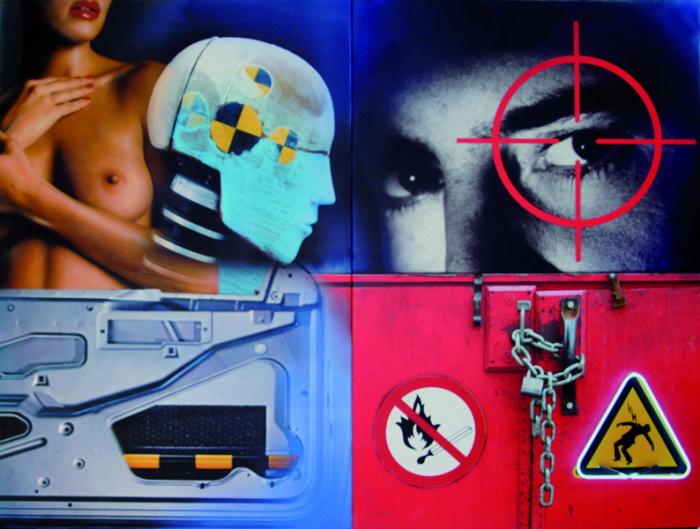
‘The Beauty and the Dummy’ is organised into four equal sections divided by central vertical and horizontal axes. Each section contains a different image, creating a sequence that the museum’s commentary compares with the cinematic device known as split screen. The arrangement allows separate but related scenes to appear simultaneously while leaving viewers to assemble their own interpretation of the image’s implied narrative.
The two upper sections bring together contrasting figures and visual references. One shows a cropped female body, with painted red lips and a bare breast, overlaid with the profile of a crash-test dummy marked by yellow-and-black impact indicators. The other presents a young man’s black-and-white face, described by the museum as taken from a frame of 1940s American film noir. A red circle and rifle-scope markings point toward his left eye, positioning the implied shooter where the viewer stands.
The lower sections shift from the human figure to industrial imagery. They depict the exterior of machinery and an industrial container, both covered with international warning symbols. The museum’s analysis identifies signs referring to electric shock and flammable contents, as well as black-and-yellow hazard striping and a blue neon tube surrounding one of the warning symbols.
The work belongs to a broader series that Klasen developed intermittently from the 1980s through the first decade of the 21st century. His practice, as described by Museus de Sitges, combines collage with airbrush techniques and images drawn from personal photographs, cinema magazines, advertising leaflets and other publications. From the 1990s onward, he also incorporated digitised imagery.
The museum places Klasen’s work in the context of French Narrative Figuration, a movement that emerged in the late 1950s and early 1960s in opposition to the dominance of abstraction. Its artists drew on mass-media forms including newspapers, comics, film and advertising, often treating a single image as a compressed narrative. Klasen took part in the 1964 exhibition ‘Mythologies Quotidiennes’ at the Musée d’Art Moderne de la Ville de Paris, identified by the museum as a foundational presentation of the movement. Museus de Sitges’ July 2016 feature remains the published source for the painting’s details and interpretation.