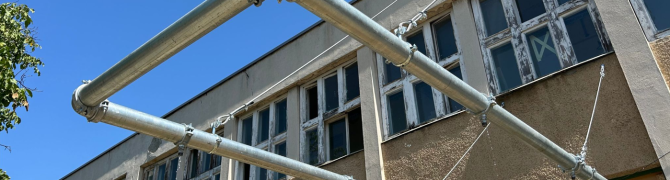
 Image: Loredana Gaiță: Voda na delu (Water at Work), 2026, site-specific installation, technical realisation: Termodinamica SRL. Courtesy of UGM | Maribor Art Gallery, Maribor.
Umetnostna galerija Maribor (UGM) will present Loredana Gaiță’s site-specific installation ‘Voda na delu’ at the sixth BETA Architecture Biennial in Timișoara, Romania. The biennial will run from 4 September to 25 October 2026, with UGM’s presentation taking place as part of the central exhibition at the former Ion Mincu Technical School, Strada Gheorghe Lazăr 16.
UGM’s participation is organised through ‘ReCITYing: Reactivation of Unused Urban Spaces through Architecture and Art’, an international project supported by the European Union’s Creative Europe programme. The collaboration connects the Maribor gallery with BETA around architectural practices, spatial interventions and alternative uses of urban space. UGM will also present the broader ‘ReCITYing’ project and its experience of reactivating abandoned spaces in Maribor and other European cities at BETA on 8 October.
Titled ‘In Practice – Contrary to “In Theory”’, this year’s biennial is curated by Andreas Kofler and Tudor Vlăsceanu. Its principal site is the former Ion Mincu Technical School in central Timișoara, where the building’s technical workshops and former student canteen, beside a botanical park, will be temporarily occupied by architectural installations and public programmes.
‘Voda na delu’—translated in the source material as ‘Water at Work’—reverses the conventional treatment of water in urban environments as a threat associated with flooding, surface runoff and infrastructure damage. Gaiță’s installation instead incorporates water into built and natural systems as an active urban resource. It is designed to retain rainwater, extend its journey through the site, and support local distribution, infiltration and soil restoration.
The installation uses the biennial venue as a small-scale testing ground. Water collected directly from the building’s roof will feed an irrigation device positioned partly in a former practical classroom and partly in the school’s courtyard. Drawing on the appearance and operation of agricultural machinery, the device distributes the water in a minimal and carefully measured manner. The project thereby makes visible a cycle linking the building, soil and vegetation, while addressing resource protection, circularity and the future use of public space.
Gaiță’s project grew out of ‘Timișoara verde-albastră’, one of her urban initiatives. According to UGM, she studied in Timișoara and Brussels before completing a doctorate in architecture at the Ion Mincu University of Architecture and Urbanism in Bucharest. Her work focuses on improving the built environment in Romania, and she has edited three good-practice manuals and developed programmes and projects concerned with public, urban and social spaces. She currently teaches at the Faculty of Architecture and Urbanism in Timișoara and runs an architecture and interior-design practice.
BETA is organised by the Timiș branch of the Romanian Order of Architects. The biennial is financed by Timișoara City Hall through Project Center, with support from the Romanian Order of Architects’ ‘architecture stamp’ programme and A.F.C.N. The 2026 edition is scheduled at the former Ion Mincu Technical School from 4 September through 25 October, while UGM’s separate ‘ReCITYing’ presentation is set for 8 October.