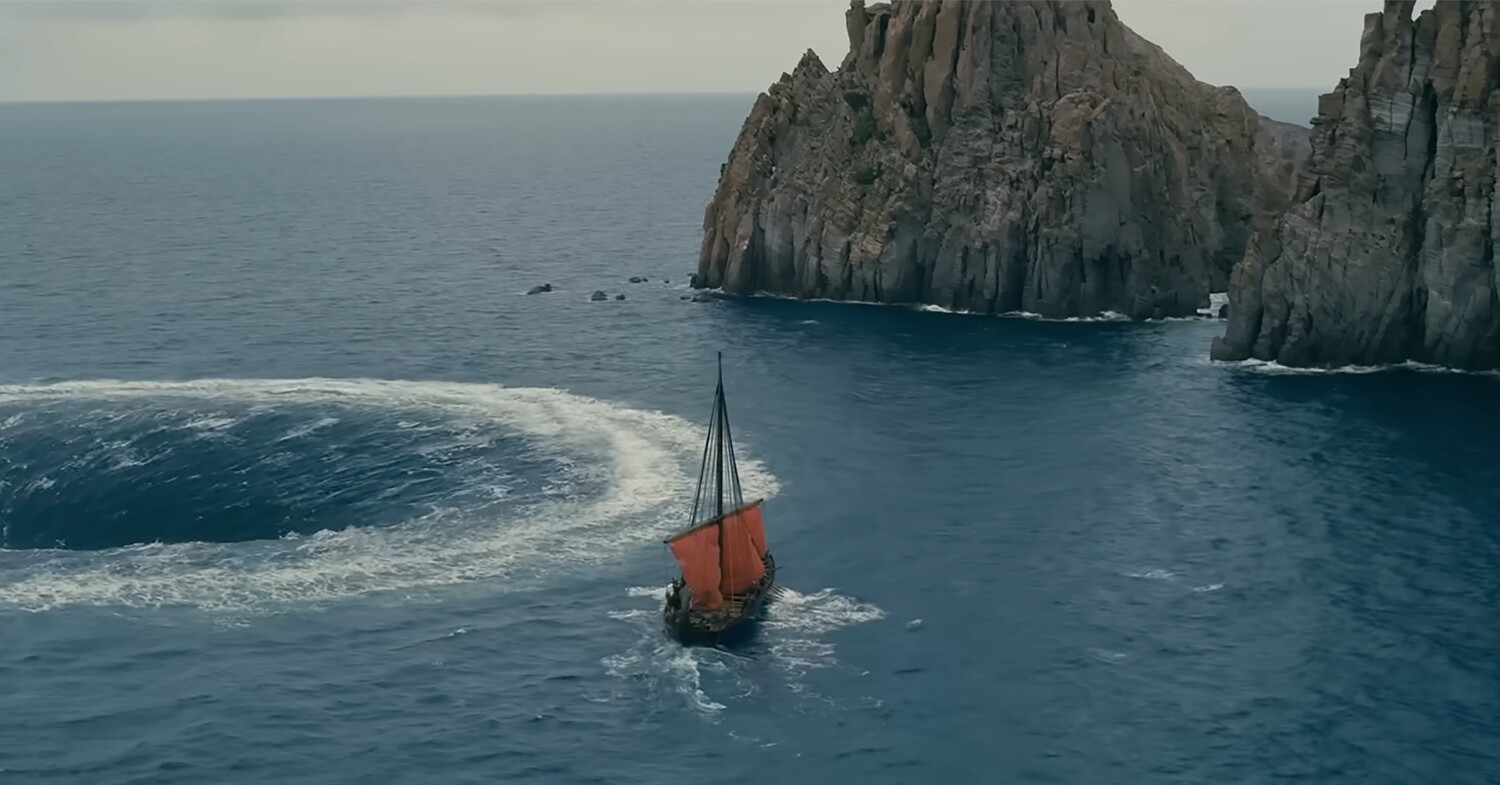
 Image: The whirlpool Charybdis in ‘The Odyssey’. Photo: The Odyssey © Universal Pictures
Getty has published a round-table on Christopher Nolan’s ‘The Odyssey’, which reached cinemas in July 2026, asking three specialists what they made of the adaptation. The conversation, by Erin Migdol and Stacy Suaya, appeared on Getty’s news site on 13 August 2026.
The panel is Claire Lyons, curator of antiquities at the Getty Villa; Nicole Budrovich, curatorial assistant of antiquities at the Villa; and John Bucher, a mythologist, story expert and executive director of the Joseph Campbell Foundation. All three saw the film on its opening weekend, and Lyons has since watched it a second time.
Lyons said the adaptation “does fine justice to the spirit of the Homeric traditions” and praised the filmmaking. Budrovich read it as a study of a man trying to recover his identity after ten years of war and ten of wandering, and pressed the question the poem itself raises: since the monsters and wanderings come from Odysseus’s own memory, how far can he be trusted as a narrator. Bucher described Nolan as “the latest bard”, arguing that every bard sang the song differently and that ancient audiences never sought a single authoritative version.
On casting, Lyons singled out Samantha Morton as Circe, John Leguizamo as the swineherd Eumaeus, Jon Bernthal as Menelaus, Lupita Nyong’o as the scarred Helen and Robert Pattinson as the suitor Antinous. Bucher dismissed the casting controversies as beside the point, since the bardic tradition worked without a canon.
Costume drew the most detailed response. Lyons noted the online argument that the warriors’ crested helmets are inaccurate, Bronze Age art showing helmets made from boar’s tusks, and pointed to the Pylos Combat Agate — a Minoan sealstone of banded agate, gold and bronze, dated 1630–1440 BCE and found in the grave of the Griffin Warrior — shown in Getty’s recent exhibition ‘The Kingdom of Pylos: Warrior-Princes of Mycenaean Greece’, on which a warrior seizes his opponent by the helmet crest. The sealstone belongs to the Archaeological Museum of Chora under the Hellenic Ministry of Culture, not to Getty. Budrovich accepted that Agamemnon’s sculpted black armour is not archaeologically defensible but found it effective, describing the god of war embodied, with a helmet crest ending in a ponytail of golden vertebrae like an external spine.
On sets and props, Lyons has visited several of the filming locations, including Pylos and Methoni Castle in the Peloponnese and the Aeolian Islands, which in Homer’s era lay on western routes used by Greek and Phoenician traders. The vessel used, the Draken, is a Viking-ship model, but she found its tall bow and stern close enough to the merchant ships of Bronze Age art, and thought a real wooden hull conveyed the risk of sailing into the unknown. Budrovich regretted that Nolan’s Circe lives in a shed rather than the palace of the poem, while welcoming drinking vessels resembling those from late Bronze Age palatial sites.
Two scenes stood out. Bucher admired the Hades sequence, in which the dead rise from the ground rather than inhabiting a cavern. Budrovich called Polyphemus “weird”, noting that ancient images place the single eye laterally in the middle of the head and that Nolan keeps the Cyclops nonverbal at first. Lyons set the episode in the eighth century BCE, a period of long-distance trade and colonial settlement, reading Odysseus’s adventures as metaphors for the clash of cultures; she regretted the omission of the blinding of the drunk Cyclops, and noted that the film has the crew tie branches to their backs rather than cling beneath the sheep. The location, the Cave of Nestor near ancient Pylos, was hard to reach with cameras and crew.
Asked what Nolan is saying, Budrovich pointed to xenia, the guest-host obligation the poem calls Zeus’s law, and to war spiralling out and following the victors home. Lyons drew attention to the anger of the women — Penelope, Circe, the nurse Eurycleia, Helen and Clytemnestra — and to Daniel Mendelsohn’s rendering of Odysseus as “having round-about ways”. Bucher tied Nolan’s choice of 70 mm and his long preoccupation with memory, going back to ‘Memento’, to the poem’s injunction to remember.
The Getty Villa is encouraging visitors to look for other Odyssey figures in the museum’s collection; a ‘Self-Guided Tour of The Odyssey’ handout is available at the Information Desk.