 Image: Smith College Museum of Art
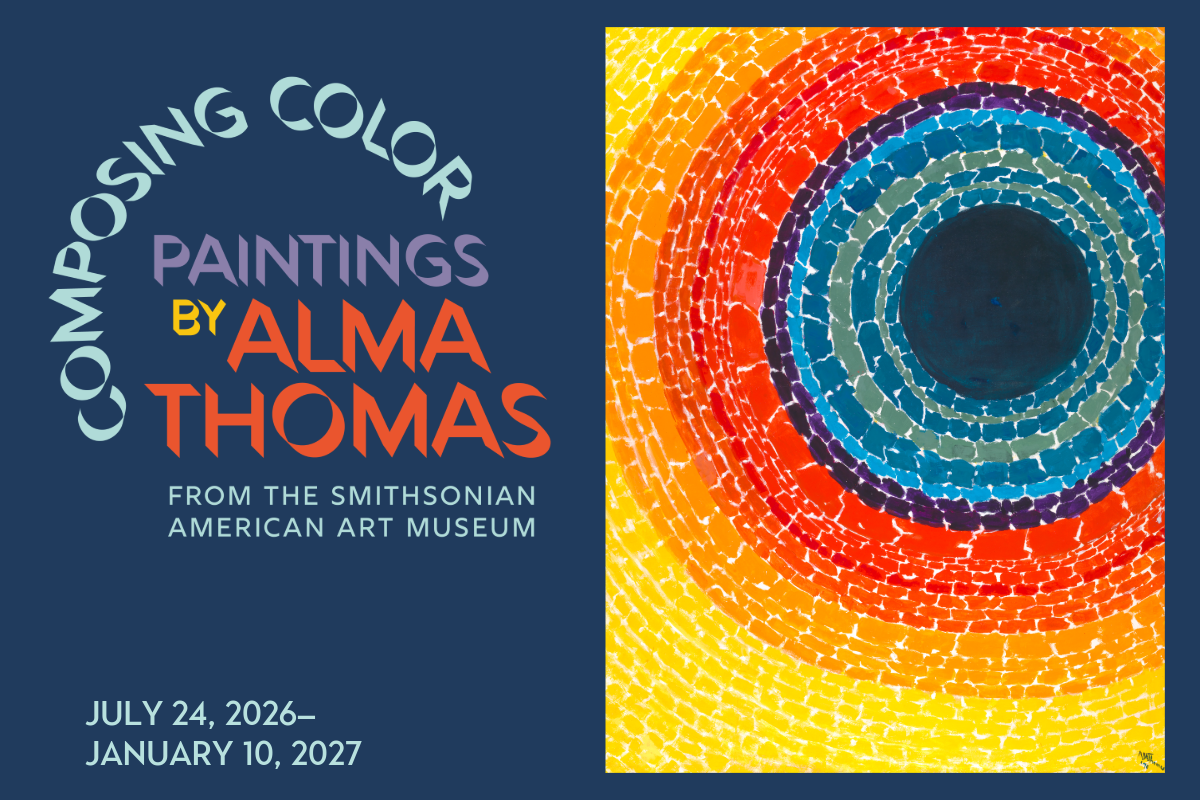
Smith College Museum of Art will open Composing Color: Paintings by Alma Thomas from the Smithsonian American Art Museum on July 24, 2026, bringing to Northampton a traveling exhibition devoted to one of the central figures in 20th-century American art. The show runs through January 10, 2027, and presents works from what the Smithsonian American Art Museum describes as the world’s largest public collection of Thomas’s paintings.
Organized around three themes that preoccupied Thomas—space, earth and music—the exhibition centers her distinctive abstract language of bold patterning, rhythmic composition and radiant color. According to the museum, Thomas developed this mature style after retiring from a long career as a schoolteacher, and her paintings drew from nature, the cosmos and music while bridging elements associated with gestural abstraction and color field painting. SCMA’s presentation is tied to that broader framing, inviting visitors to encounter Thomas’s work as a multisensory visual practice rather than as a single formal school or movement.
Among the highlighted works at SCMA are The Eclipse (1970) and Light Blue Nursery (1966), both acrylic paintings from the Smithsonian American Art Museum, along with Celestial—Fantasy (1973), Delightful Song by Red Dahlia (1976), White Roses Sing and Sing (1976) and Red Abstraction (1960). The museum’s exhibition page also notes that SCMA will add two works of its own to the traveling installation: Morning in the Bowl of Night (1973), acquired by the museum in 2018, and an untitled watercolor on loan from Sylvia and Byron Lewis Sr., who have promised to donate it in the future.
The museum is also using the exhibition to build a public program around Thomas’s legacy and the experience of color. A Friends’ Exhibition Tour is scheduled for July 25 from 2 to 4 p.m., led by Emma Chubb, Charlotte Feng Ford ’83 Curator of Contemporary Art. SCMA is also listing an Aug. 22 writing-through-art poetry workshop and a Sept. 25 fall reception connected to the exhibition. More broadly, the museum’s July Second Friday program on July 10 will explore the color blue through art-making and a gallery talk, adding a public-facing layer of interpretation around themes that resonate with Thomas’s work.
The Smithsonian text quoted on SCMA’s exhibition page captures the stakes of Thomas’s practice in stark terms: “Through color I have sought to concentrate on beauty and happiness, rather than on man’s inhumanity to man.” That statement helps explain why Thomas matters so much in American art history today. Her paintings offer a rigorous, emotionally direct abstraction made at a moment when questions of race, visibility and artistic freedom were especially charged, and her work has become increasingly important to museums and audiences seeking fuller accounts of modern American art.
SCMA says the exhibition is organized by the Smithsonian American Art Museum and is made possible through support from the Helen Frankenthaler Foundation, Chris G. Harris, the Wolf Kahn Foundation and Susan Talley. At SCMA, additional support comes from the Suzannah J. Fabing Programs Fund, the Charlotte Feng Ford, class of 1983, Research and Travel Fund for Contemporary Art, the Ann Weinbaum Solomon, class of 1959, Fund and the Art Bridges Foundation’s Access for All program. For Smith, the show extends the museum’s free-access mission while placing a major national loan exhibition in conversation with its own collection and public programs.