 Image: Wien Museum, Vienna
Wien Museum has announced a new magazine feature on Egon Riss, the architect and designer whose work is being newly reassessed through an upcoming London exhibition and accompanying publication. The museum’s newsletter presents the feature as part of its latest magazine offering and notes that Riss is being honoured on the occasion of his 125th birthday.
The newsletter frames Riss as a figure whose career moved across several countries and professional fields. It says that he shaped “Red Vienna” through his buildings, designed an iconic bookcase during his exile in London, and later created entire building complexes for the Scottish coal industry. The publication positions this as the first time his work has been recognised in its full breadth.
According to the museum text, the London exhibition is intended to bring together that wide-ranging output, with the show paired to a companion publication. No venue within London is specified in the source material provided, but the announcement clearly identifies the exhibition as taking place there and presents it as part of a broader effort to restore Riss to view as both architect and designer.
The featured images that accompany the newsletter highlight two strands of his practice. One is ‘Egon Riss, 1952, Architectural Press Archive/RIBA Collection’, and the other is ‘Isokon Penguin Donkey, 1939, Prichard Papers, University of East Anglia’. These references underline the mix of architectural and design work associated with Riss in the museum’s presentation.
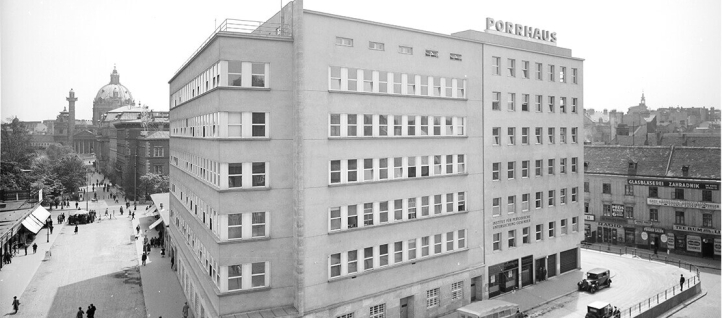
The newsletter also connects Riss to Vienna’s interwar architecture through an introductory image showing the Porrhaus and its neighbouring building in Operngasse, designed by Egon Riss and Fritz Judtmann in 1931. That caption places his work within the built landscape of Vienna while the accompanying text expands the story to his later years abroad.
The magazine feature itself is credited to Peter Stuiber and appears under the headline ‘Egon Riss: Architekt und Designer zwischen den Welten’. It sits alongside two other museum magazine pieces in the same newsletter, but those items are separate from the Riss feature and concern Donauinsel photographs from the 1980s and the history of the Viennese group Coming Out.
Wien Museum’s newsletter indicates that the Riss article is now available in the museum magazine, and that the London exhibition and publication are part of a centenary-plus reassessment of his work. The source does not give opening dates or venue details beyond identifying London, but it does make clear that the anniversary project is the first comprehensive acknowledgment of Riss’s practice across architecture and design.