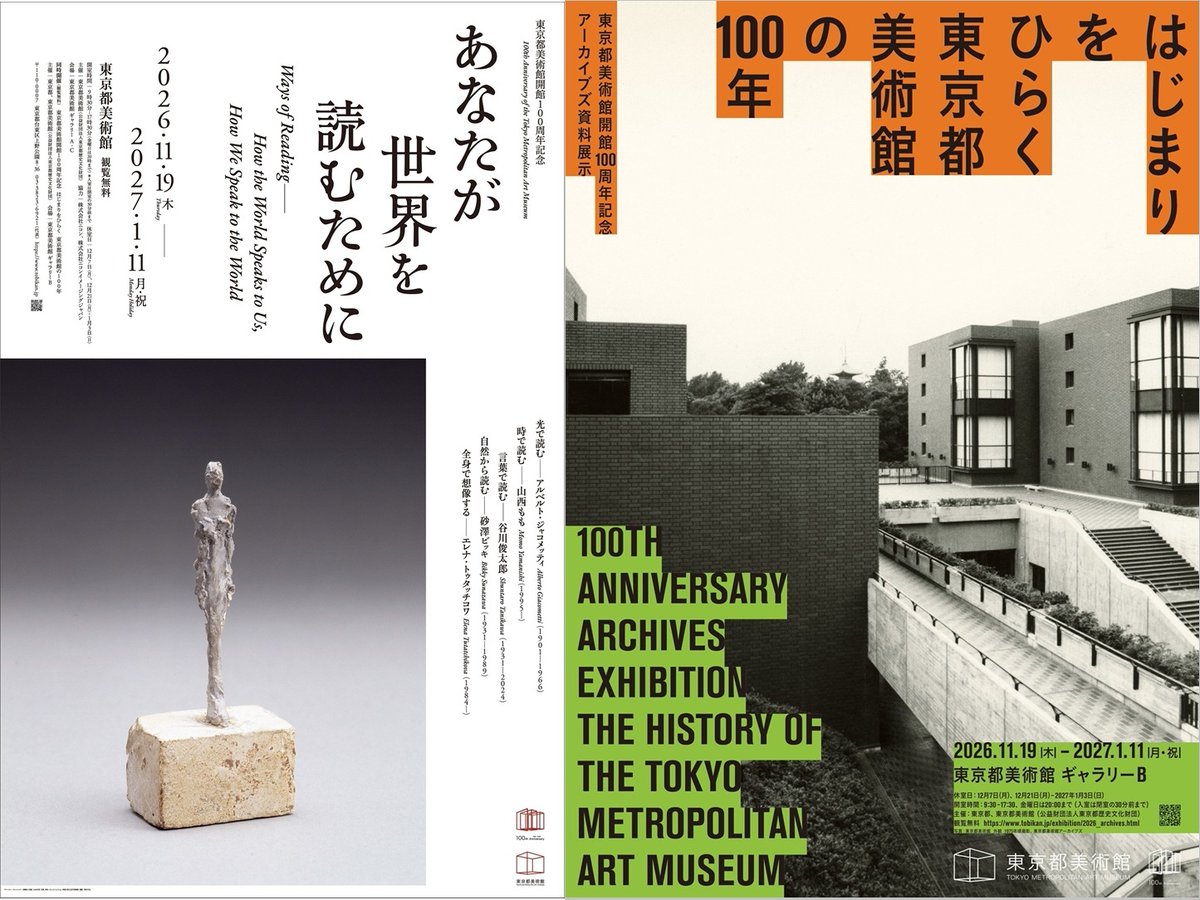
The Tokyo Metropolitan Art Museum will close its 100th-anniversary year with two free exhibitions, both opening on 19 November 2026 and running until 11 January 2027. The museum opened in May 1926 as Japan’s first public art museum.
The larger of the two, ‘Ways of Reading – How the World Speaks to Us, How We Speak to the World’ (あなたが世界を読むために), occupies Galleries A and C. Built around the theme of dialogue with the world, it treats reading as an active process of exploring unfamiliar territory and deepening understanding through the senses. Five artists from different periods and disciplines are each linked to a mode of reading: through light, through time, through words, through nature, and by imagining with the whole body.
Light is represented by Alberto Giacometti (1901–1966), with works once owned by his friends Yanaihara Isaku and Usami Eiji, among them a small painted plaster Nude Figurine of about 1946 from the Kanagawa Prefectural Museum of Modern Art and a Standing Nude in coloured bronze of about 1950 from the Toyama Prefectural Museum of Art and Design.
Momo Yamanishi (born 1995), who studied casting at Tokyo University of the Arts, shows pinhole photographs from her series ‘Light Kingdom’, centred on new images made in Nepal in December 2025 with a homemade camera, as well as a new work combining an ammonite fossil cast with glass.
The poet Shuntaro Tanikawa (1931–2024), known for his debut collection Two Billion Light-Years of Solitude, is represented by his own photographs, including a 1951 self-portrait, some shown for the first time, together with handwritten notebooks and a radio from his collection.
Bikky Sunazawa (1931–1989), born in Asahikawa and later based in Otoineppu in northern Hokkaido, carved large trees. The exhibition includes his oak sculpture God’s Tongue (1980), more than two metres tall, from the Sapporo Art Park Museum, and works from a private collection shown in Tokyo for the first time.
Elena Tutatchikova (born 1984), a Moscow-born artist based in Kyoto, contributes entirely new work: the ceramic series ‘Islands’ alongside reliefs, paintings and drawings arranged as an installation.
The second exhibition, ‘はじまりをひらく 東京都美術館の100年’, turns to the museum’s own century, focusing on the activities it has hosted and the people behind them. Drawing mainly on its archives, it revisits a history that began with a donation from a coal merchant to found what was then the Tokyo Prefectural Art Museum, and went on to include artist-group shows, avant-garde exhibitions and major displays of Western painting, as well as early public art lectures and a library.